
Introduction: Why Candela Changed the Electric Boating Conversation
Electric boats existed long before Candela. What they lacked was credibility beyond sheltered waters, short ranges, and niche use cases. The Candela C-8, developed in Sweden with close technological and philosophical alignment to Polestar, changed that equation entirely.
Rather than attempting to compete with petrol boats on brute force alone, Candela re-engineered the problem from first principles. The result was not simply an electric boat, but a radically more efficient way of moving across water—one that makes electric propulsion not just viable, but superior in defined conditions.
Within Emerging Watercraft And Experimental Concepts, the Candela C-8 stands as one of the clearest examples of experimental thinking translating directly into real-world adoption.
Scandinavian Origins: Engineering Before Marketing
Candela’s roots lie in Sweden’s long tradition of minimalist, efficiency-driven engineering. Much like Polestar’s approach to electric cars, the Candela philosophy prioritises:
- Energy efficiency over raw power
- Software-led optimisation
- Precision engineering
- Honest design with minimal excess
This mindset is critical. Instead of asking “how do we electrify an existing boat?”, Candela asked “how do we eliminate the fundamental inefficiencies of boats altogether?” The answer was hydrofoiling.
What Is the Candela C-8?
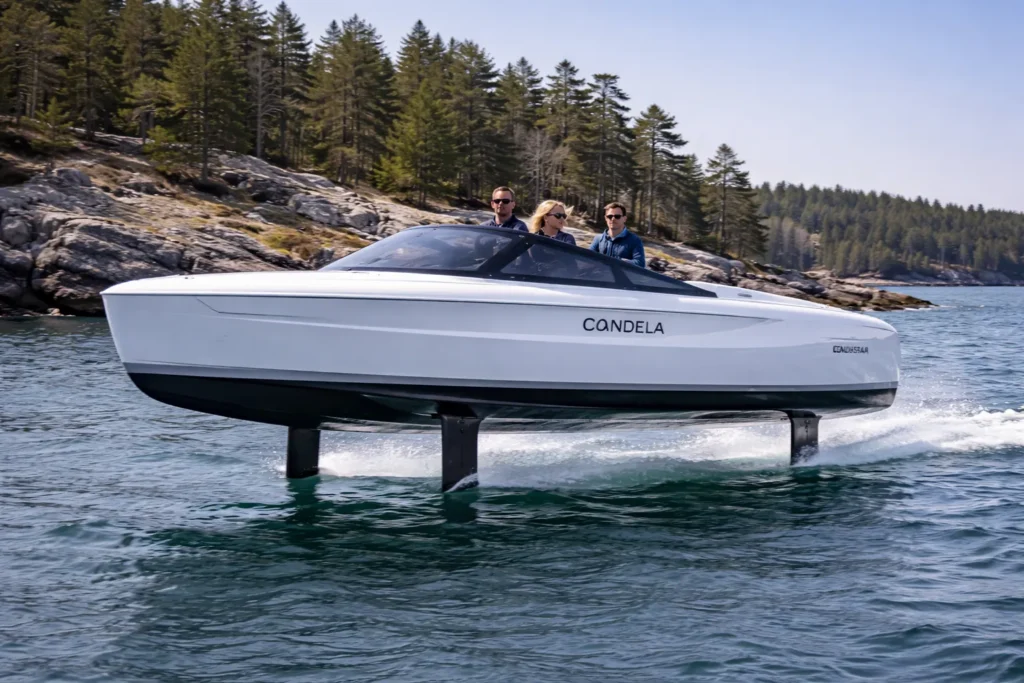
At first glance, the Candela C-8 resembles a refined modern dayboat—clean lines, open cockpit, premium finishes. Beneath the surface, however, it is fundamentally different from any conventional powerboat.
Core characteristics include:
- Fully electric propulsion
- Computer-controlled hydrofoil system
- Ultra-light composite construction
- Software-defined ride control
- Drastically reduced energy consumption
Once underway, the Candela C-8 rises clear of the water, riding on submerged foils and leaving only a whisper of disturbance behind.
Why Hydrofoils Are the Key to Electric Viability
Traditional boats waste enormous amounts of energy pushing water aside. At planing speeds, drag increases exponentially, making electric propulsion impractical without huge batteries. Candela’s solution is decisive:
- Lift the hull clear of the water
- Reduce drag by up to 80%
- Maintain stable, efficient cruise at speed
By foiling at around 16–18 knots, the Candela C-8 transitions into a regime where electric propulsion suddenly makes sense—delivering range and performance previously thought impossible for an electric boat of its size.
The Foil System: Aviation Thinking on Water
The Candela C-8’s hydrofoils are not passive appendages. They are actively controlled flight surfaces, more akin to an aircraft than a traditional boat. Key features include:
- Carbon-fibre foils with extreme stiffness
- Real-time sensors monitoring pitch, roll, and heave
- Computer-controlled actuators adjusting foil angle hundreds of times per second
- Automatic ride stabilisation regardless of load or sea state
The result is a ride that is not only efficient, but exceptionally smooth—often smoother than much larger conventional boats.
Electric Propulsion and Battery Integration
Candela pairs its foil system with a carefully optimised electric drivetrain. Key elements include:
- High-efficiency electric motor
- Liquid-cooled battery system
- Integrated power management software
- Regenerative capability during deceleration
Rather than chasing headline horsepower figures, Candela focuses on sustained efficiency across the entire operating envelope. This philosophy mirrors Polestar’s automotive approach: optimise the system, not just the motor.
Range and Performance Redefined
The Candela C-8’s most disruptive achievement is its real-world range. Compared to conventional electric boats of similar size, the C-8 can achieve:
- 2–3× the range at cruising speed
- Comparable top speeds to petrol boats
- Dramatically lower operating costs
By reducing drag so profoundly, Candela makes electric boating practical for everyday use—not just short harbour runs.
Software as a Core Marine System
One of Candela’s most significant departures from traditional boating is its reliance on software. The vessel continuously manages foil geometry, ride height, stability corrections, energy consumption, and system diagnostics. This makes the C-8 less a “boat with electronics” and more a marine platform defined by software. Updates and refinements can improve performance over time, much like modern electric vehicles.
Wake Reduction and Environmental Impact
Beyond efficiency, hydrofoiling delivers another critical benefit: dramatic wake reduction. Because the hull rides above the surface, shoreline erosion is minimised, sensitive waterways experience less disturbance, and noise levels are drastically reduced.
This has real policy implications. In some regions, Candela vessels are permitted to operate at higher speeds in restricted waterways because they generate less environmental impact than conventional boats.
Interior Design and User Experience
True to Scandinavian design principles, the Candela C-8 interior is restrained and functional. Key characteristics include premium but minimal materials, a clear helm layout, intuitive digital displays, and an emphasis on usability rather than excess. Everything serves a purpose.
Why Polestar’s Association Matters
Polestar’s involvement—philosophically and technologically—adds credibility rather than hype. The shared DNA includes systems-level efficiency thinking, clean design language, electrification as a core identity, and software-centric development. This crossover between automotive and marine engineering represents a broader trend where boundaries between transport sectors are dissolving.
Comparison With Conventional Boats
Compared to petrol boats:
- Lower operating costs
- Near-silent operation
- No emissions at point of use
- Far smoother ride in many conditions
Compared to non-foiling electric boats:
- Vastly superior range
- Practical cruising speeds
- Reduced battery weight requirement
Limitations and Constraints
Despite its success, the Candela C-8 is not universal. Constraints include a higher initial purchase price, the complexity of foil systems, limited suitability for very shallow waters, and dependence on software reliability. These are accepted trade-offs for pioneering technology—and are steadily improving with each generation.
Why Candela C-8 Belongs in Emerging Watercraft And Experimental Concepts
The Candela C-8 earns its place because it makes electric propulsion genuinely viable, uses hydrofoiling as a system rather than a gimmick, and integrates software as a primary marine control layer. It is experimental not because it is unfinished, but because it redefines the rules.
Broader Significance for the Marine Industry
Candela’s success signals a turning point where electric boats no longer need to apologise for limitations, and hydrofoils are moving from racing to mainstream use. Environmental regulation may increasingly favour these low-impact designs, mirroring the transformation already seen in the automotive sector.
Conclusion: The Boat That Made Electric Make Sense
The Candela C-8 by Polestar is one of the most important watercraft of the modern era—not because it is electric, but because it is efficient in a way boats rarely are. By lifting itself clear of the water and letting software manage physics in real time, it demonstrates a future where speed, sustainability, and usability coexist.
See more at vectorwatercraft.com.au