
Why Minutes, Seconds, and Immediate Access Decide Survival Outcomes
In water rescue, speed is not a convenience metric—it is the defining factor between survival, permanent injury, and fatality. While traditional rescue methods have saved countless lives, their effectiveness is constrained by deployment time, environmental conditions, and human limitations. Modern rescue technology, particularly rapid-deployment and remote-controlled systems, exists for one reason: to collapse the time gap between incident and assistance.
This article examines deployment speed in practical, real-world terms. It compares traditional rescue methods with modern rescue technologies, explains where delays actually occur, and clarifies why faster deployment consistently translates into better outcomes.
The Reality of Drowning: A Time-Critical Emergency
Drowning is often misunderstood as a prolonged, visible struggle. In reality, most drowning incidents are:
- Silent
- Rapid
- Unpredictable
Loss of effective movement can occur within seconds. Hypoxia begins almost immediately. Irreversible brain injury can occur within minutes, long before professional help arrives in many locations.
The implication is simple but confronting: the first intervention is often the only intervention that matters.
Traditional Rescue Methods: Where Time Is Lost
Traditional water rescue relies on a layered response model: recognition, mobilisation, deployment, and recovery. Each layer introduces time delays that compound rapidly.
Human Entry Rescues
Swimming rescues remain one of the oldest methods and are still taught worldwide. However, they are inherently slow and dangerous.
Delays occur because:
- A capable rescuer must be present
- Conditions must be assessed
- The rescuer must physically reach the victim
- Fatigue, currents, and waves slow progress
Even a strong swimmer moving against current or surf covers distance slowly. In floodwaters or cold conditions, effective swimming speed drops dramatically.
Critically, human rescues scale poorly. One rescuer can assist one person at a time, and only within their physical limits.
Throw and Reach Devices
Life rings, throw ropes, and poles are effective when the victim is conscious, coordinated, and within range.
However:
- Range is limited
- Accuracy depends on skill under stress
- Victims may be unable to grasp the device
- Multiple throws may be required
Each failed attempt consumes precious seconds and increases panic.
Boards, Boats, and Craft
Rescue boards, inflatable boats, jet skis, and other craft dramatically extend reach, but they introduce their own delays:
- Launching time
- Crew availability
- Operator skill requirements
- Safe access to water
In unpatrolled or remote locations, these assets may not be present at all. After hours, response times extend further.
Emergency Services Arrival
Professional rescue services are highly skilled, but they are constrained by geography and logistics. Travel time alone often exceeds the window where early intervention is most effective.
This is not a failure of services—it is a reality of distance and infrastructure.
Where Time Actually Disappears
When analysing rescue timelines, the most significant delays usually occur before professional responders arrive.
Key loss points include:
- Incident recognition
- Decision hesitation
- Equipment access
- Deployment preparation
In many drownings, bystanders recognise distress too late or are unsure how to act. Even when they do act, traditional equipment may not be immediately accessible or usable.
The Speed Advantage of Modern Rescue Technology
Modern rescue technologies are designed to eliminate these delays, not merely reduce them.
Immediate Availability
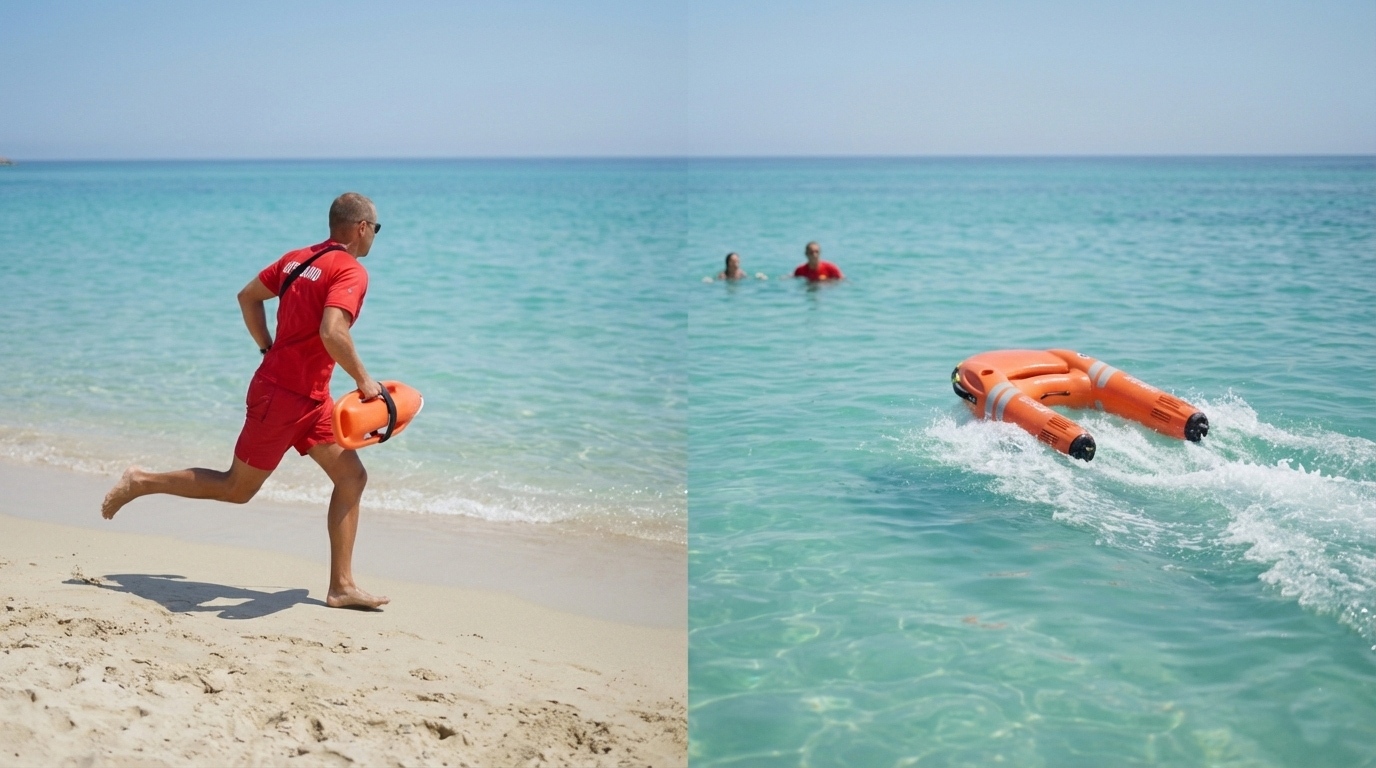
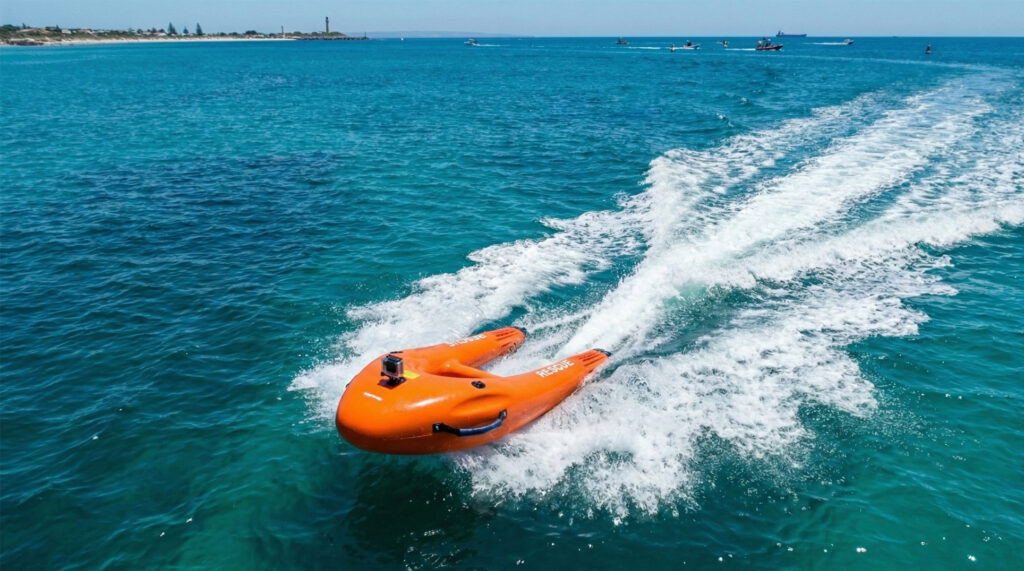
Remote-controlled rescue devices and rapid-deployment systems are typically stored at the hazard location, not kilometres away.
This eliminates:
- Travel time
- Launch preparation
- Operator mobilisation delays
Once the incident is recognised, the device is already there.
Seconds, Not Minutes
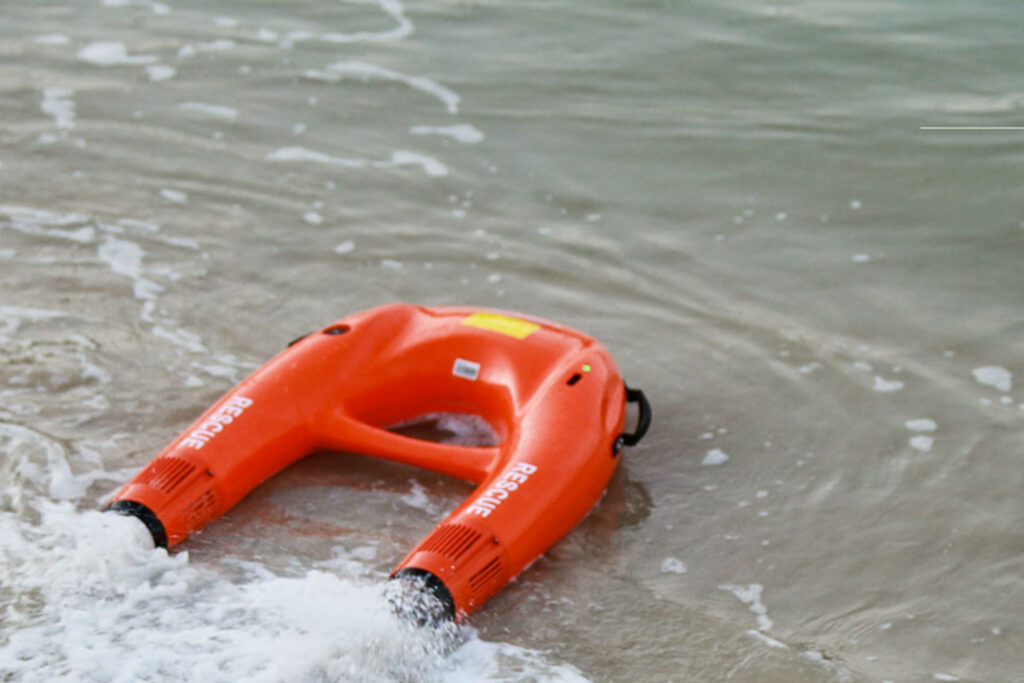
Deployment of modern rescue devices often takes seconds:
- Open housing
- Place device in water
- Activate control
No physical entry. No warm-up. No setup.
This compresses the rescue timeline dramatically.
Direct-to-Victim Travel
Unlike swimmers or thrown devices, powered rescue systems travel directly to the victim at consistent speed, regardless of:
- Current
- Chop
- Fatigue
This predictability is critical. Speed does not degrade under stress.
Comparative Timeline: Traditional vs Modern Response
While every incident differs, typical timelines illustrate the difference clearly.
Traditional unpatrolled scenario
Recognition → hesitation → call for help → attempt throw → failed attempt → second attempt → victim submerges
Often under two minutes total, with no successful intervention.
Modern rapid-deployment scenario
Recognition → immediate device deployment → flotation reaches victim
Often under 30 seconds.
That difference is decisive.
Deployment Speed and Panic Reduction
Speed does more than deliver flotation—it reduces panic.
When a victim sees help approaching quickly and visibly:
- Panic subsides
- Energy expenditure drops
- Cooperation improves
This stabilisation alone can prevent submersion.
Traditional methods often fail to provide this psychological intervention in time.
Rescuer Safety and Speed Are Linked
Slower rescues often tempt rescuers to take greater risks. Bystanders enter the water prematurely. Trained personnel exceed safe limits.
Fast, equipment-based intervention removes this pressure. When help is visibly on the way, fewer people make impulsive decisions that create secondary emergencies.
This is one of the most important, yet least discussed, benefits of rapid deployment systems.
Remote and After-Hours Environments
Deployment speed becomes even more critical in:
- Remote beaches
- Rivers and dams
- Rock platforms
- Flood zones
- Night-time incidents
In these settings, traditional response times can stretch into tens of minutes. Only equipment already on site can intervene during the critical early phase.
Public Access Rescue: Speed Without Expertise
One of the most transformative aspects of modern rescue technology is that it decouples speed from expertise.
Traditional rescues require trained swimmers or operators. Modern devices require:
- Recognition of distress
- Basic activation
- Simple directional control
This allows bystanders, staff, or community members to intervene immediately, rather than waiting for professionals.
The result is not amateur rescue—it is early stabilisation, which professionals can then build upon.
Why Speed Beats Strength
Historically, water rescue culture has celebrated strength, endurance, and bravery. While admirable, these traits are not scalable solutions.
Speed is scalable. Technology delivers speed consistently, regardless of who is present or how they feel in the moment.
This represents a shift from heroic rescue to systemic prevention of fatality.
Deployment Speed in Policy and Planning
Councils, authorities, and land managers increasingly recognise that warning signs alone are insufficient. Passive safety assumes perfect behaviour under stress.
Active rescue capability acknowledges reality: people make mistakes, conditions change, and help must arrive immediately.
Deployment speed is now a measurable safety metric, not an abstract concept.
The False Economy of Slow Response
Some argue that advanced rescue technology is unnecessary because incidents are rare. This ignores the severity of consequences when incidents do occur.
A single fatality carries:
- Human cost
- Community trauma
- Legal exposure
- Reputational damage
Compared to this, investment in rapid-deployment rescue technology is modest.
Why Traditional Methods Still Matter—but Are No Longer Enough
Traditional rescue methods remain essential. Training, boats, helicopters, and professional responders save lives every day.
However, they are not first-response tools in most real-world scenarios. They are second-phase interventions.
Modern rescue technology fills the gap that traditional methods cannot: the first critical seconds.
The Direction of Modern Water Safety Strategy
Best-practice water safety now follows a layered model:
- Prevention and education
- Immediate rescue technology
- Professional response and recovery
Deployment speed defines the effectiveness of layer two. Without it, the entire system weakens.
Conclusion: Speed Is the Intervention
In water rescue, speed is not simply about arriving sooner. It is the intervention itself.
Every second saved increases survival probability, reduces panic, protects rescuers, and improves outcomes. Modern rescue technologies exist because traditional methods, while valuable, cannot always move fast enough.
The future of water safety belongs to systems that act immediately, decisively, and without hesitation—because water emergencies do not wait.
See more at www.vectorwatercraft.com.au