Drag and Hydrodynamics Below the Surface: A Practical, Physics-Based Guide for Australian Underwater Scooter Users, Rescue Operators, and Technical Buyers
Introduction: Why Drag Is the Silent Performance Killer
If thrust is what moves an underwater scooter forward, drag is what constantly tries to stop it. In real underwater use, drag—not motor power—sets the upper limit on speed, efficiency, runtime, and control. Two scooters with identical motors and batteries can perform very differently purely because of hydrodynamic design.
For Australian conditions—open beaches, surge zones, river mouths, harbours, reefs, and offshore environments—understanding drag and hydrodynamics is essential. This article explains how water resistance works below the surface, how it interacts with underwater scooter design, and why reducing drag is often more important than increasing power.
What Drag Really Is Underwater
Drag is the resistive force created when an object moves through water. Unlike air, water’s high density makes drag forces dominant and unforgiving. Underwater drag increases with:
- Speed (non-linearly)
- Surface area
- Shape inefficiency
- Turbulence
- Flow separation
- Attached payloads (divers, rescue victims, gear)
Critically, drag rises roughly with the square of velocity, meaning a modest increase in speed requires a disproportionately large increase in thrust.
The Three Types of Drag That Matter Most
Most underwater scooters are affected by three primary forms of drag. Each must be addressed in design.
Form Drag (Pressure Drag)
Form drag is caused by pressure differences between the front and rear of a moving object. A blunt front face creates high pressure, while a turbulent wake behind the object creates low pressure, effectively pulling backward. High form drag occurs when the nose is blunt or squared, the body widens abruptly, the tail does not taper smoothly, or external fittings interrupt flow. Well-designed underwater scooters use teardrop or torpedo-style profiles to minimise pressure differentials.
Skin Friction Drag
Skin friction drag occurs as water flows along the surface of the scooter. Even perfectly streamlined shapes experience this type of drag. Factors affecting skin friction include total surface area, surface roughness, coatings and finishes, and biofouling or scratches. This is why premium scooters use smooth, sealed housings with minimal seams, fasteners, or protrusions.
Induced Drag (Secondary Drag Effects)
Induced drag arises from flow disturbances created by lift, turbulence, and vortex generation—particularly around propellers, ducts, handles, and appendages. Poor duct design, exposed controls, or sharp transitions dramatically increase induced drag.
Laminar vs Turbulent Flow: The Invisible Battle
Water flowing around a scooter can behave in two ways:
- Laminar flow: Smooth, layered movement with minimal energy loss
- Turbulent flow: Chaotic motion with swirling eddies and vortices
The goal of hydrodynamic design is to maintain laminar flow for as long as possible along the body before inevitable transition to turbulence. Early flow separation dramatically increases drag and reduces stability.
Why Small Shape Changes Make Big Differences
Because water is dense, minor geometric changes can have outsized effects. For example, a sharp edge can trigger early turbulence, a sudden diameter change can cause flow separation, poor handle placement can double wake size, and external mounting rails can destroy laminar flow. This is why professional underwater scooters appear deceptively simple—every contour is deliberate.
Nose Design: Where Drag Begins
The nose of an underwater scooter is critical. It determines how water first interacts with the body. Low-drag nose characteristics include rounded or ogive profiles, a gradual pressure rise, no abrupt edges, and no exposed fasteners or recesses. Flat or blunt noses dramatically increase pressure drag and reduce efficiency.
Body Length-to-Diameter Ratio
Hydrodynamics strongly favour longer, slimmer bodies over short, thick ones. A well-chosen length-to-diameter ratio delays flow separation, reduces wake size, improves directional stability, and lowers the required thrust for cruising speed. This is why high-performance DPVs are elongated rather than compact blocks.
Tail Tapering and Wake Management
The rear of the scooter is just as important as the front. A poorly designed tail creates large turbulent wakes, low-pressure suction drag, and unstable yawing forces. Gradual tapering allows water to close smoothly behind the scooter, reducing wake energy losses.
Hydrodynamics of Ducted Propulsion
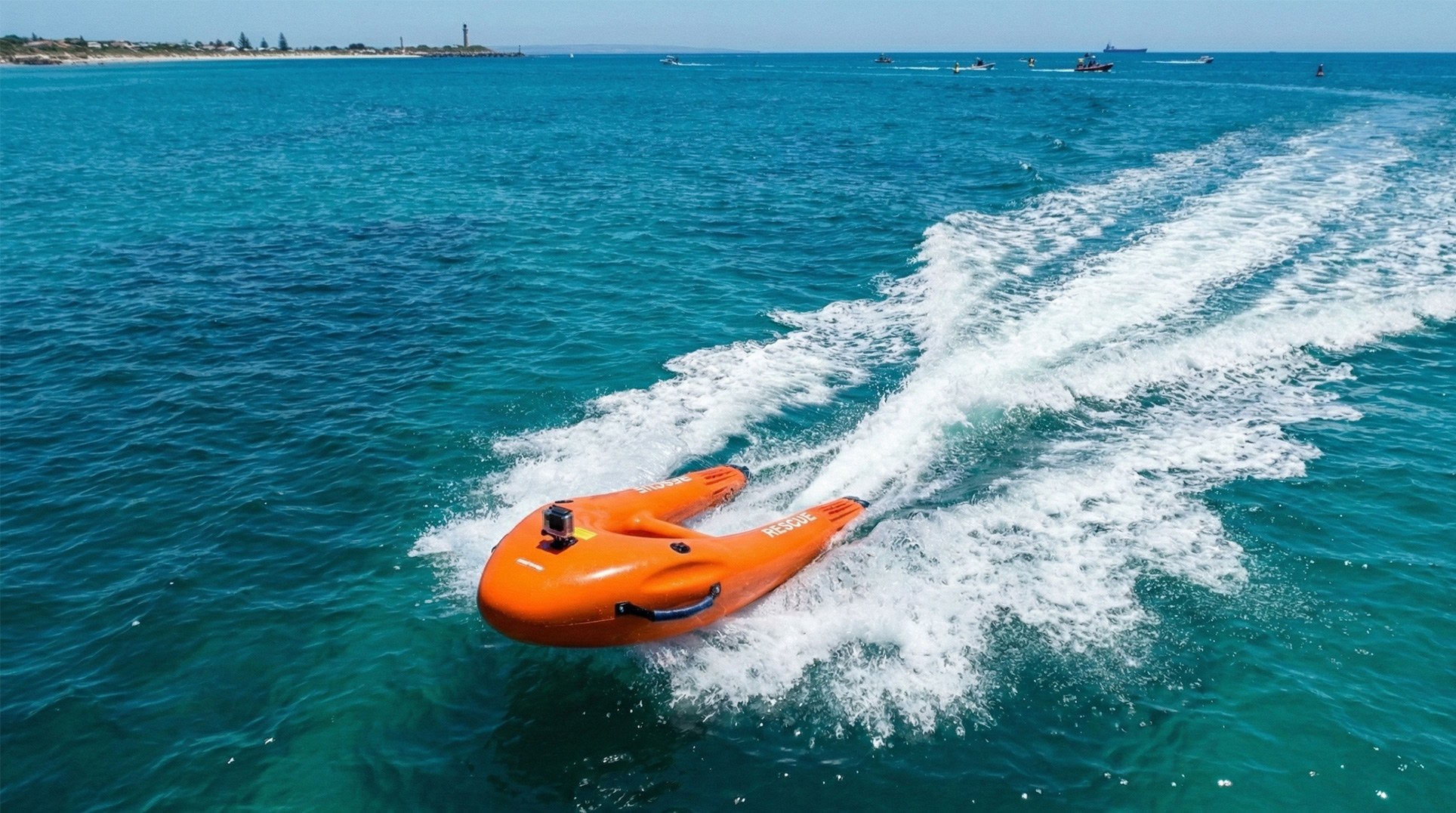
Ducted propulsion systems are not just about thrust—they are also about drag control. A properly designed duct straightens water flow, reduces lateral velocity components, minimises vortex shedding, and protects propeller tips from cavitation. However, poorly designed ducts can actually increase drag, particularly if their inlet or exit geometry is incorrect.
Propeller Slipstream Interaction
The high-energy jet of water exiting the propeller interacts with the surrounding body. Good designs align the slipstream with the body axis, avoid impingement on housing surfaces, and prevent flow recirculation. Bad designs waste energy by forcing propeller wash to collide with structural elements.
Rider and Payload Drag: The Hidden Multiplier
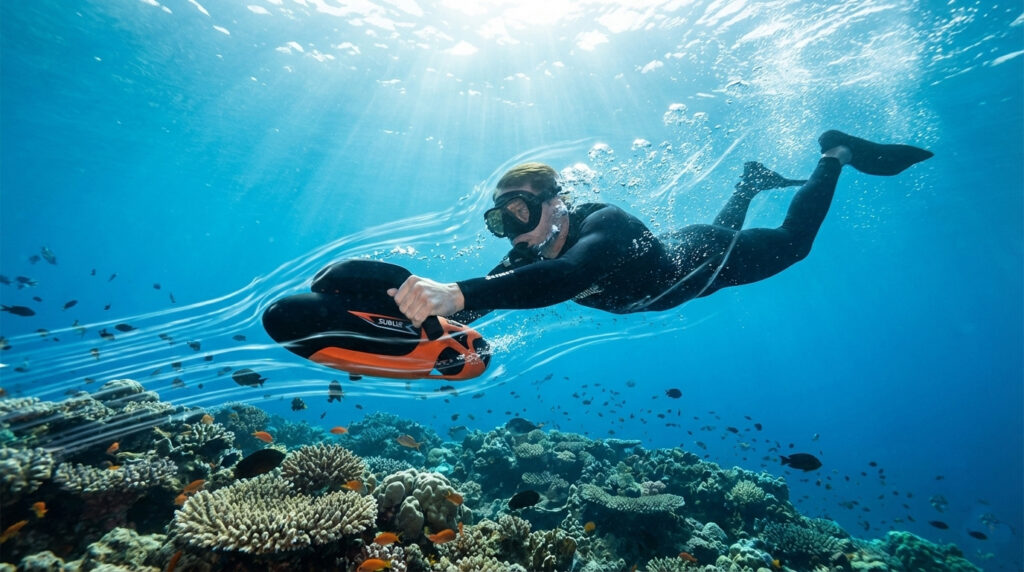
In real use, the scooter is rarely alone in the water. A diver, swimmer, or rescue victim adds enormous frontal area, irregular shapes, and flexible surfaces that flap and vibrate, creating additional turbulence. Hydrodynamically efficient scooters are designed to pull load smoothly, not fight it. This is why torque-rich, steady thrust matters more than headline speed.
Why Drag Limits Speed Long Before Power Runs Out
Many buyers assume that doubling power doubles speed. Underwater, this is false. Because drag rises exponentially with speed, doubling speed may require 4–6× more power. Battery drain increases dramatically, heat and inefficiency escalate, and control becomes unstable. Most practical underwater scooters are therefore optimised for efficient cruising speeds, not extreme velocity.
Hydrodynamic Stability and Control
Drag is not just resistance—it affects handling. Uneven drag distribution causes yaw (side-to-side wandering), pitch instability, and roll sensitivity, leading to user fatigue. Balanced hydrodynamics produce straight-line tracking, predictable response, and reduced corrective effort. This is particularly important in rescue and training environments.
Environmental Drag Factors in Australian Waters
Australian conditions introduce additional drag challenges, such as strong tidal flows, surge and swell-induced oscillation, suspended sand and silt, kelp and debris, and variable salinity and temperature. Designs optimised in calm pools often underperform dramatically offshore.
Surface Proximity and Wave-Induced Drag
Operating near the surface introduces unsteady flow effects, including wave orbital motion, air-water interface turbulence, and variable density gradients. These factors increase effective drag and demand robust, stable propulsion systems.
Hydrodynamics and Runtime Are Directly Linked
Every unit of drag requires additional thrust, which consumes energy. Reducing drag extends runtime, reduces battery stress, lowers heat generation, improves reliability, and increases operational safety margins. This is why hydrodynamics matter just as much as battery capacity.
Why Marketing Speed Claims Miss the Point
Speed claims are often measured without load, in still water, over very short durations, or at unsustainable power levels. Real-world performance is governed by drag, not peak motor output. Experienced operators judge scooters by efficiency at cruising speed, stability under load, predictability in currents, and runtime consistency.
Practical Takeaway for Buyers and Operators
Understanding drag allows buyers to ignore misleading specs, focus on design fundamentals, choose safer, more efficient equipment, and match scooters to real operating conditions. Hydrodynamics separate professional-grade equipment from toys.
Final Thoughts: Drag Is the Constant Opponent
Every underwater scooter fights drag every second it operates. Good design minimises that fight; poor design wastes energy trying to overpower it. The best underwater scooters reduce drag before adding power, prioritise smooth flow, deliver stable, efficient performance, and perform consistently across environments. For Australian users, this understanding is not academic—it directly affects safety, endurance, and operational success.
See More at vectorwatercraft.com.au