
When Australians talk about boat licences, the conversation often sounds deceptively simple: “You only need a licence if it’s over X horsepower” or “As long as you stay under 10 knots, you’re fine.” Those statements contain fragments of truth, but they hide a much more nuanced regulatory structure that matters enormously in practice — especially now that electric propulsion is becoming common.
Power thresholds sit at the centre of Australian recreational boating regulation. They are the line regulators use to decide when a vessel moves from being a low-risk craft to one that demands formal competency, training, and legal accountability. Understanding how those thresholds work — and how they differ by state — is essential if you want to operate legally, insure properly, and avoid nasty surprises on the water.
This article explains, in plain terms, how power thresholds and licensing interact across Australia, why different states use different triggers, and how electric watercraft fit squarely into these frameworks despite sounding quieter and appearing less intimidating than petrol-powered craft.
What do regulators mean by “power thresholds”
A power threshold is a defined point at which a vessel’s propulsion capability is considered significant enough to require formal licensing or certification.
In Australia, regulators generally use three different kinds of thresholds:
- A power-based threshold, measured in kilowatts (kW) or horsepower (hp).
- A speed-based threshold, usually expressed as 10 knots.
- A craft-type threshold, where certain designs (such as personal watercraft) are regulated regardless of power or speed.
These thresholds are not arbitrary. They reflect decades of accident data, enforcement experience, and practical judgement about when a vessel becomes capable of causing serious harm to others — or to its operator.
The most common power benchmark: 4.5kW / 6 horsepower
Across Australia, the most widely used power benchmark is 4.5 kilowatts, which is approximately 6 horsepower.
This threshold appears in multiple jurisdictions because it represents a meaningful jump in propulsion capability. Below this level, vessels tend to accelerate slowly, have limited towing capability, and struggle to reach higher-risk speeds in normal conditions. Above it, vessels can plane, tow riders, accelerate quickly, and mix with higher-speed traffic.
Queensland, Western Australia, Tasmania, and other jurisdictions explicitly reference this threshold in their licensing frameworks.
For traditional petrol engines, this threshold is intuitive — a 6hp outboard has long been recognised as the point where a dinghy becomes a “proper” powered boat. For electric motors, however, the same threshold applies even though the motor characteristics feel very different.
Why electric motors don’t get a free pass
One of the most common misconceptions with electric watercraft is the belief that quiet operation or smaller physical size means they fall outside traditional boating rules.
From a regulatory perspective, fuel type is largely irrelevant. What matters is capability.
Electric motors often deliver instant torque, meaning a craft can accelerate faster than an equivalent petrol-powered vessel at the same rated power. This can actually increase risk in congested waterways if the operator lacks training or experience.
As a result, Australian regulators consistently apply the same power and speed thresholds to electric motors as they do to internal combustion engines. If the motor exceeds the relevant power threshold — or the vessel can exceed the relevant speed threshold — licensing requirements almost always apply.
Speed-based thresholds: the 10-knot rule
Some states, most notably New South Wales and the ACT, emphasise speed capability rather than engine output.
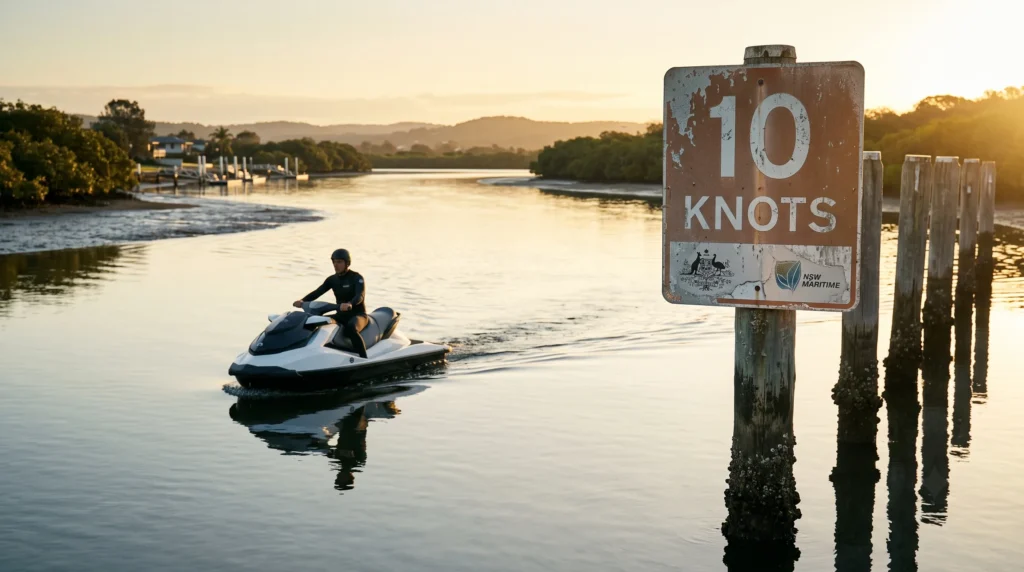
In NSW, a recreational boat licence is required if you intend to operate a vessel at 10 knots or more, or if the vessel is a personal watercraft.
This approach reflects a practical enforcement philosophy: speed is directly linked to collision severity, stopping distance, and reaction time. A low-powered vessel operated slowly may pose limited risk, but the same vessel driven at speed becomes a hazard regardless of motor type.
For electric craft, this is critical. Many electric vessels can exceed 10 knots even with relatively modest motors. Operators who assume “It’s only electric” often cross the licensing threshold without realising it.
Craft-type thresholds: why PWCs are treated differently
Across Australia, personal watercraft (PWCs) — commonly referred to as jet skis — are regulated more strictly than conventional boats. This is not because they are inherently unsafe, but because their operating profile is different:
- High acceleration
- High manoeuvrability
- Rider-exposed design
- Frequent operation close to swimmers and shorelines
As a result, most states require either a specific PWC licence or a PWC endorsement in addition to a general marine licence.
- Queensland requires a recreational marine licence plus a PWC licence.
- Victoria requires a marine licence with a PWC endorsement, and restricted licence holders cannot obtain that endorsement.
- NSW treats PWCs as licensable regardless of speed thresholds.
For modern electric PWCs and jet-style craft, this classification is particularly important. Even if the craft looks smaller or quieter than traditional petrol PWCs, its design and use pattern often places it squarely in the same regulatory category.
How power thresholds interact with age restrictions
Power thresholds do not exist in isolation. They are closely tied to age-based operating rules, which vary across jurisdictions.
Many states allow younger operators to obtain a licence or permit, but restrict what they can do with it. Common restrictions include:
- Lower maximum speeds
- Daylight-only operation
- No towing
- No passenger carrying
- No PWC operation
For example, NSW licence holders under 16 face explicit operational limits even after being licensed.
Victoria’s restricted marine licence for those aged 12 to 16 prohibits operating at 10 knots or more and prohibits towing.
WA restricts young PWC operators to very low speeds, even if they hold an RST.
These rules are tightly linked to power and speed thresholds. Regulators recognise that higher-powered craft magnify inexperience, so younger operators are deliberately kept below those thresholds until maturity and experience increase.
Western Australia’s approach: competency over classification
Western Australia’s Recreational Skipper’s Ticket (RST) system offers a slightly different philosophy.
Instead of focusing heavily on multiple licence categories, WA emphasises demonstrated competency once a vessel exceeds the 6hp / 4.5kW threshold.
This reflects WA’s unique conditions: long distances, remote waters, and fewer rescue resources. The system prioritises ensuring that anyone operating meaningful power understands navigation rules, emergency response, and collision avoidance.
For electric craft owners, this is a reminder that quiet technology does not reduce responsibility. If anything, remote operation increases the need for competence.
Tasmania and South Australia: conservative thresholds
Tasmania and South Australia tend to adopt more conservative approaches to powered boating.
Tasmania requires a licence once a vessel reaches 4hp or more, a notably low threshold.
South Australia requires a Boat Operator’s Licence for operating any recreational vessel fitted with an engine, with tightly controlled permits for younger operators and firm restrictions around PWC use.
In these jurisdictions, the regulatory mindset is clear: if a vessel has meaningful propulsion, the operator should be formally trained and accountable.
Northern Territory: the exception that proves the rule
The Northern Territory famously does not require a recreational boating licence.
At first glance, this seems to contradict everything said above. In reality, it reinforces an important principle: power thresholds still matter, even without a licence.
NT operators are still bound by marine safety laws, speed limits, alcohol limits, and general duty-of-care obligations. If an incident occurs, lack of licensing does not shield the operator from prosecution or liability.
The NT approach works in part because of lower traffic density and different waterway use patterns. It should never be interpreted as a signal that power capability is unimportant.
Insurance, liability, and why thresholds matter after an incident
One of the least discussed — but most important — aspects of power thresholds is how they affect insurance and liability.
If you operate a vessel above a licensing threshold without the required licence or endorsement, insurers may refuse cover following an incident. This applies equally to electric and petrol craft.
In serious accidents, investigators routinely examine:
- The vessel’s power capability
- The speed at which it was operated
- Whether licensing requirements were met
- Whether age or endorsement restrictions were breached
Crossing a power or speed threshold without the correct licence turns a routine incident into a compliance failure — and that failure often becomes central to legal and civil proceedings.
A traditional rule that still applies
Experienced operators have always understood a simple rule: if a craft can accelerate quickly or reach meaningful speed, you treat it as a licensed vessel.
That rule remains valid today, regardless of propulsion technology.
Electric motors change how boats feel, not how the law views risk. Regulators are not impressed by silence or clean energy if the craft can still injure swimmers, collide with other vessels, or overwhelm an inexperienced operator.
Practical guidance for owners and buyers
If you are considering or already own a modern powered craft — especially an electric one — use this practical checklist:
- Identify the motor’s rated power in kilowatts and horsepower.
- Determine whether the craft can exceed 10 knots.
- Confirm whether the craft falls into a PWC-style category under local definitions.
- Check state-specific licensing triggers for where you intend to operate.
- Confirm whether endorsements or additional permits apply.
- Factor licensing compliance into insurance and resale decisions.
This is not bureaucracy for its own sake. It is the framework that keeps Australian waterways usable, predictable, and comparatively safe.
Looking ahead: thresholds will matter more, not less
As electric watercraft continue to evolve, regulators are unlikely to relax power-based licensing. If anything, the growth of fast, compact, high-torque electric craft will push authorities to enforce existing thresholds more actively.
What may change is clarity. Expect more explicit references to electric propulsion in state guidance, not fewer rules.
For operators who understand power thresholds and licensing from the outset, this evolution is not a threat. It’s simply the modern expression of an old truth: capability brings responsibility.