

Extending Life-Saving Capability Beyond Patrols, Rosters, and Reach
Remote and unpatrolled waterways account for a disproportionate share of serious water incidents and fatalities. Beaches without lifeguards, inland rivers, flood-prone crossings, rock platforms, dams, lakes, and harbours present risks that traditional rescue models struggle to cover. Staffing these locations continuously is impractical. Relying solely on warning signs assumes ideal behaviour under stress. Public access rescue technology exists to close this gap—by placing immediate, usable rescue capability at the point of risk, available to anyone, at any time.
This article explains why public access rescue technology is essential for remote areas, how it works in practice, and what separates effective installations from symbolic gestures.
The Reality of Remote Water Risk
Remote does not mean rare. In many regions, remote locations are where people actually recreate—fishing spots, swimming holes, river crossings, boat ramps, cliff-backed beaches, and tidal rock shelves. These places attract locals and visitors precisely because they are quiet and unregulated.
Several consistent risk factors converge in these settings:
- No patrols or limited patrol hours
- Delayed emergency response due to distance
- Unpredictable environmental conditions
- Limited visibility from roads or public areas
- High likelihood of solo activity or small groups
When an incident occurs, the window for effective intervention is short. By the time emergency services arrive, the outcome is often already determined.
Public access rescue technology is designed for this reality—not the idealised conditions of staffed beaches or urban waterways.
Why Signs and Education Are Not Enough
Warning signage and public education campaigns are essential, but they are preventive tools, not rescue tools. They work best before people enter the water, not after something has gone wrong.
In remote areas:
- Signs are ignored or misunderstood
- Conditions change after signage is installed
- Visitors lack local knowledge
- Risk perception is often low
Once a person is in distress, signage offers no assistance. At that moment, only active intervention matters.
Public access rescue technology acknowledges a simple truth: people will continue to enter risky water environments, and systems must be designed for real behaviour, not ideal compliance.
What “Public Access Rescue Technology” Really Means
Public access rescue technology refers to rescue equipment permanently installed at hazard locations, designed to be:
- Immediately accessible
- Simple to operate
- Effective without specialist training
- Safe for use by bystanders
- Reliable in harsh environments
This is not about replacing professional responders. It is about bridging the time gap until they arrive.
The most effective public access systems share three core attributes:
- Availability – always present, always ready
- Simplicity – minimal steps, intuitive use
- Capability – able to stabilise or retrieve a victim
Evolution from Passive to Active Public Rescue
Historically, public rescue infrastructure was passive. Life rings mounted on posts, ropes tied to rails, ladders fixed to seawalls. These tools remain valuable, but their effectiveness depends heavily on victim condition and bystander skill.
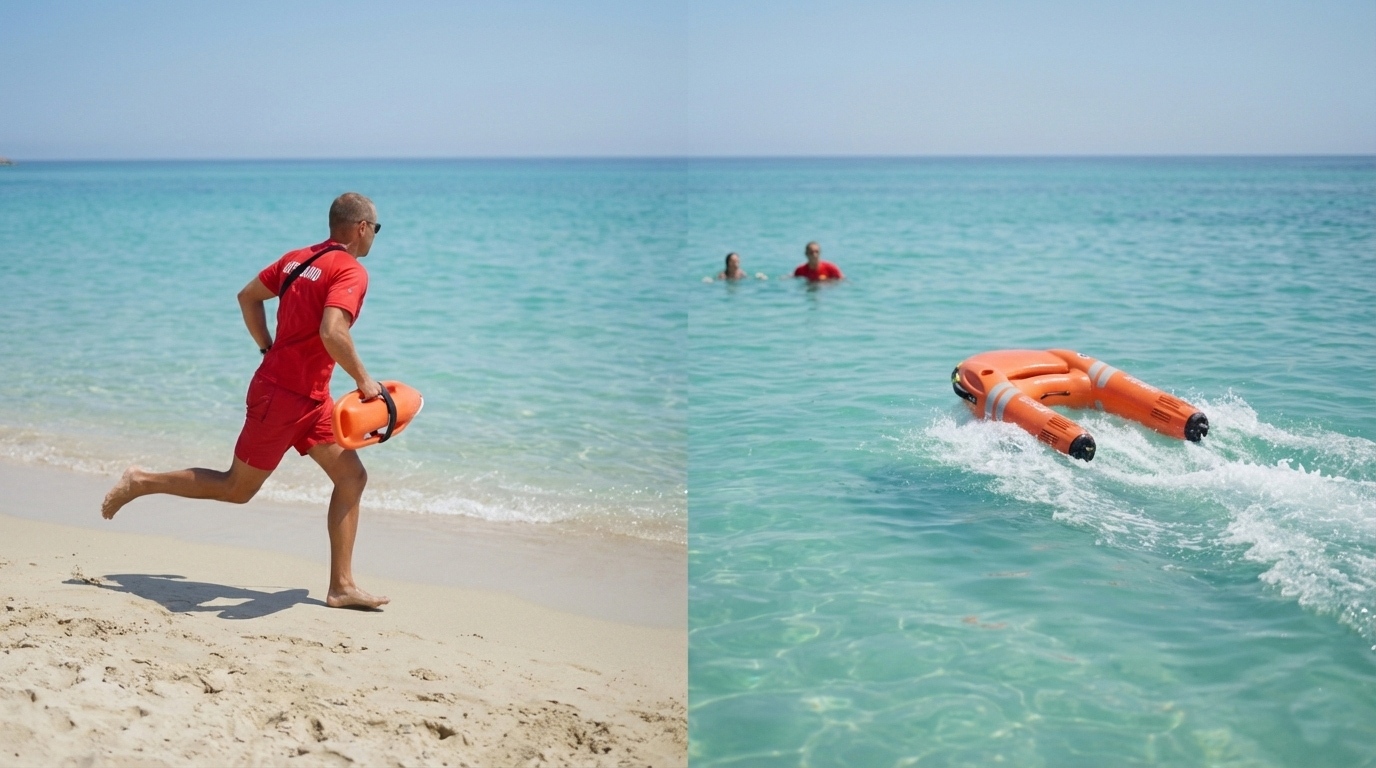
Modern public access rescue technology is active. It moves toward the victim, provides controlled flotation, and in many cases assists with retrieval—without requiring anyone to enter the water.
This shift mirrors developments in other safety domains, such as automated defibrillators. The principle is the same: early intervention by the public, using purpose-built equipment, saves lives.
Why Remote Areas Need Active Rescue Capability
Remote locations magnify every weakness of traditional rescue models.
Distance multiplies delay
Ambulances, boats, and helicopters take longer to reach remote sites. Even small delays matter in drowning incidents.
Bystanders face higher risk
In the absence of equipment, people attempt rescues themselves. Many secondary drownings occur this way.
Environmental hazards are greater
Currents, surge, debris, and cold water increase both victim and rescuer risk.
Active public access rescue technology addresses all three factors by delivering flotation and assistance immediately, without creating new victims.
Design Requirements for Remote Deployments
Not all rescue equipment is suitable for remote installation. To function reliably, public access rescue technology must meet specific design requirements.
Durability and Environmental Resistance
Remote installations are exposed to:
- Salt spray and corrosion
- UV radiation
- Temperature extremes
- Impact and vandalism
Equipment must be built from materials that tolerate long-term exposure without degradation. Electronics must be sealed. Housings must protect the device without impeding rapid access.
Standby Reliability
Rescue devices in remote areas may sit unused for months. When needed, they must work instantly.
This demands:
- Stable battery chemistry
- Low self-discharge
- Clear readiness indicators
- Minimal maintenance requirements
Reliability in standby is more important than peak performance.
Intuitive Operation
Public users may be panicked, untrained, or unfamiliar with rescue procedures. Equipment must be usable with minimal instruction.
Successful systems rely on:
- Visual cues rather than text
- Obvious controls
- Limited options that prevent misuse
- Clear “deploy first, think later” logic
If a device requires explanation, it will not be used in time.
Remote Control Rescue Devices as Public Assets
Remote-controlled rescue devices are particularly well suited to public access deployment in remote areas.
They offer:
- Rapid, powered delivery of flotation
- Operation from shore or structure
- No requirement for water entry
- Effectiveness even if the victim cannot assist
This combination makes them uniquely capable of stabilising incidents in locations where traditional rescues are slow or dangerous.
Importantly, they change bystander behaviour. When equipment is visible and accessible, people are far more likely to use it rather than attempting risky rescues themselves.
Placement Strategy: Location Matters
Public access rescue technology must be installed where it can be used quickly and safely.
Effective placement considers:
- Lines of sight to common incident zones
- Typical entry and exit points
- Safe operator positions
- Avoidance of wave impact zones for storage
Poor placement negates the advantages of even the best equipment. A device that cannot be reached quickly is functionally absent.
Integration with Signage and Wayfinding
While signage alone is insufficient, signage combined with active rescue equipment is powerful.
Best practice includes:
- Clear identification of rescue equipment
- Simple instructions using diagrams
- Visibility from a distance
- Night-time recognition where appropriate
The goal is not to educate in detail, but to prompt immediate action.
After-Hours and Unsupervised Safety
One of the greatest advantages of public access rescue technology is continuous availability. Unlike patrols or rosters, equipment does not go home at night.
Many serious incidents occur:
- Early morning
- Late evening
- Outside peak seasons
Public access systems provide coverage during these high-risk, low-supervision periods.
Remote Communities and Limited Resources
For remote communities, staffing and funding constraints are real. Public access rescue technology offers a cost-effective way to extend safety without ongoing personnel costs.
A single installation can protect:
- Locals
- Tourists
- Workers
- Emergency responders
When evaluated over its service life, the cost per protected person is often extremely low.
Psychological Impact on Risk Behaviour
Visible rescue infrastructure has a secondary effect: it changes how people perceive risk.
Knowing that rescue equipment is present:
- Encourages faster intervention
- Reduces hesitation
- Discourages reckless bystander rescues
This does not increase risky behaviour, as is sometimes claimed. Instead, it acknowledges reality and provides a safer response pathway.
Legal and Governance Considerations
Authorities increasingly recognise that known hazards require reasonable mitigation. While no system eliminates risk entirely, public access rescue technology demonstrates proactive risk management.
From a governance perspective, this can:
- Reduce liability exposure
- Demonstrate due diligence
- Align with best-practice safety frameworks
It also sends a clear message that public safety is taken seriously, even in remote locations.
Maintenance and Oversight
Remote installations must be supported by simple maintenance protocols.
Best practice includes:
- Periodic visual checks
- Battery status verification
- Clear responsibility allocation
Well-designed systems minimise maintenance burden, making them practical even for councils with limited resources.
From Reaction to Preparedness
Traditional rescue models are reactive. They mobilise after an incident is reported.
Public access rescue technology represents preparedness. It assumes incidents will occur and ensures the tools to respond are already in place.
This shift is fundamental. It mirrors advances in road safety, fire safety, and medical response where early intervention has proven decisive.
Conclusion: Bringing Rescue Capability to Where It’s Needed
Remote and unpatrolled waterways will always present risk. Eliminating access is neither practical nor desirable. What can be changed is the availability of immediate help when something goes wrong.
Public access rescue technology transforms remote locations from helpless environments into places where anyone can act, immediately and safely.
By placing active rescue capability at the point of risk, communities move from warning people about danger to giving them a chance to survive it.
See more at www.vectorwatercraft.com.au