
Introduction: Redefining What Is Possible Under Sail
For centuries, sailors have sought speed through refinement—better hulls, taller rigs, lighter materials, and more efficient foils. Yet every so often, a project abandons refinement altogether and instead chooses reinvention. Sailrocket 2, developed in Great Britain, is one such craft.
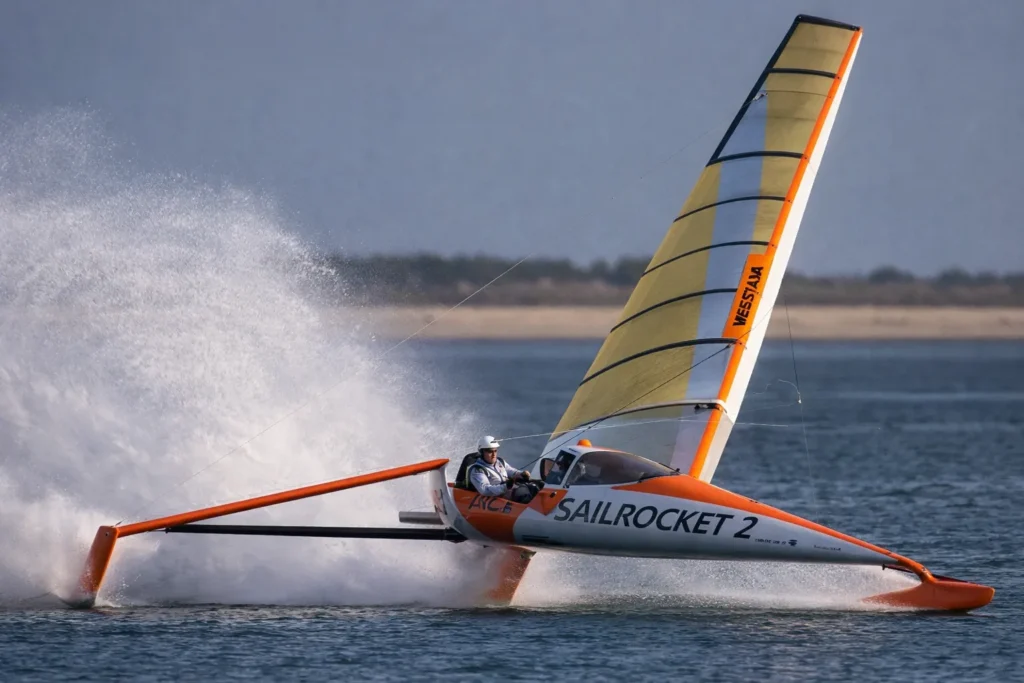
Rather than optimising an existing sailing archetype, Sailrocket 2 was designed from the ground up with a single, uncompromising objective: to be the fastest sailing craft ever to travel across water. It is not a yacht, not a trimaran, not a catamaran, and not a hydrofoil in the conventional sense. It is a purpose-built speed machine that exists solely to answer one question—how fast can wind propel a craft across water?
Its success rewrote the record books and permanently altered how naval architects think about the relationship between wind force, stability, and drag.
The Problem with Traditional Sailing Speed
To understand why Sailrocket 2 matters, it is important to understand the limitation it set out to defeat. Traditional sailing craft—whether monohulls, catamarans, or trimarans—share a common problem at high speed: heeling force. As sail power increases, the force generated by the sail pushes the boat sideways and attempts to roll it over. Designers counter this with ballast, beam width, or additional hulls, but these solutions introduce drag and structural complexity.
At extreme speeds, conventional sailing craft reach a point where:
- Added sail power increases instability
- Hull drag rises exponentially
- Structural loads become prohibitive
Sailrocket 2 was designed to bypass this entire problem rather than manage it.
Radical Asymmetric Design
At first glance, Sailrocket 2 looks unbalanced—and that is precisely the point. The craft consists of:
- A central fuselage-like hull where the pilot sits
- A single leeward sponson that provides hydrodynamic lift
- A wing sail mounted at a dramatic angle
This asymmetry is deliberate. Unlike conventional boats where sail force tries to capsize the vessel, Sailrocket 2 aligns the sail force so that it pushes the craft downward into the water, increasing stability as speed increases. In effect, the faster Sailrocket 2 goes, the more stable it becomes.
The Wing Sail: Aviation Meets Sailing
Instead of a soft sail, Sailrocket 2 uses a rigid wing sail, more closely related to an aircraft wing than traditional canvas. This wing generates lift with extreme efficiency and produces predictable aerodynamic forces while minimising turbulence and drag.
Crucially, the wing is positioned so that its aerodynamic force vector passes directly through the hydrodynamic resistance point of the leeward sponson. This alignment eliminates the rotational moment that causes heeling in conventional boats. The result is a sailing craft where power does not create instability—it reinforces control.
Hydrodynamics and Drag Reduction
Speed on water is fundamentally a battle against drag. Sailrocket 2 attacks this problem ruthlessly. Key drag-reduction strategies include:
- Minimal wetted surface area, with only the leeward sponson contacting the water
- A highly refined planing surface designed to operate at extreme speeds
- Elimination of unnecessary appendages
As speed increases, Sailrocket 2 effectively rides on a narrow, controlled hydrodynamic footprint. The main hull lifts clear of the water, reducing drag to levels previously thought unattainable for a wind-powered craft.
Structural Engineering at the Limit
At speeds exceeding 60 knots, structural loads become immense. Sailrocket 2 is engineered to withstand forces more commonly associated with aerospace vehicles than boats. The structure incorporates high-modulus carbon fibre composites and precision load paths to prevent torsional failure. Every component was designed not only for strength, but for stiffness. Flex at these speeds would introduce instability, so rigidity was essential.
The Pilot’s Role
Unlike conventional sailing, Sailrocket 2 is operated by a single pilot, seated in a cockpit integrated into the main fuselage. The pilot’s role is highly technical and demanding. Control inputs include wing sail trim, ride height, and directional stability. At record speeds, reaction time is critical. The pilot is effectively managing a controlled release of aerodynamic energy, balancing lift, drag, and stability in real time.
Record-Breaking Performance
In 2012, at Walvis Bay, Namibia, Sailrocket 2 achieved what had eluded sailors for decades. Over a 500-metre course, it recorded an average speed of 65.45 knots (121.21 km/h), officially becoming the fastest sailing craft in history. This was not a marginal improvement—it was a decisive leap forward. The record stood not only as a testament to engineering brilliance, but as proof that radical thinking could overcome barriers once considered absolute.
Why Sailrocket 2 Is Not a “Boat” in the Traditional Sense
Sailrocket 2 cannot tack upwind, carry cargo, or take passengers. It cannot cruise, race around buoys, or be adapted for leisure sailing. Its purpose was not versatility—it was exploration at the extreme edge of physics. Like experimental aircraft or land speed record vehicles, Sailrocket 2 exists to expand the envelope of what is possible.
Influence on Future Design
While Sailrocket 2 itself will never be commercialised, its influence is profound. Lessons drawn from the project have informed high-speed sailing foils, asymmetric hull design in racing craft, and wing sail development. The project demonstrated that aligning force vectors—rather than opposing them—can unlock dramatic performance gains.
Comparison With Hydrofoils
Modern hydrofoil sailing craft lift clear of the water to reduce drag. Sailrocket 2 achieves a similar outcome through a different philosophy. Where hydrofoils rely on underwater wings, Sailrocket 2 relies on extreme planing efficiency and aerodynamic-hydrodynamic force alignment. Both approaches seek the same goal: minimising drag while maximising stability.
Risks and Limitations
Operating at the limits of speed carries inherent risks. Sailrocket 2’s operating window is narrow, requiring specific wind strength, flat water conditions, and precise setup. Outside these parameters, the craft is neither safe nor controllable. This reinforces its role as an experimental platform rather than a practical vessel.
Conclusion: Speed as a Laboratory
Sailrocket 2’s legacy lies in the data it generated, the assumptions it shattered, and the inspiration it provided. As long as humans harness wind and water, Sailrocket 2 will remain a landmark achievement: proof that even in one of the world’s oldest technologies, there is still room for revolutionary thinking.
See more at vectorwatercraft.com.au