Introduction: Breaking the Rules of Marine Design
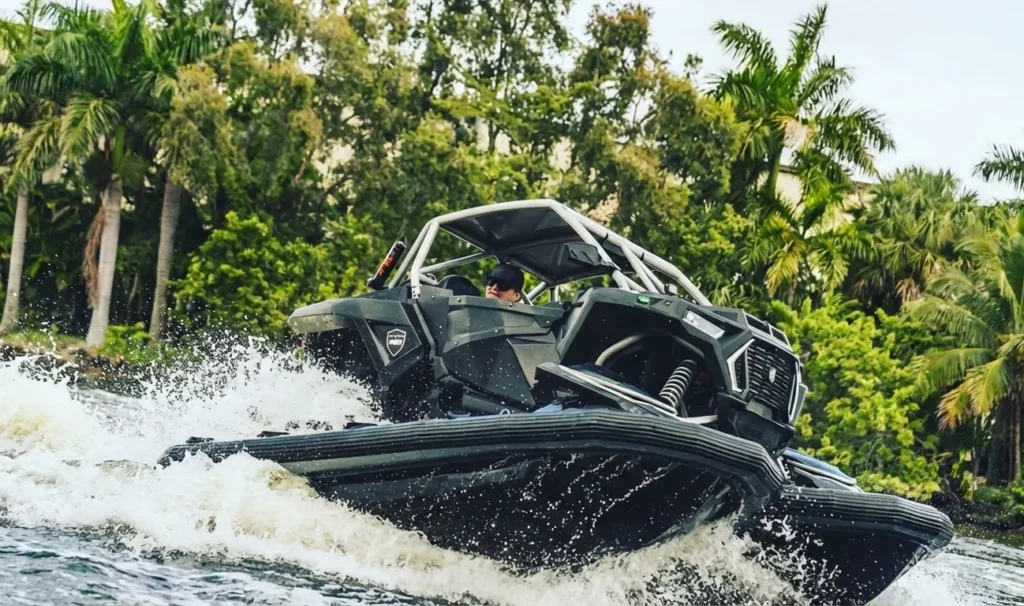
If you wanted to design something that breaks the “rules” of personal watercraft, you could hardly do better than Shadow Six. The Typhoon (often described by the company and media as an “Aquatic Utility Vehicle”) is essentially a hard-edged, high-performance mash-up: a side-by-side (UTV) style cabin mounted over twin, jet-driven hulls, producing something that behaves less like a conventional jet ski and more like a compact, overpowered offshore toy with a roll cage.
It’s easy to dismiss a craft like this as a stunt—until you look at what it represents in design terms. Shadow Six is part of a broader trend in experimental watercraft: blending established platforms (PWC jet propulsion, composite hulls, off-road vehicle ergonomics) into a new category. In the same way early jet skis blurred the boundary between boat and motorcycle, the Typhoon blurs the boundary between PWC, skiff, and off-road machine—and it does so with an unapologetically American “hot-rod engineering” attitude.
For the “Emerging Watercraft and Experimental Concepts” series, Shadow Six matters because it demonstrates a practical lesson: innovation doesn’t always come from new propulsion systems. Sometimes it comes from a new layout, new ergonomics, and a new interpretation of what the user is trying to do on the water.
What Shadow Six Actually Is
Most coverage of Shadow Six centres on the Typhoon, which multiple outlets describe as a fusion concept: a UTV body placed over twin personal-watercraft-style jet-driven hulls. The Shadow Six site positions the Typhoon as a flagship product with published pricing and specifications, treated as a manufactured offering rather than a one-off prototype.
That core architecture—UTV cockpit + twin jet hulls—creates a craft with three defining traits:
- Familiar control and seating: Wheel, pedals, bucket seats, and harnesses—a radical departure from straddling a jet ski.
- High stability at speed: The wide stance and twin hulls increase lateral stability compared with a single-hull PWC.
- Aggressive PWC-style thrust: Jet propulsion lends instant acceleration and shallow-water capability relative to prop-driven craft.
Why the Layout Is the Innovation, Not the Headline Speed
Speed claims get attention. But the real leap here is packaging and control. A conventional jet ski is fast and nimble, but it demands athletic balance and constant body input. A small boat is easier for novices, but often heavier, slower to accelerate, and less “connected” to the driver.
Improving the Learning Curve
Shadow Six tries to take the immediate response of a PWC and pair it with a more intuitive, confidence-inspiring cockpit—particularly for drivers who already understand off-road side-by-sides. The biggest barrier to performance watercraft adoption is often the learning curve. A seated cockpit with a wheel makes high-speed running feel “car-like” in the best sense: predictable steering, bracing points, and clear sightlines.
Engineering Logic: Twin Hulls and Stability
From a marine-design point of view, a wide twin-hull arrangement is a simple way to increase stability without adding deep keel structures. That stability can be used in two ways:
- To carry more mass above the waterline (like a UTV cabin) without making the craft unmanageable.
- To increase high-speed confidence in chop, where narrow single-hull craft can feel twitchy.
The Typhoon’s visual stance suggests it’s designed to ride “on top” rather than cut like a deep-V. That fits the PWC lineage, where the goal is usually to plane quickly, skip, carve, and keep the experience visceral. It chases a new human-machine interface for speed on water by taking known building blocks and rearranging them.
The “Aquatic Utility Vehicle” Concept: Gimmick or Real Category?
The phrase “Aquatic Utility Vehicle” is clever because it implies capability beyond joyriding. While most will view the Typhoon as a high-end recreational machine, it raises a legitimate question: can a craft like this bridge land-water recreation culture in a way boats and PWCs haven’t?
Targeting the Off-Road Tribe
Off-road side-by-side owners are a distinct tribe: they like roll cages, harnesses, and aggressive styling. Shadow Six speaks directly to that tribe—offering something that looks like it belongs on the same trailer as their land toys. This points to a future watercraft possibility: more hybrid categories where the cockpit borrows from land machines while the propulsion remains marine.
Materials and Build Approach
Features around Shadow Six coverage hint at a motorsport-inspired build philosophy, prioritizing rigidity, serviceability, and modularity. This “race shop” DNA allows for rapid iteration based on testing and customer feedback.
Market Positioning and Performance
The Typhoon is positioned as a premium product, often cited around the US$250k mark. This confirms the market segment: it is not a mass-market PWC challenger; it’s a boutique exotic. Speed and power claims should be viewed through this lens—designed for a high-disposable-income demographic seeking rarity and extreme presence.
Australian Reality Check: Where This Concept Fits
Even though Shadow Six is not an Australian-built platform, the concept is very relevant to Australia. Our market is full of PWC enthusiasts, off-road side-by-side owners, and massive coastal playgrounds. For local adoption, key considerations would include:
- Compliance and registration category: Which varies by state and territory.
- Waterway rules: Particularly regarding noise near populated areas.
- Towing practicality: Beam width on Australian boat ramps.
Lessons for Future Watercraft Designers
Whether Shadow Six succeeds long-term is less important than what it teaches: if you can reduce the skill barrier, you can expand the performance market. In the future, we may see similar experiments combining enclosed cockpits with electric jets or catamaran stability with rescue and patrol roles.
Conclusion: Shadow Six as “Hot-Rod Marine” Innovation
Shadow Six is a proof that radical re-packaging can create a new class of water fun without inventing new propulsion. The Typhoon concept shows that performance can be made more approachable through cockpit design, and the experience can be reframed to appeal to entirely different buyers.
This is exactly what experimental watercraft should do: show what’s possible when you stop treating categories as fixed.
See more at vectorwatercraft.com.au