
A Detailed, Safety-Focused Guide for Australian Underwater Scooter Users, Engineers, and Procurement Decision-Makers
Introduction: Why Battery Sealing Is the Single Most Critical System
In an underwater scooter, nothing is more mission-critical than the battery enclosure and its sealing integrity. Motors can tolerate moisture to some degree, housings can flex, and electronics can sometimes survive brief exposure — but battery failure underwater is catastrophic.
Battery sealing is not simply about keeping water out. It is about maintaining structural integrity under pressure, protecting high-energy cells from moisture ingress, preventing electrical short circuits, and ensuring predictable performance across depth, temperature, and time.
For Australian users — where underwater scooters are increasingly used in surf zones, harbours, rivers, offshore waters, training environments, and public safety contexts — understanding battery sealing and pressure resistance is essential for safety, longevity, and compliance.
This article explains how battery sealing works, why pressure resistance is far more complex than most buyers realise, and how to distinguish robust engineering from superficial marketing claims.
Why Batteries Are Unforgiving Underwater
Lithium-based batteries store a large amount of energy in a compact space. When exposed to water, especially saltwater, the risks include:
- Immediate short circuits
- Rapid heat generation
- Thermal runaway
- Gas release
- Internal cell rupture
- Permanent battery destruction
Unlike other components, battery failures are rarely graceful. This is why battery sealing is engineered to standards far exceeding those applied to motors or housings alone.
Pressure and Batteries: A Dangerous Combination if Poorly Managed
As depth increases, external pressure acts on every surface of the battery enclosure. This pressure:
- Compresses housing walls
- Loads seals and gaskets
- Stresses fasteners and interfaces
- Alters internal clearances
- Forces moisture toward microscopic gaps
A battery compartment that appears watertight at the surface may fail at depth if pressure effects are not properly engineered.
The Two Fundamental Battery Sealing Philosophies
There are two primary approaches to battery sealing in underwater scooters:
Fully Sealed (Dry Compartment) Systems
This is the most common and safest approach.
Characteristics:
- Battery remains in a completely dry environment
- Enclosure is pressure-resistant
- Seals prevent any water ingress
- No intentional pressure equalisation
Advantages:
- Maximum electrical safety
- Predictable battery behaviour
- No contamination risk
- Easier inspection and maintenance
Challenges:
- Requires robust housing design
- Seal integrity is critical
- Pressure loads must be structurally managed
Most professional and rescue-grade underwater scooters use this approach.
Pressure-Balanced or Flooded Systems
Less common and usually limited to specialised or experimental designs.
Characteristics:
- Battery compartment equalises pressure with surrounding water
- Uses oil filling or flexible membranes
- Minimises structural pressure loads
Disadvantages:
- Complex engineering
- High contamination risk
- Difficult maintenance
- Unsuitable for lithium systems in most applications
For public, rescue, and recreational markets, fully sealed systems are overwhelmingly preferred.
Battery Housing Materials and Pressure Resistance
Battery enclosures must resist pressure without excessive deformation.
Common materials include:
- Reinforced polymers
- Glass-filled nylon
- Aluminium alloys
- Composite laminates
Each material behaves differently under pressure:
- Polymers flex elastically
- Metals resist deformation but concentrate stress
- Composites distribute loads but require precise manufacturing
Good designs account for elastic deformation without seal compromise, rather than relying on brute stiffness alone.
Why Shape Is Critical for Battery Compartments
Flat battery lids are one of the most common failure points.
Under pressure:
- Flat panels bow inward
- Seal compression becomes uneven
- Edge gaps form microscopically
- O-rings extrude or twist
High-quality battery enclosures:
- Use cylindrical or domed shapes
- Avoid large flat surfaces
- Distribute pressure evenly
- Minimise seal distortion
This is why professional underwater scooters rarely use rectangular battery boxes.
O-Rings: Small Components, Massive Responsibility
O-rings are the most common sealing method for battery compartments, but they are also the most misunderstood.
Proper O-ring sealing depends on:
- Correct material selection
- Proper groove design
- Precise compression
- Clean, smooth mating surfaces
- Correct lubrication
A perfectly designed housing can fail if the O-ring system is poorly executed.
O-Ring Materials and Depth Performance
Not all elastomers behave the same under pressure.
Common materials include:
- Nitrile (NBR)
- Fluorocarbon (FKM/Viton)
- EPDM
- Silicone (less suitable for pressure)
Depth exposure affects:
- Compression set
- Elastic recovery
- Extrusion resistance
- Temperature sensitivity
High-quality underwater scooters use pressure-stable elastomers specifically chosen for underwater cycling, not generic seals.
Seal Extrusion: A Hidden Failure Mode
At depth, pressure can force O-rings into microscopic gaps between components — a process known as extrusion.
Extrusion leads to:
- Permanent seal damage
- Micro-leaks on ascent
- Progressive failure over time
Preventing extrusion requires:
- Tight manufacturing tolerances
- Backup rings
- Proper groove geometry
- Controlled material hardness
Cheap designs often skip these details entirely.
Battery Lid Fastening Systems and Pressure Loads
How the battery compartment is fastened matters as much as how it is sealed.
Common fastening methods:
- Threaded caps
- Bolted flanges
- Cam locks
- Quick-release latches
Under pressure:
- Threads experience axial loads
- Bolts experience shear and tension
- Uneven fastening causes seal distortion
Professional designs ensure:
- Even clamping force
- Redundant retention
- Pressure-assisted sealing (pressure improves seal rather than defeating it)
Electrical Isolation Inside Battery Compartments
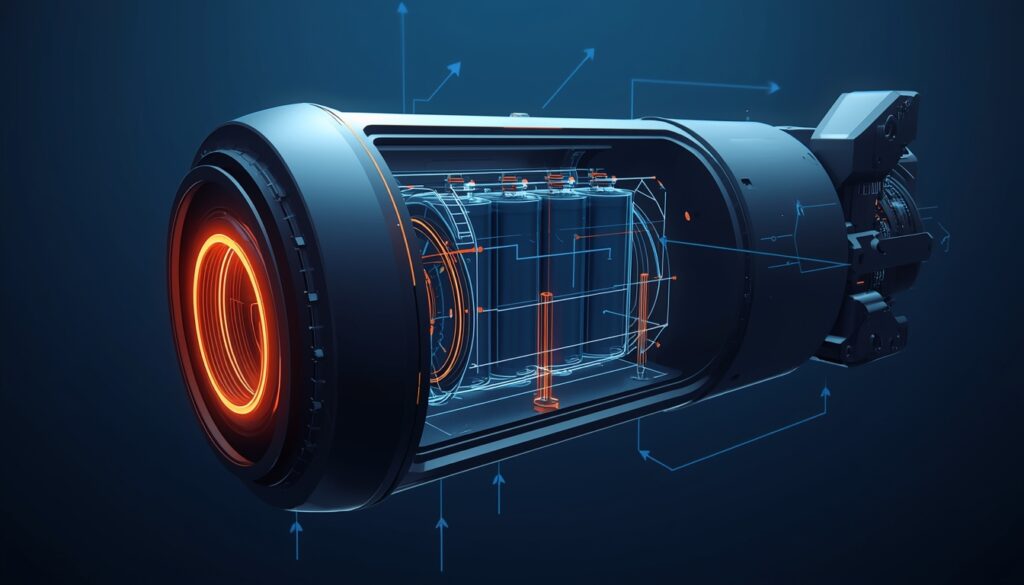
Sealing alone is not enough. Inside the battery compartment:
- Cells must be mechanically restrained
- Electrical terminals must be insulated
- No movement can occur under acceleration or deceleration
- Shock and vibration must be absorbed
At depth, pressure can subtly alter internal alignment, increasing the importance of proper internal design.
Pressure Cycling and Battery Seal Fatigue
Repeated dives expose seals to:
- Compression at depth
- Relaxation on ascent
- Micro-movement under vibration
- Thermal expansion and contraction
Over time, this leads to:
- Loss of elasticity
- Permanent deformation
- Reduced sealing margin
This is why maintenance intervals and seal replacement schedules are critical for battery safety.
Temperature Effects on Battery Sealing
Australian waters can vary significantly in temperature depending on location and depth.
Temperature affects:
- Seal hardness
- Housing expansion
- Battery chemistry
- Internal pressure differentials
Cold water increases seal stiffness, reducing compliance. Warm water increases elasticity but can accelerate ageing. Good designs accommodate both.
Internal Pressure Changes from Battery Heating
During operation, batteries generate heat.
In sealed compartments, this can:
- Increase internal air pressure
- Stress seals from the inside
- Interact with external water pressure
- Create pressure differentials during ascent
Advanced designs manage this through:
- Thermal pathways
- Controlled internal volumes
- Conservative operating limits
Poor designs ignore it entirely.
Saltwater: The Ultimate Seal Test
Saltwater is far more aggressive than freshwater.
It:
- Attacks metals
- Crystallises in micro-gaps
- Degrades elastomers
- Conducts electricity efficiently
Battery sealing systems designed only for freshwater may fail rapidly in Australian coastal environments.
Battery Sealing and Safety Standards
While there is no single universal standard governing underwater scooter battery sealing, best practice draws from:
- Marine electrical standards
- Pressure vessel principles
- Lithium battery safety protocols
- Industrial sealing design
Serious manufacturers design to these principles even when not explicitly required.
Warning Signs of Poor Battery Sealing Design
Experienced users learn to recognise red flags:
- Flat battery lids
- Single O-rings with no backup
- Exposed fasteners
- Thin plastic housings
- Minimal sealing documentation
- No maintenance guidance
These features often correlate with premature failure.
Maintenance Is Part of the Sealing System
No battery sealing system is maintenance-free.
Proper maintenance includes:
- Regular O-ring inspection
- Cleaning sealing surfaces
- Correct lubrication
- Scheduled seal replacement
- Careful reassembly
Ignoring maintenance negates even the best engineering.
Battery Sealing and Long-Term Reliability
Long-term reliability depends on:
- Conservative pressure margins
- Quality materials
- Good user practices
- Honest depth ratings
- Realistic duty cycles
Scooters that survive hundreds of dives do so because battery sealing was treated as a core engineering discipline, not an afterthought.
What Battery Sealing Does NOT Guarantee
Even excellent sealing does not guarantee:
- Infinite depth capability
- Zero maintenance
- Immunity to abuse
- Indefinite service life
It provides controlled, predictable risk, which is the foundation of safe operation.
Practical Guidance for Australian Buyers
Instead of asking “Is the battery waterproof?”, informed buyers ask:
- How is the battery compartment sealed?
- How is pressure managed?
- What seal materials are used?
- What maintenance is required?
- How many pressure cycles is it designed for?
These questions reveal real quality.
Final Thoughts: Battery Sealing Is Where Quality Reveals Itself
Battery sealing and pressure resistance are the most demanding aspects of underwater scooter design. They require careful integration of materials science, mechanical engineering, electrical safety, and real-world experience.
Well-engineered systems:
- Protect users
- Preserve batteries
- Extend service life
- Maintain performance under pressure
Poor systems eventually fail — often without warning.
For Australian users operating in demanding environments, battery sealing is not a specification to skim past. It is the difference between dependable equipment and unacceptable risk.