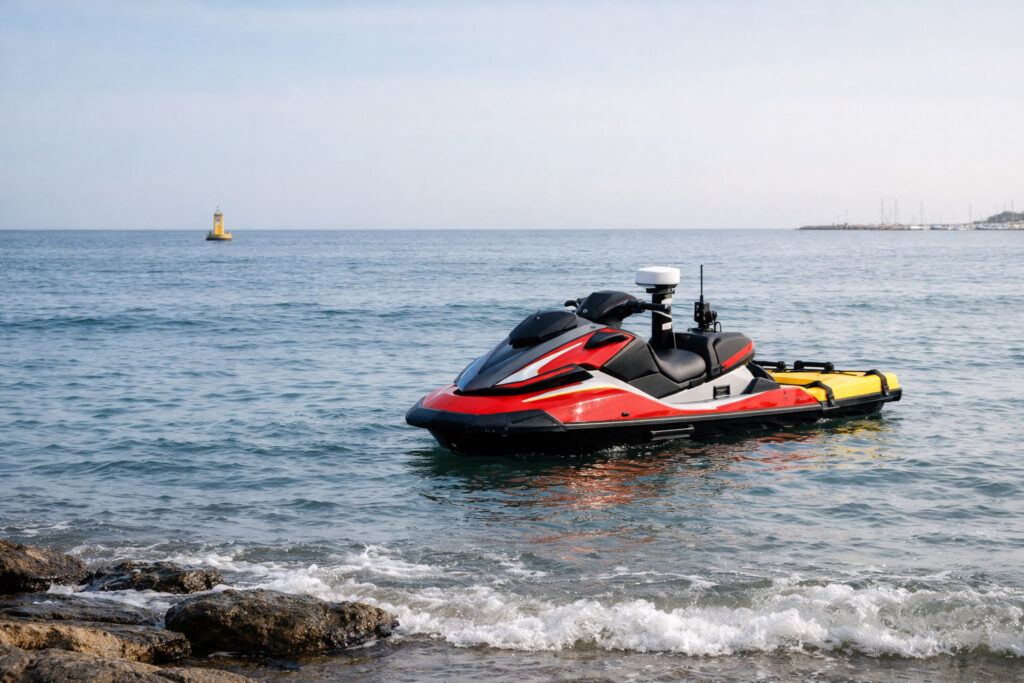
In Australia, the line between “small boat” and “personal watercraft” used to be fairly clear. A PWC was what most people called a jet ski: a compact, jet-propelled machine you sit on, kneel on, or stand on, built for sharp manoeuvres, quick acceleration, and close-quarters fun.
That neat little definition is no longer enough for 2026.
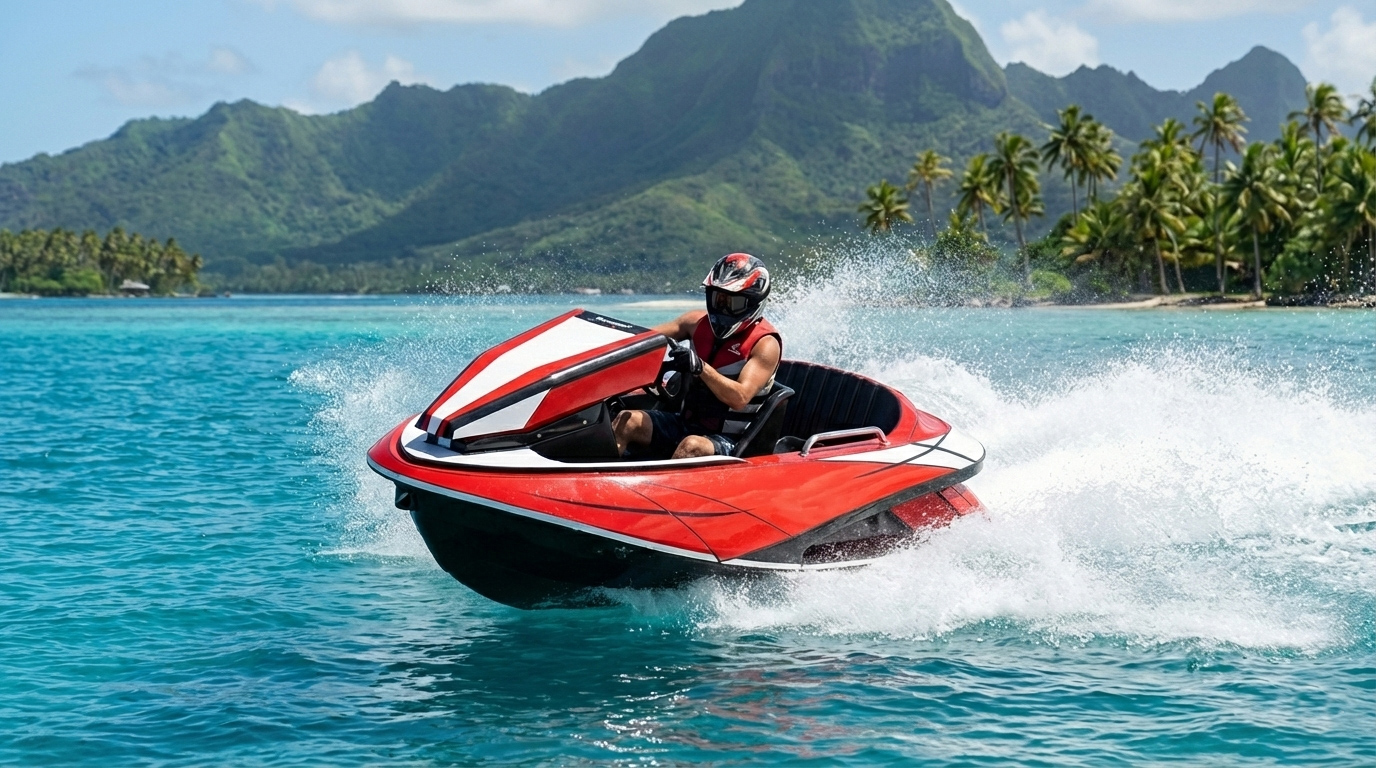
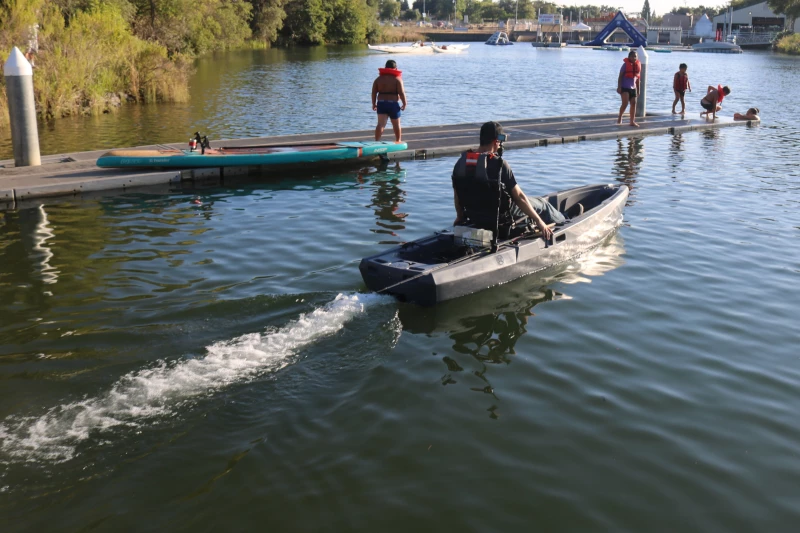
Mini jet boats have matured fast. They’re smaller, lighter, more powerful (often with electric drivetrains coming through), and they’re being used in the same environments as PWCs: river mouths, estuaries, lakes, sheltered bays, and inshore coastal zones. They accelerate hard, turn sharply, and they invite the same behaviours that have always made PWCs exciting—and risky—when the operator is undertrained or complacent.
So here’s the central point: in 2026, a mini jet boat must be treated as a PWC—operationally, safety-wise, and in the way buyers think about licensing, rules, and responsibility—even if a particular state’s wording classifies it differently on paper.
This is not about semantics. It’s about outcomes: fewer collisions, fewer prop-related injuries (jet drives remove prop strikes but introduce other risks), less shoreline conflict, fewer near-misses with swimmers, and fewer rescues triggered by overconfidence.
Let’s unpack why the PWC lens is the correct lens for mini jet boats now.
What regulators already mean by “PWC” (and why it matters)
Across Australian states, the common theme in PWC guidance is not just the label—it’s the risk profile:
- rapid acceleration and speed potential
- high manoeuvrability and sudden course change capability
- operation close to swimmers, shorelines, structures, and other vessels
- rider exposure and higher ejection likelihood
- frequent use in high-traffic recreational areas
- higher incident rates when judgement and lookout fail
New South Wales defines a PWC as a vessel with a fully enclosed hull that may be driven standing, lying down, sitting astride or kneeling, and explicitly includes craft like jet-powered surfboards.
South Australia’s safety guidance describes a PWC as a powerful, fast vessel with a motor and fully enclosed hull, operated by a person sitting, standing or kneeling, and highlights how quickly PWCs can change course—again pointing at the handling and risk factors.
Western Australia’s definition focuses on jet pump propulsion and rider-style operation (sit/stand/kneel) and notes that PWCs (and similar craft) are considered power boats and must be registered.
Queensland separates PWC licensing from general boat licensing and makes it clear that operating a PWC requires the relevant marine licence and PWC licence.
The recurring theme is that a PWC is not just “a small boat”. It’s a small, highly responsive, high-power craft that demands a higher standard of operator skill and stricter operational discipline.
Now look at where mini jet boats have landed in 2026.
Mini jet boats now behave like PWCs (and that’s the whole issue)
A modern mini jet boat—particularly the new compact, performance-tuned designs—shares the characteristics that caused PWCs to be regulated distinctly in the first place:
Jet propulsion changes the safety equation—but doesn’t eliminate danger
Jet drives remove exposed props, which can reduce one class of injury. But they also encourage operation in shallower water and closer to people because the operator feels safer. That can increase near-shore conflict and collision risk.
Power-to-weight has surged
Light hull + powerful drive = rapid acceleration. In electric configurations, torque can arrive instantly, meaning the craft can surge forward before the operator fully processes what’s ahead. That is classic PWC risk territory: “fast, fun, and unforgiving of lapses.”
High manoeuvrability invites high-risk behaviour
When a craft turns quickly, the operator is tempted to carve tighter lines, weave through traffic, or “play” near shore. That’s why PWC rules and education focus so heavily on judgement, lookout, separation distances, and speed moderation.
Operator exposure is often closer to PWC than “runabout boat”
Many mini jet boats are compact enough that the operator is seated low, close to the water, with a very direct physical feel of speed and movement—more “ride” than “boat”. Even when there’s a wheel, the operator experience is closer to a PWC than to a conventional small runabout.
The conclusion is simple: mini jet boats now live in the same behavioural and risk environment as PWCs. That means they deserve the same mindset and (practically) the same operating discipline.
The 2026 reality: “classification” isn’t enough—risk-based thinking is required
A purely legalistic argument (“what does the definition say in my state?”) misses the point.
You can comply with the letter of a rule and still create danger if you operate a mini jet boat like it’s a harmless tender.
A smarter approach—especially for buyers, families, clubs, councils, and anyone thinking about community safety—is risk-based classification:
- If it accelerates like a PWC, treat it like a PWC.
- If it turns like a PWC, treat it like a PWC.
- If it’s typically used in the same zones as PWCs, treat it like a PWC.
- If it’s likely to be operated by newcomers drawn in by “it looks easy”, treat it like a PWC.
This is exactly why government PWC handbooks and safety pages exist: to address a class of craft that tends to be involved in incidents when the operator’s judgement and training don’t match the performance. Mini jet boats have entered that class.
Why “PWC-level licensing mindset” should be standard for mini jet boat buyers
Even where a mini jet boat may not be labelled a PWC in a particular jurisdiction, buyers should assume they need PWC-level competency.
In Queensland, the difference is explicit: a PWC requires the relevant PWC licensing on top of the marine licence. In NSW, a PWC requires a specific licence regardless of speed, reinforcing that the craft type itself triggers higher responsibility.
So what does “PWC-level competency” actually mean in practical terms?
Understanding high-risk zones and typical conflict points
Most incidents and complaints cluster around predictable areas:
- river entrances and sandbars
- busy boat ramps and launch channels
- swimming beaches and designated bathing areas
- narrow rivers with blind bends
- marinas and mooring fields
- ski lanes and shared recreation corridors
Mini jet boats commonly operate in these same areas because their size makes access easy.
Mastering situational awareness at speed
A compact craft covers distance quickly. The faster you go, the less time you have to detect:
- swimmers and paddle craft
- anchored boats and fishing lines
- debris, shallow patches, and wakes
- kids on inflatables near shore
- other craft crossing your path at odd angles
This is the same “rapid closure rate” problem that PWC safety education constantly tries to fix.
Knowing that handling can “outpace” the operator’s judgement
High manoeuvrability is only safe when paired with conservative decision-making. PWCs are notorious for incidents caused by sudden turns, misjudged gaps, or “I thought I had room.” The same pattern is now appearing in other compact, high-performance craft categories worldwide. Mini jet boats are not immune—if anything, they can be more tempting because some buyers assume “it’s a boat, so it’s calmer than a jet ski.” In 2026, that assumption is often wrong.
The strongest argument: mini jet boats should follow PWC operating rules because they create the same external risks
When the public complains about PWCs, they’re usually complaining about behaviour:
- excessive speed near shore
- weaving close to other craft
- noise and disturbance in quiet zones
- wake impacts in narrow waterways
- intimidation of swimmers and paddlers
- near misses
Those outcomes don’t care what the craft is called. If a mini jet boat produces the same outcomes, it must be governed by the same operating discipline. That’s why the safest stance—especially if you’re advising a buyer, a family, or a club—is: **Operate a mini jet boat with PWC rules as your baseline.**
If your state’s rules for your vessel type are stricter, follow those. If they’re looser, your moral and practical responsibility remains: don’t create PWC-type risks just because you can.
Electric and hybrid systems make the PWC argument even stronger in 2026
The electric era doesn’t just change propulsion. It changes how people behave.
Instant torque compresses reaction time
Electric drive can deliver peak torque immediately. That means faster holeshot acceleration, stronger mid-range surge, less “build up” time to reassess, and a greater chance of accidental lurch (especially with inexperienced throttle control). That throttle sensitivity is a classic PWC issue—now transferred into mini jet boats.
Quiet operation can increase collision risk
A quieter craft may be less noticeable to swimmers, paddlers, and anglers. That can reduce perceived warning time for others in the water. It places a bigger burden on the operator to maintain separation and reduce speed near people.
Range confidence can encourage “just one more run”
As systems improve, people push further, stay out longer, and take more chances with weather and fatigue. Fatigue + speed + tight waterways is the recipe PWC educators have warned about for decades. So in 2026, the “treat it like a PWC” position is not conservative—it’s realistic.
“But it has a steering wheel, so it’s a boat”—why that thinking fails
This is one of the most common mental traps. A steering wheel does not automatically make a craft safe. What matters is hull size and stability at speed, turning radius and handling response, acceleration and stopping distance, operator exposure and likelihood of ejection, and the typical operating environment. A small jet boat can turn aggressively and accelerate rapidly regardless of steering type. It can also be operated in shallows and close to shore for the same reasons PWCs are: access and fun.
If anything, the wheel can create a false sense of security for new owners—“I’ve driven a car, I’ll be right.” Unfortunately, the water doesn’t work like roads. There are no lanes, no brakes, constantly changing conditions, and other people often behave unpredictably. That is precisely why PWC regulation and licensing evolved the way it did.
A practical buyer’s checklist: when a mini jet boat should be treated as a PWC
If you answer “yes” to most of these, the PWC lens is non-negotiable:
- Does it use jet propulsion (water jet pump) rather than an exposed prop?
- Is it small enough to be operated close to shore and in tight waterways?
- Can it accelerate hard enough to surprise an inexperienced operator?
- Can it turn sharply at speed?
- Will it likely be used for “fun runs”, carving, towing, or quick bursts rather than steady cruising?
- Will it be used where swimmers, paddle craft, or fishing boats are common?
- Is it likely to be purchased by first-timers attracted by the compact size?
If that’s your craft, then your mindset should be: **PWC training, PWC caution, PWC courtesy, PWC discipline.**
The community safety angle: why councils, clubs, and surf groups should push the PWC framing
If you’re looking at mini jet boats through a public safety lens—surf lifesaving clubs, council officers, waterway managers, local residents—the PWC framing matters because it sets expectations early, reduces conflict with other water users, supports consistent messaging on safe distances and speed near shore, discourages “grey area” loophole behaviour, and makes enforcement and education easier. People accept rules more readily when the category is clearly understood. “PWC” is a category the public recognises as needing more discipline. Mini jet boats in 2026 belong in that same mental bucket because they generate similar externalities when misused.
The insurance and liability reality (the part buyers ignore until it hurts)
When something goes wrong on the water—collision, injury, property damage—the argument is rarely “what was it called?” It becomes: Were you licensed appropriately? Were you operating safely for the conditions? Were you keeping a proper lookout? Were you travelling at a safe speed near people and structures? Did you follow common safety guidance for high-performance craft?
If your mini jet boat performs like a PWC and you operate it like a casual dinghy, your legal and financial exposure rises fast. The sensible buyer treats a mini jet boat as a PWC from day one, because that is the standard a court, insurer, and investigator will implicitly expect when the craft is high-performance and operated in shared recreation zones.
The bottom line for 2026: classify by behaviour, not marketing
In 2026, product categories are blurring. Jet-powered surfboards are explicitly included under PWC guidance in NSW, PWCs are described by propulsion and handling characteristics in WA, and Queensland treats PWCs as distinct enough to require separate licensing. This is the direction of travel: regulators and safety bodies are responding to performance and risk, not just shape.
A mini jet boat that is small, jet-propelled, quick to accelerate, and highly manoeuvrable is, in real-world effect, operating as a PWC. So if you’re buying, selling, advising, or operating one, adopt the correct standard: Learn like a PWC operator, Ride with PWC caution, Give space like a responsible PWC rider, Assume the craft is capable of getting you into trouble quickly, and Respect shared waterways and public perception.
That’s how you protect yourself, your passengers, and everyone else trying to enjoy the water.
See www.velocitywatercraft.com.au for all the mini jet boats