
Introduction: Balance Has Always Ruled Board Design
From the earliest hollow wooden surfboards to modern EPS foam constructions, one principle has never changed: a board that is poorly balanced will never perform properly, no matter how powerful or expensive it is. Electric propulsion has not replaced this truth—it has amplified it.
In electric surfboards and foil boards, the battery is the single heaviest component on the craft. Where that weight is placed, how it interacts with rider mass, and how it behaves dynamically in motion determines whether the board feels intuitive and confidence-inspiring—or awkward, unstable, and fatiguing.
This article explains, in practical and technical terms, how battery weight distribution influences trim, pitch, roll, yaw, take-off behaviour, turning precision, foil stability, rider safety, and long-term usability. It also explains why many early and low-cost electric boards fail not because of weak motors, but because of poor mass management.
Understanding Static vs Dynamic Balance
Before looking at battery placement, it is essential to distinguish between static balance and dynamic balance.
Static balance describes how the board sits in the water when stationary or moving slowly. It affects:
- Waterline trim
- Nose and tail immersion
- Rider stance comfort
- Ease of mounting and dismounting
Dynamic balance describes how the board behaves once in motion. It affects:
- Acceleration stability
- Turning response
- Foil lift progression
- Control at speed
- Rider fatigue and safety
Battery weight influences both forms of balance, but the consequences become far more pronounced once the board is under power.
The Battery as the Centre of Mass
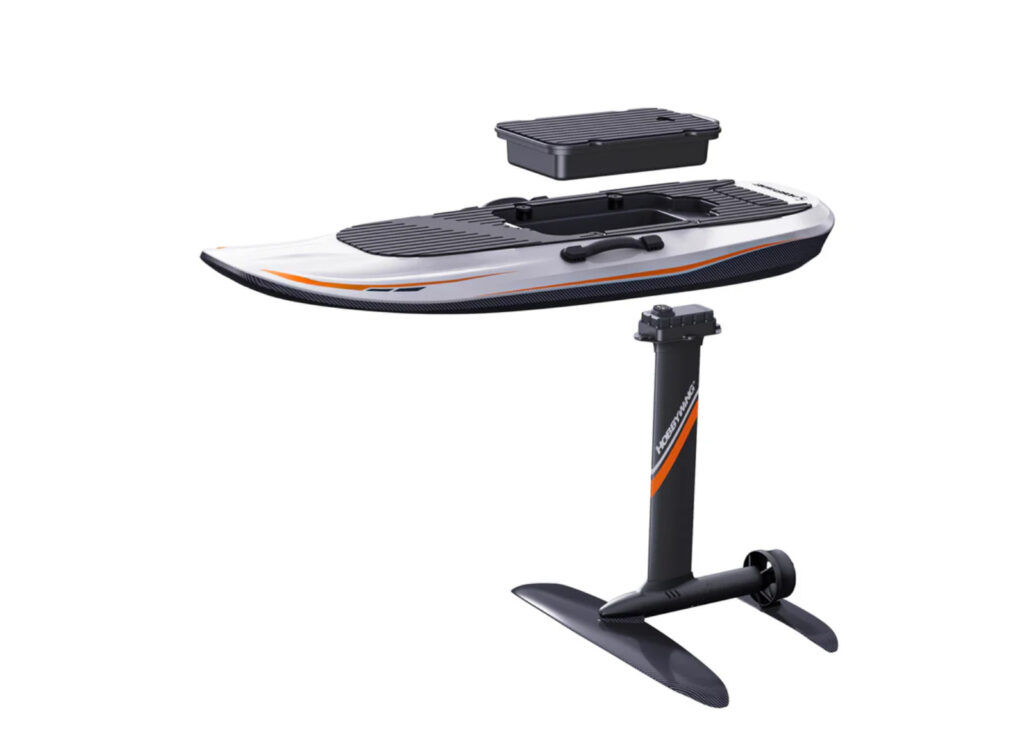
In traditional surfboards, the centre of mass is dominated by the rider. In electric boards, the battery introduces a fixed mass that often weighs between 10 kg and 20 kg—sometimes more.
This means:
- The board’s balance is no longer rider-only dependent
- Mass distribution must be engineered, not improvised
- Poor placement cannot be “ridden around”
In effect, the battery becomes the board’s structural anchor, influencing every aspect of performance.
Longitudinal Placement: Nose to Tail Balance
Forward-Biased Battery Placement
When a battery is positioned too far forward:
- The nose rides low at rest
- The board tends to pearl or push water
- Acceleration feels sluggish
- Take-off in foil boards is delayed
- Rider stance becomes defensive
On foil boards, forward weight dramatically increases the effort required to generate lift. The foil must overcome both rider weight and a nose-heavy pitch moment, leading to:
- Over-throttling during take-off
- Sudden breaching once lift finally occurs
- Increased crash risk for beginners
Rear-Biased Battery Placement
When the battery sits too far aft:
- The tail squats under power
- The nose lifts excessively
- Acceleration feels abrupt
- Turning becomes twitchy
- Low-speed control deteriorates
On foil boards, excessive rear bias causes:
- Premature lift
- Over-pitching
- Porpoising (oscillating pitch instability)
- Difficulty maintaining steady flight height
Neutral Longitudinal Placement
The optimal solution places the battery near the board’s designed centre of buoyancy, allowing:
- Flat trim at rest
- Predictable acceleration
- Smooth foil lift progression
- Minimal rider compensation
This is not guesswork—it is the result of hydrodynamic modelling and real-world testing.
Vertical Placement: Deck vs Hull Mass
High Battery Placement (Near Deck)
Placing battery mass high in the board increases the centre of gravity, which:
- Reduces roll stability
- Increases wobble at low speed
- Makes balance more tiring
- Amplifies rider mistakes
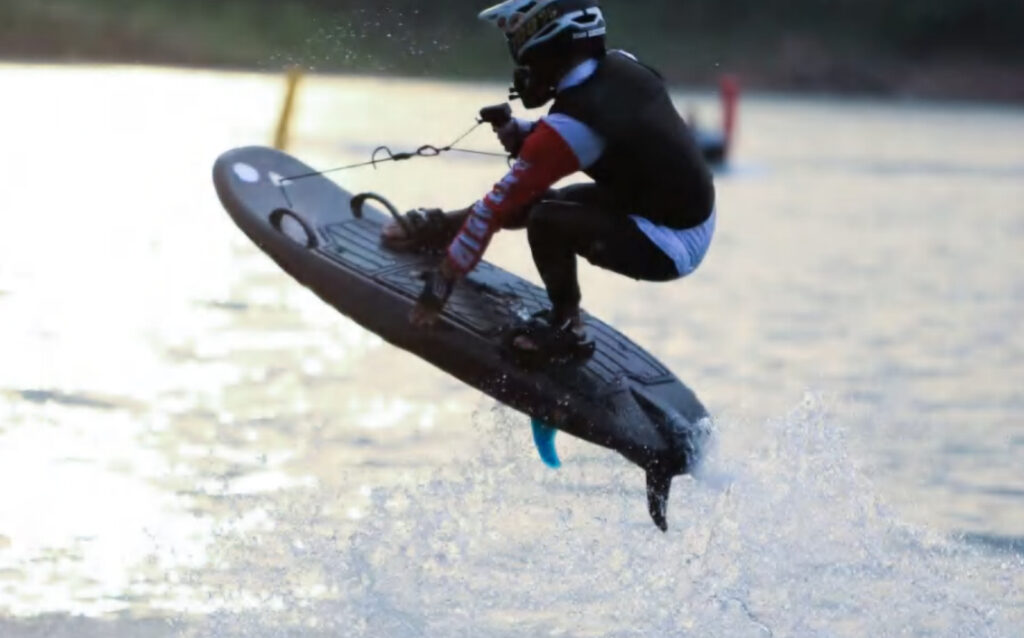
For foil boards, a high centre of gravity increases roll coupling, making micro-corrections more difficult and increasing the likelihood of tip-touches and crashes.
Low Battery Placement (Near Hull or Foil Mount)
Lowering the battery mass:
- Improves roll stability
- Dampens oscillations
- Makes the board feel planted
- Enhances confidence at speed
This is why high-quality electric boards integrate batteries as low as structurally possible without compromising water sealing or strength.
Lateral Balance: Left-Right Symmetry
Even small lateral imbalances become noticeable at speed.
If the battery is offset:
- The board lists to one side at rest
- Turns feel asymmetrical
- One rail engages earlier than the other
- Rider fatigue increases due to constant correction
In foil boards, lateral imbalance can cause:
- Uneven wing loading
- One-sided breach tendencies
- Persistent roll bias
Professional designs maintain strict lateral symmetry, often aligning battery modules along the central stringer or keel line.
Interaction Between Battery Weight and Rider Weight
A common mistake is designing boards around an “average rider” without accounting for battery mass interaction.
Key realities:
- Heavier riders amplify balance errors
- Lighter riders feel battery dominance more strongly
- Fixed battery placement must accommodate a wide rider range
This is why advanced designs adjust:
- Battery lengthwise position
- Motor placement
- Mast track position (for foil boards)
The goal is to allow rider stance to fine-tune balance rather than fight it.
Battery Weight Distribution in Electric Surfboards
Planing Behaviour
In electric surfboards, proper battery placement allows:
- Clean planing at lower speeds
- Reduced drag during acceleration
- Stable carving turns
- Predictable deceleration
Poor placement results in:
- Nose slap
- Tail drag
- Spray inefficiency
- Increased energy consumption
Turning Dynamics
Mass located near the board’s rotational centre allows quicker directional changes. Excessive forward or rear mass increases rotational inertia, making turns feel heavy and delayed.
This directly impacts:
- Playfulness
- Wave-riding realism
- Rider enjoyment
Battery Weight Distribution in Foil Boards
Take-Off Phase
The take-off moment is where battery placement matters most. Proper distribution allows:
- Progressive lift
- Smooth transition from displacement to flight
- Reduced throttle spikes
Poor placement forces riders to compensate aggressively, increasing fall risk.
Sustained Flight
Once airborne, battery placement affects:
- Pitch stability
- Roll damping
- Energy efficiency
A well-balanced foil board feels calm at speed, allowing the rider to focus on line choice rather than survival.
Energy Efficiency and Range
Balanced boards are more efficient because:
- Less energy is wasted correcting instability
- Foils operate at optimal angles
- Motors run at steadier loads
This translates directly into:
- Longer ride times
- Lower battery stress
- Improved component longevity
Range is not only about battery capacity—it is about how intelligently that capacity is integrated.
Safety Implications
Poor battery weight distribution increases:
- Sudden loss of control
- High-speed ejections
- Unpredictable behaviour in chop
- Rider fatigue leading to mistakes
Balanced boards reduce cognitive load, allowing riders to respond calmly to changing conditions.
Why Cheap Boards Often Get This Wrong
Low-cost electric boards often:
- Use off-the-shelf battery blocks
- Prioritise ease of assembly over balance
- Avoid structural redesign due to tooling cost
The result is boards that look impressive on paper but feel unstable on water.
Experienced riders immediately recognise this difference.
The Traditional Lesson: Balance Before Power
For decades, board shapers understood that weight placement matters more than horsepower. Electric propulsion has not changed this rule—it has made it unavoidable.
Power can be added easily. Balance must be engineered.
Final Perspective
Battery weight distribution is not a minor design detail. It is the foundation of electric board performance, influencing control, safety, efficiency, and enjoyment.
Boards that get this right feel intuitive, calm, and confidence-building. Boards that get it wrong feel demanding, unpredictable, and tiring—regardless of how powerful the motor may be.
As electric surfboards and foil boards continue to evolve, the most respected designs will not be those with the biggest numbers, but those that quietly disappear beneath the rider, allowing skill—not compensation—to define the experience.
Related products, technical guides, and electric watercraft innovations:
www.vectorwatercraft.com.au