
Why Power Systems Are the Hidden Determinant of Reliability, Trust, and Survival
In modern water rescue and emergency response equipment, battery systems are not a supporting component—they are the backbone of the entire system. No matter how well a rescue device is designed mechanically or ergonomically, it is only as reliable as the energy source that powers it. In emergency contexts, battery safety is not about convenience or performance optimisation; it is about predictability, stability, and absolute trust under worst-case conditions.
This article explains why battery safety is critical in emergency equipment, how emergency-grade battery systems differ from consumer or recreational products, and what decision-makers must understand when evaluating rescue technology for public or professional use.
Why Battery Safety Is Different in Emergency Equipment
Battery discussions are often framed around capacity, runtime, or charging speed. In emergency equipment, these are secondary considerations. The primary requirement is certainty.
Emergency equipment must:
- Sit unused for long periods
- Operate instantly on demand
- Deliver consistent power under load
- Remain safe under immersion, impact, and temperature variation
- Never fail catastrophically
Unlike consumer electronics, emergency devices are not used in controlled environments. They are exposed to saltwater, UV radiation, vibration, shock, and sometimes vandalism. Battery systems must be engineered accordingly.
A battery failure in a recreational product is inconvenient. A battery failure in rescue equipment can be fatal.
The Standby Paradox: The Hardest Operating Condition
One of the least understood challenges in emergency battery design is standby longevity.
Most rescue devices spend the vast majority of their life:
- Fully charged
- Unused
- Installed in the field
This is far more demanding than regular cycling. Batteries degrade not only through use, but through time, temperature, and charge state.
Emergency-grade battery systems are therefore designed to:
- Minimise self-discharge
- Resist capacity loss at high state of charge
- Avoid chemical instability during long idle periods
Consumer batteries optimised for frequent use often perform poorly in this scenario. Emergency systems prioritise stability over energy density.
Battery Chemistry: Stability Over Density
While lithium-based batteries dominate modern electric systems, not all lithium chemistries are suitable for emergency equipment.
Emergency applications favour chemistries with:
- High thermal stability
- Low risk of thermal runaway
- Predictable voltage curves
- Long calendar life
In many cases, this means accepting lower energy density in exchange for dramatically improved safety margins.
This trade-off is intentional. In rescue equipment, a slightly heavier or larger battery is acceptable if it reduces risk and increases reliability.
Thermal Runaway: Why It Is Unacceptable in Rescue Systems
Thermal runaway—where a battery overheats uncontrollably—is one of the most serious hazards in lithium systems. In consumer devices, this risk is mitigated by usage patterns and controlled environments. In emergency equipment, the consequences are unacceptable.
Rescue batteries must be designed so that:
- Cell temperatures remain within safe limits under load
- External heat does not trigger instability
- Internal faults are contained
This is achieved through conservative current limits, robust cell spacing, and thermal buffering within the battery enclosure.
Emergency battery systems are intentionally over-engineered relative to their power demands.
Waterproofing and Sealing: Beyond “Water Resistant”
Waterproofing is often misunderstood. For emergency equipment, it is not enough to resist splashes or brief immersion.
Battery systems must tolerate:
- Full submersion
- Repeated wave impact
- Pressure changes
- Long-term exposure to moisture
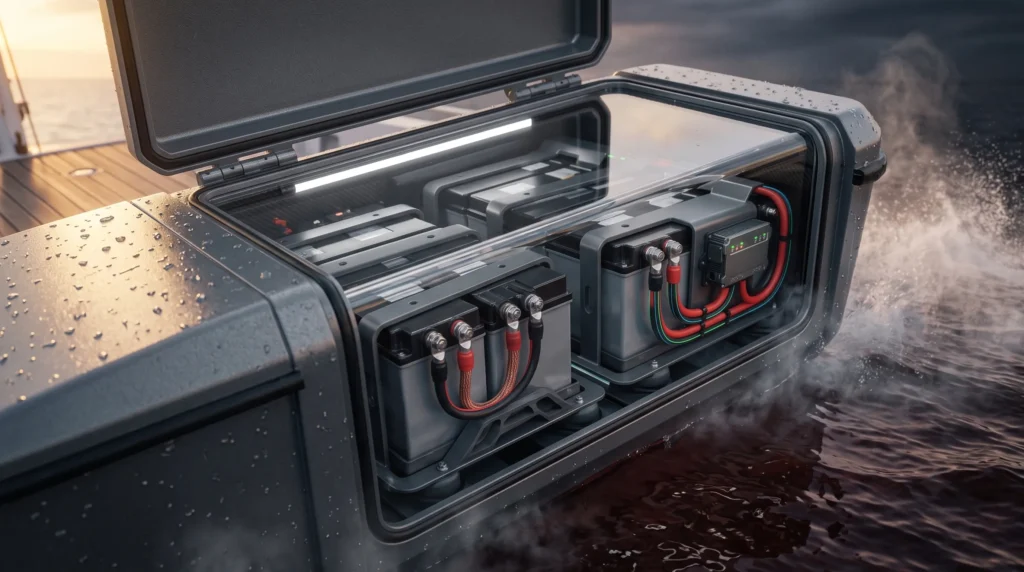
To achieve this, batteries are housed in multi-layer sealed enclosures, often isolated from the main electronics compartment. Gaskets, compression seals, and redundant barriers are used to prevent water ingress even if one layer is compromised.
Importantly, sealing must also account for pressure equalisation. Trapped air expands and contracts with temperature. Emergency battery housings are designed to manage this without allowing water entry.
Electrical Isolation and Short-Circuit Prevention
In water environments, electrical isolation is critical. Emergency battery systems are designed to prevent:
- Internal short circuits
- External conduction paths
- Corrosion-induced failures
All conductive components are isolated, coated, or encapsulated. Wiring paths are minimised. Connectors are internal wherever possible.
This ensures that even in the event of partial flooding or damage, the battery does not present an electrical hazard to the user or the victim.
Battery Management Systems: Conservative by Design
Every emergency battery system relies on a battery management system (BMS). However, the philosophy behind the BMS differs markedly from consumer applications.
Emergency BMS design prioritises:
- Over-current protection
- Over-temperature protection
- Conservative charge and discharge limits
- Fail-safe shutdown modes
Rather than extracting maximum performance, the system enforces strict boundaries that protect the cells under all conditions.
If a fault is detected, the system defaults to a safe state—not continued operation at risk.
Predictable Runtime vs Maximum Runtime
In rescue scenarios, predictability matters more than duration.
A device that provides a guaranteed, consistent runtime is far more valuable than one that sometimes runs longer but unpredictably loses power.
Emergency battery systems are therefore rated conservatively. Operators are not expected to estimate remaining capacity under stress. Instead, the system is designed to deliver full performance for a defined operational window.
This reduces cognitive load and prevents hesitation or misjudgement during deployment.
Charging Safety: Controlled, Not Fast
Fast charging is a selling point in consumer products. In emergency equipment, it is a secondary concern.
Charging systems for rescue batteries are designed to:
- Minimise heat generation
- Prevent overcharging
- Avoid cell imbalance
- Operate safely in unattended environments
Charging often occurs in depots, vehicles, or fixed installations. The priority is safe, repeatable charging, not speed.
Many emergency systems deliberately limit charge rates to extend battery life and reduce risk.
Fire Risk and Public Installations
When rescue equipment is installed in public spaces, battery safety becomes a public infrastructure issue.
Authorities must consider:
- Fire risk
- Vandalism
- Unauthorised access
- Environmental exposure
Emergency battery systems are therefore designed to remain safe even if:
- The device is dropped
- The housing is struck
- The equipment is exposed to extreme heat
This level of resilience is essential for public trust and regulatory acceptance.
Compliance, Certification, and Due Diligence
Battery safety is not just a technical issue—it is a governance issue.
Decision-makers must ensure that emergency equipment batteries:
- Meet recognised safety standards
- Use traceable, quality-controlled cells
- Are supported by documented testing
Cheap or poorly specified battery systems may appear attractive on paper, but they introduce unacceptable risk in emergency contexts.
In rescue equipment, unknown battery provenance is a red flag, not a cost saving.
Battery Degradation and Replacement Planning
All batteries degrade over time. Emergency systems acknowledge this reality through conservative replacement schedules and clear inspection protocols.
Well-designed systems provide:
- Clear indicators of battery health
- Defined service intervals
- Straightforward replacement procedures
This ensures that battery degradation does not silently undermine readiness.
A rescue device with a degraded battery is not partially effective—it is potentially ineffective.
Environmental Conditions and Temperature Extremes
Emergency equipment must function across wide temperature ranges:
- Hot coastal environments
- Cold inland waters
- Rapid temperature changes
Battery chemistry, enclosure design, and BMS parameters are all selected to maintain safe operation under these conditions.
Consumer batteries optimised for room-temperature use often fail in these environments. Emergency systems are engineered for the extremes.
Why Battery Safety Directly Impacts Public Confidence
Public access rescue technology relies on trust. People must believe that:
- The device will work
- It is safe to use
- It will not endanger them
Battery failures—especially visible ones such as overheating or smoke—destroy that trust instantly.
For this reason, battery safety is not merely a technical requirement. It is central to adoption, acceptance, and long-term effectiveness.
The Cost of Getting Battery Safety Wrong
The consequences of battery failure in emergency equipment are severe:
- Loss of rescue capability
- Increased rescuer risk
- Reputational damage
- Legal exposure
These risks far outweigh any savings achieved by compromising on battery quality or safety engineering.
In emergency systems, battery safety is not the place to economise.
The Direction of Emergency Power Systems
As battery technology continues to evolve, emergency equipment will benefit from improved materials, better sealing techniques, and enhanced monitoring.
However, the core principles will not change:
- Stability over density
- Predictability over peak performance
- Safety over convenience
These principles reflect the reality of emergency response, where conditions are uncontrolled and outcomes matter profoundly.
Conclusion: Power You Can Trust When It Matters Most
In water rescue and emergency equipment, the battery is not just a power source. It is a promise—that when someone is in trouble, the system will respond without hesitation or failure.
Every design choice, from chemistry to enclosure to charging protocol, exists to uphold that promise.
When evaluating rescue technology, the most important question is not how powerful it is, or how long it runs, but whether its battery system has been engineered for the one moment when failure is not an option.
In emergency response, safe power is lifesaving power.