
Introduction: Redefining the Boat as a Capsule Experience
The Jet Capsule is one of the most visually distinctive and philosophically different watercraft to emerge in recent decades. It does not attempt to refine the traditional boat form, nor does it pursue performance benchmarks in speed or range. Instead, Jet Capsule asks a fundamentally different question:
What if a boat were designed first as a protected, immersive environment for people, rather than as an exposed platform moving across water?
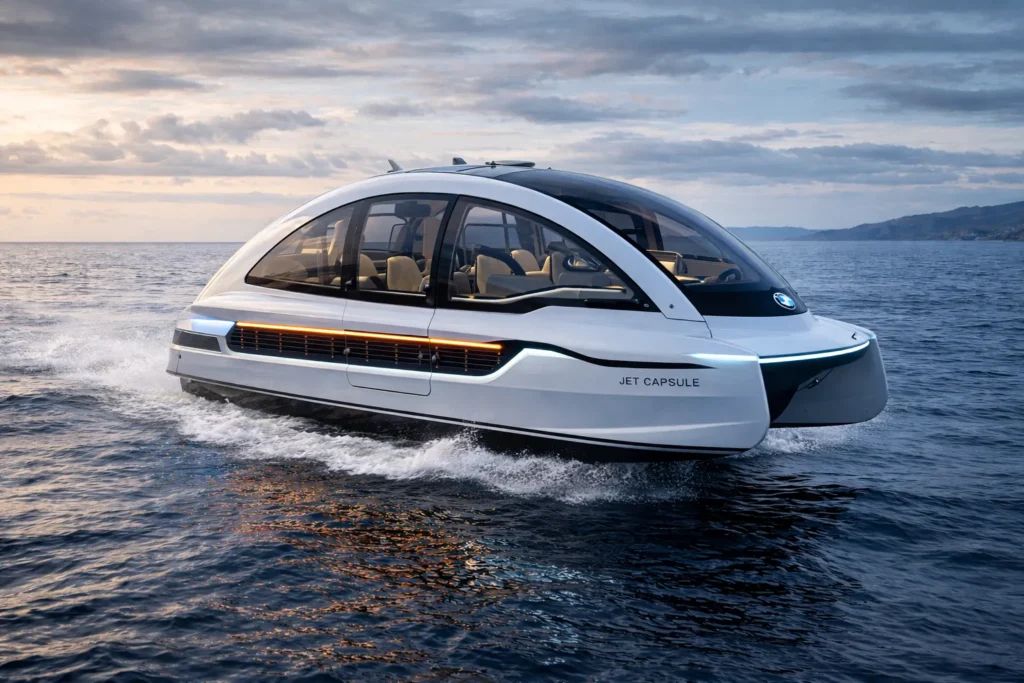
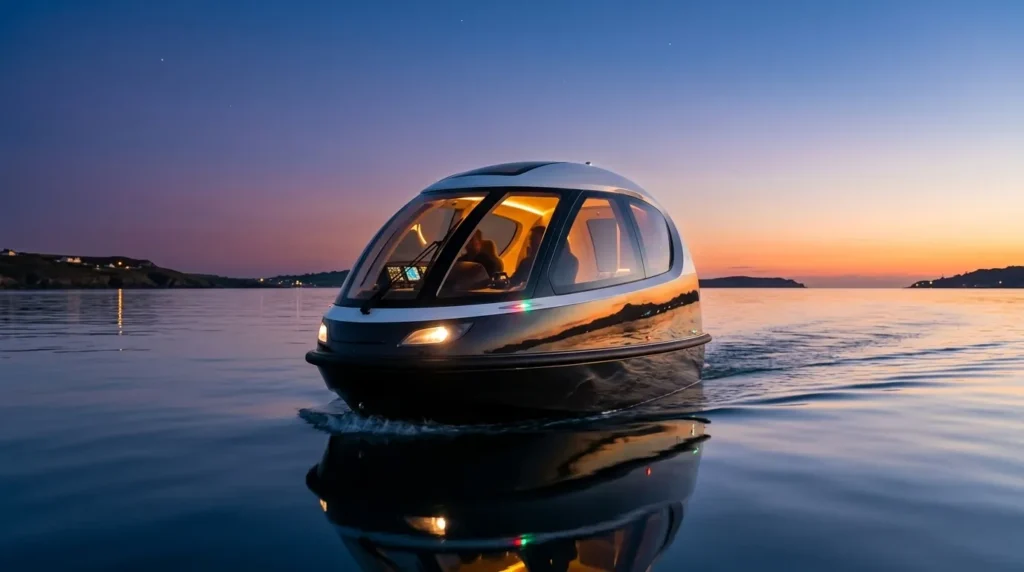
The result is a vessel that looks more like a futuristic pod or capsule than a conventional boat—fully enclosed, rounded, and intentionally isolated from wind, spray, and external chaos. In doing so, Jet Capsule challenges long-held assumptions about what recreational and luxury watercraft are supposed to feel like.
As an experimental and emerging watercraft, Jet Capsule is not about incremental improvement. It is about redefining the relationship between passengers, the environment, and the sea itself.
Origins of the Jet Capsule Concept
Jet Capsule originated in Italy, a country with a long tradition of marine craftsmanship combined with bold industrial design. The creators recognised that while boats had become faster and more luxurious, they had not fundamentally addressed several persistent discomforts:
- Exposure to wind, spray, and sun
- Noise intrusion from engines and the surrounding environment
- Limited climate control
- Reduced usability in marginal weather
Rather than attempting to solve these problems within the constraints of conventional open or semi-enclosed boats, the designers pursued a clean-sheet approach. The idea was radical but simple: create a fully enclosed capsule capable of operating comfortably on water, regardless of external conditions.
Capsule Architecture: Form Follows Experience
The defining characteristic of Jet Capsule is its capsule-shaped superstructure. This is not merely an aesthetic choice; it is central to the vessel’s function.
The rounded form offers several advantages:
- Reduced wind resistance
- Improved structural rigidity
- Enhanced sound insulation
- Superior weather protection
Unlike traditional cabins bolted onto hulls, the Jet Capsule integrates hull and superstructure into a unified volume. This creates a continuous interior environment that feels more like a luxury lounge than a boat cockpit.
Enclosed Environment and Climate Control
One of the Jet Capsule’s most significant departures from conventional boats is its fully climate-controlled interior.
Inside the capsule, occupants are insulated from:
- Wind chill
- Salt spray
- Engine noise
- External temperature extremes
Air conditioning, heating, and ventilation systems allow the vessel to be used comfortably in conditions that would render open boats unpleasant or unusable.
This fundamentally alters how and when the vessel can be used, particularly in regions with variable weather or strong sun exposure.
Hull Design and Stability Philosophy
Beneath its futuristic exterior, the Jet Capsule employs a catamaran-style hull configuration. This choice supports the capsule concept in several important ways:
- Increased stability at rest and underway
- Reduced rolling motion
- Shallow draft
- Enhanced safety for enclosed passengers
Stability is particularly critical for an enclosed vessel, where passengers are seated inside rather than bracing against motion. The twin-hull design ensures predictable, comfortable behaviour even at low speeds or in choppy conditions.
Propulsion Systems and Power Options
Jet Capsule models have been offered with a range of propulsion options, typically based around waterjet systems.
Waterjet propulsion aligns well with the capsule concept because it offers:
- No exposed propellers
- Reduced vibration
- Smooth acceleration
- Enhanced manoeuvrability
Depending on configuration, Jet Capsules may use petrol, diesel, or hybrid propulsion systems. The focus is not extreme speed, but controlled, smooth movement suitable for premium passenger experiences.
Noise Reduction and Acoustic Isolation
Noise is one of the most underappreciated discomforts in boating. Jet Capsule addresses this directly through:
- Structural insulation
- Enclosed engine compartments
- Sound-dampening materials
- Isolation of mechanical vibration
The result is a significantly quieter experience compared to open boats or even conventional cabin cruisers. Conversations can occur at normal volume, music can be enjoyed without competing with engine noise, and passengers experience far less fatigue.
Interior Design: The Boat as a Lounge
Inside, Jet Capsule interiors are deliberately non-nautical. Rather than adopting traditional marine styling cues, the designers draw inspiration from:
- Luxury automotive interiors
- Private aviation cabins
- High-end hospitality spaces
Seating is arranged for comfort and social interaction rather than helm-centric control. Panoramic windows maintain visual connection to the outside world while preserving the feeling of enclosure and safety.
User Experience and Passenger-Centric Design
Jet Capsule places passengers—not operators—at the centre of the design.
Key experience-driven features include:
- Wraparound glazing for uninterrupted views
- Ambient lighting systems
- Intuitive climate and entertainment controls
- Smooth, predictable ride characteristics
This approach makes Jet Capsule particularly well-suited to non-boating audiences, including guests who may be uncomfortable on traditional boats.
Safety Considerations in an Enclosed Vessel
Fully enclosed watercraft introduce unique safety considerations, which Jet Capsule addresses through multiple design strategies:
- High-visibility glazing
- Multiple access and egress points
- Stable hull geometry
- Redundant systems
The enclosed structure also provides a psychological sense of safety, which can be particularly important for passengers unfamiliar with boating.
Use Cases and Applications
Jet Capsule is not designed for fishing, watersports, or high-speed offshore racing. Its strength lies in experiential transport and leisure.
Typical use cases include:
- Luxury tenders
- VIP transfers
- Coastal sightseeing
- Resort and hotel operations
- Private leisure cruising
In these roles, comfort, protection, and visual impact matter more than speed or payload.
Market Positioning and Buyer Profile
Jet Capsule occupies a niche position in the marine market.
It appeals to buyers who value:
- Design differentiation
- Passenger comfort
- All-weather usability
- Novelty and exclusivity
These buyers may include luxury yacht owners, resorts, charter operators, or private individuals seeking something genuinely different from conventional boats.
Cultural and Design Impact
Jet Capsule’s greatest contribution may be cultural rather than technical. It challenges the assumption that boating must involve exposure, wind, and discomfort.
By treating the boat as a mobile interior space, Jet Capsule opens the door to new ways of thinking about marine leisure—ways that align more closely with modern expectations of comfort and design.
Why Jet Capsule Qualifies as an Emerging Watercraft
Jet Capsule belongs firmly in the category of emerging watercraft and experimental concepts because it:
- Rejects traditional boat archetypes
- Prioritises passenger experience over performance metrics
- Integrates enclosure, stability, and comfort as core design principles
- Targets new user demographics
Rather than optimising existing solutions, it redefines the problem entirely.
Influence on Future Marine Design
While Jet Capsule may remain a niche product, its ideas are likely to influence future developments in:
- Enclosed leisure craft
- Autonomous passenger vessels
- Luxury marine transport
- Weather-independent boating solutions
As boating audiences expand beyond traditional enthusiasts, designs that prioritise comfort and inclusivity may become increasingly relevant.
Conclusion
The Jet Capsule is not about speed, power, or tradition. It is about experience.
By reimagining the boat as a protected, immersive capsule rather than an exposed platform, it challenges centuries of marine convention. In doing so, it offers a compelling vision of how watercraft might evolve to meet the expectations of a broader, more comfort-oriented audience.
As an experimental and emerging watercraft, Jet Capsule succeeds precisely because it dares to be different.