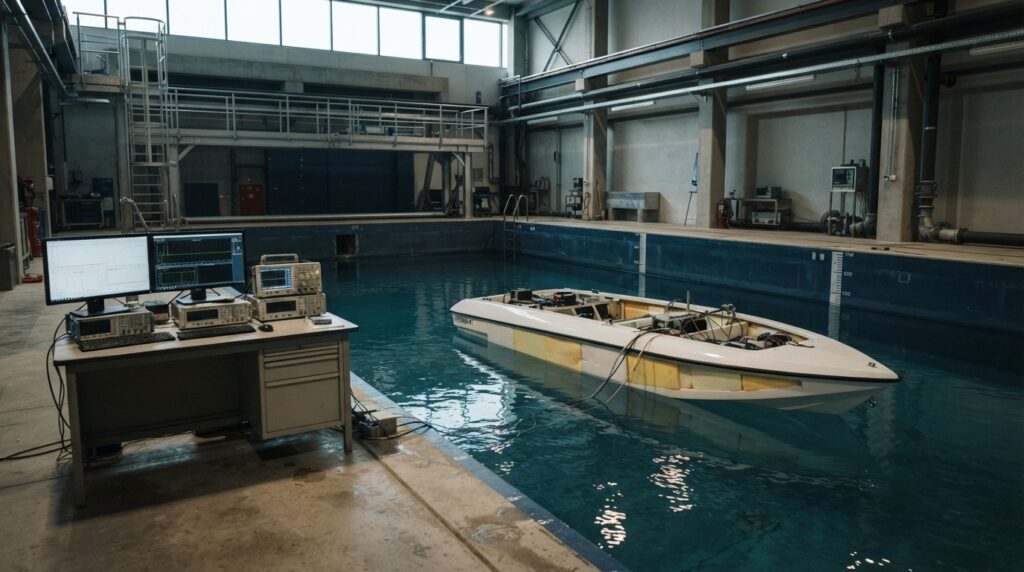

The Difference Between Assumption and Proof
In the expanding market of mini jet boats, much attention is given to specifications—power output, speed, size, and design. Yet one of the most critical factors influencing safety is rarely discussed in detail: testing.
Not theoretical testing. Not assumptions based on component ratings. But real, factory-based, system-level testing conducted before a vessel ever reaches the water under customer control.
The difference between a mini jet boat that has been properly factory tested and one that has not is profound. It is the difference between a vessel that has been proven to behave safely under defined conditions and one that is, in effect, still an experiment.
This article examines how factory testing fundamentally changes the safety profile of mini jet boats, why it is essential in modern electric propulsion systems, and why its absence represents one of the most significant hidden risks in the category.
What Factory Testing Actually Means
Factory testing is often misunderstood as a simple quality check. In reality, it is a comprehensive validation process that evaluates the entire vessel as a single integrated system.
A properly tested mini jet boat undergoes:
- Performance testing under load
- Handling and manoeuvrability testing
- Electrical system validation
- Thermal and cooling system testing
- Structural stress evaluation
These tests are conducted in controlled environments and, importantly, under real-world operating conditions.
The goal is not just to confirm that the boat works—but to confirm that it works safely, consistently, and predictably.
System Integration: The Core of Safety
Mini jet boats are not collections of individual components. They are integrated systems where:
- The motor affects the hull behaviour
- The battery influences weight distribution
- The jet propulsion system determines handling
- The control systems govern responsiveness
Factory testing evaluates how these elements interact.
Without this process, even well-made individual components can produce unsafe outcomes when combined.
Load Testing: Understanding Real-World Use
Why Load Matters
A mini jet boat does not operate in a fixed configuration. It may carry:
- A single operator
- Two passengers
- Additional equipment
Each scenario changes the weight and balance of the vessel.
What Factory Load Testing Reveals
Through load testing, manufacturers can determine:
- Safe operating weight limits
- Changes in handling under different loads
- Acceleration and braking characteristics
- Stability in turns
This ensures that the boat performs safely across its intended usage range—not just in ideal conditions.
Handling and Stability Testing
Predictability as a Safety Requirement
Safe boating depends on predictability. The operator must know how the vessel will respond to steering and throttle inputs.
Factory testing evaluates:
- Turning radius at different speeds
- Stability during rapid manoeuvres
- Behaviour in emergency stops
- Resistance to spin or instability
The Risk Without Testing
Without proper handling validation:
- The boat may behave unpredictably
- Steering response may lag or overreact
- Stability limits may be unknown
These uncertainties increase the likelihood of accidents, particularly in confined or busy waterways.
Electrical System Validation in Electric Mini Jet Boats
Electric propulsion introduces a level of complexity that demands rigorous testing.
Key Areas of Electrical Testing
- Battery performance under load
- Controller response and reliability
- Wiring integrity and insulation
- Protection against water ingress
Thermal Management
Electric systems generate heat, particularly under sustained use.
Factory testing ensures that:
- Cooling systems function effectively
- Components remain within safe temperature ranges
- Performance does not degrade due to overheating
The Consequences of Inadequate Testing
Without proper validation:
- Overheating may occur unexpectedly
- Power loss may happen without warning
- Electrical faults may pose safety risks
In a marine environment, these issues can escalate quickly.
Jet Propulsion Testing
Mini jet boats rely on jet propulsion systems that require precise alignment and optimisation.
What Is Tested
- Water intake efficiency
- Jet output consistency
- Alignment between motor and jet unit
- Cavitation resistance
Why It Matters
Improperly tested propulsion systems can result in:
- Loss of thrust
- Increased vibration
- Reduced control at speed
Factory testing ensures that propulsion performance is stable and reliable across operating conditions.
Structural Integrity and Stress Testing
The Forces Acting on a Mini Jet Boat
During operation, the hull is subjected to:
- Acceleration forces
- Impact from water and wakes
- Torsional forces during turning
What Factory Testing Evaluates
- Hull response to repeated stress
- Reinforcement of key structural areas
- Long-term durability under load
The Hidden Danger of Untested Structures
A boat that has not been stress-tested may:
- Develop structural weaknesses over time
- Fail unexpectedly under load
- Provide no warning before failure
Factory validation identifies these risks before the vessel is released.
Emergency Scenario Testing
Preparing for the Unexpected
One of the most valuable aspects of factory testing is the evaluation of emergency scenarios.
This may include:
- Sudden stops
- Rapid directional changes
- Operation at maximum capacity
- Response to system faults
Why This Matters
Real-world boating is unpredictable. Conditions can change quickly, and operators must be able to rely on their vessel.
A tested mini jet boat provides:
- Known behaviour under stress
- Reliable response in emergencies
- Reduced likelihood of catastrophic failure
Quality Control and Consistency
Beyond a Single Boat
Factory testing is not limited to individual units—it informs the entire production process.
Manufacturers use testing data to:
- Refine designs
- Improve component selection
- Standardise build quality
The Result
Each unit produced benefits from:
- Proven engineering
- Consistent performance
- Reduced variability
This consistency is critical in maintaining safety across the product range.
The Absence of Testing in Kit and Custom Builds
The Reality of User-Assembled Systems
In kit-based or custom builds:
- Components are often sourced from different suppliers
- Integration is performed without system-level validation
- Testing is limited or non-existent
The First Real Test
In many cases, the first true test of the system occurs during actual use on the water.
This introduces significant risk because:
- Unknown faults may emerge under load
- Performance limits are not clearly defined
- The operator becomes the test subject
Australian Conditions: Why Testing Is Even More Important
Australia’s waterways present diverse and sometimes challenging environments, including:
- Shallow rivers
- Coastal areas with changing tides
- Remote locations with limited support
In these conditions:
- Reliability is essential
- Predictability is critical
- Failure can have serious consequences
Factory-tested mini jet boats are better equipped to handle these demands, providing confidence to operators in a wide range of scenarios.
Long-Term Safety Benefits
Reduced Wear and Tear
Properly tested systems operate within safe limits, resulting in:
- Lower stress on components
- Reduced likelihood of failure
- Extended lifespan
Maintenance Predictability
Factory-tested boats provide clear maintenance guidelines based on known performance characteristics.
This allows owners to:
- Maintain the vessel effectively
- Identify issues early
- Avoid unexpected breakdowns
Buyer Confidence and Industry Standards
As the mini jet boat market matures, buyers are becoming more discerning. Awareness of safety, engineering quality, and testing is increasing.
Factory testing contributes to:
- Greater buyer confidence
- Higher perceived value
- Stronger industry standards
Manufacturers who invest in testing are not only protecting their customers—they are shaping the future of the category.
Conclusion: Testing Is the Foundation of Safety
Factory testing transforms a mini jet boat from a theoretical design into a proven, reliable, and safe watercraft.
It ensures that:
- All components work together as intended
- Performance is predictable across conditions
- Safety margins are clearly defined
Without testing, a boat remains an unknown quantity—one that may perform well, or may expose the operator to unnecessary risk.
In the context of mini jet boats, where size, power, and agility combine in a compact platform, this distinction is critical.
For buyers, the message is straightforward:
a boat that has been tested is a boat that can be trusted.
See More at www.vectorwatercraft.com.au