
A Practical, Professional Buyer’s Guide for the Electric Era
Introduction: Why Electric Watercraft Demand a New Way of Thinking
Electric watercraft are not simply petrol craft with a battery bolted on. They represent a fundamental shift in propulsion philosophy, ownership experience, safety considerations, maintenance requirements, and long-term cost structure. Yet many buyers — including experienced boat owners — still attempt to compare electric watercraft using outdated petrol-era thinking.
This is where most purchasing mistakes occur.
In Australia, electric personal watercraft, mini jet boats, jet surfboards, electric foils, rescue craft, and utility watercraft are arriving faster than consumer education can keep pace. Marketing language is often shallow, specifications are selectively presented, and meaningful performance indicators are buried or omitted altogether.
This guide exists to correct that imbalance.
What follows is a clear, structured, professional framework for comparing electric watercraft properly — not emotionally, not by headline speed numbers, and not by price alone — but by the factors that actually determine performance, safety, longevity, and ownership satisfaction over time.
The First Rule: Stop Comparing Electric Craft Like Petrol Craft
Petrol-powered watercraft evolved over decades around a familiar set of assumptions:
- Refuel in minutes
- Service annually
- Mechanical wear is expected
- Noise and vibration are normal
- Heat, exhaust, and fuel storage are accepted risks
Electric watercraft operate under entirely different principles:
- Energy management replaces fuel consumption
- Electronic control replaces mechanical tuning
- Software stability becomes critical
- Battery chemistry and protection systems determine safety
- Torque delivery matters more than peak horsepower
Any comparison that fails to account for this shift is fundamentally flawed from the start.
Step One: Understand the Role of Torque — Not Top Speed
One of the most common errors in electric watercraft comparisons is an obsession with top speed.
In real-world electric operation, torque availability across the operating range matters far more than headline speed figures.
Electric motors deliver near-instant torque. This affects:
- Hole-shot performance
- Ability to carry load
- Stability in chop
- Control at low speed
- Emergency response capability
A craft that reaches 45 km/h but struggles under load or loses efficiency at mid-range is inferior to one that tops out lower but delivers consistent torque across real operating conditions.
When comparing electric watercraft, always look for:
- Rated continuous torque (not peak bursts)
- Torque curve behaviour under load
- Controller limitations that cap sustained output
If torque data is not disclosed, that is not an oversight — it is a warning sign.
Step Two: Battery Systems Are the Heart — Not an Accessory
In petrol craft, the engine is the defining component.
In electric craft, the battery system is the craft.
Yet many buyers compare battery capacity using a single number (Wh or kWh) without understanding what that number actually represents in practice.
A proper battery comparison includes:
- Battery chemistry (Li-ion, LiFePO₄, hybrid cells)
- Cell quality and origin
- Thermal management systems
- Battery Management System (BMS) sophistication
- Waterproofing and enclosure design
- Charge and discharge cycle ratings
Two batteries with identical capacity can perform radically differently depending on:
- Voltage stability under load
- Heat dissipation
- BMS response to stress
- Environmental sealing
If a supplier cannot clearly explain their battery architecture in plain language, they likely do not fully control it.
Step Three: Rated Power vs Usable Power — A Critical Distinction
Another widespread issue in electric watercraft marketing is inflated power ratings.
Electric motors are often advertised using:
- Peak output (short burst)
- Unregulated bench figures
- Combined motor + controller theoretical maximums
What matters in reality is continuous usable power, defined as:
- Power that can be sustained without overheating
- Power available without controller throttling
- Power delivered without accelerating battery degradation
When comparing craft, ask:
- Is this power rating continuous or peak?
- How long can it be sustained?
- Under what thermal conditions?
Professional-grade electric watercraft are engineered around continuous output. Consumer-grade models often rely on short performance bursts that feel impressive initially but degrade quickly over time.
Step Four: Hull Efficiency Is More Important Than Raw Power
Electric propulsion exposes poor hull design far more quickly than petrol power ever did.
Because energy is finite and replenishment is slower, inefficient hulls punish owners with:
- Reduced runtime
- Excessive battery drain
- Poor handling under load
- Increased component stress
When comparing electric watercraft, hull efficiency should be assessed through:
- Hull type and waterline length
- Planing characteristics
- Weight distribution (especially battery placement)
- Drag profile at cruising speed
A lighter, well-balanced hull with moderate power will outperform a heavy, poorly balanced hull with higher advertised output in almost every real-world scenario.
Step Five: Control Systems Matter More Than Most Buyers Realise
Electric watercraft are software-controlled machines.
The quality of the controller, firmware, and system integration determines:
- Throttle smoothness
- Safety cut-off behaviour
- Low-speed manoeuvrability
- Over-current protection
- Thermal throttling response
Two craft with identical motors and batteries can feel entirely different based solely on control system quality.
Professional-grade systems prioritise:
- Predictable throttle mapping
- Redundant safety logic
- Smooth ramp-up under load
- Fail-safe shutdown protocols
Consumer systems often prioritise:
- Aggressive throttle response
- Sensational performance feel
- Minimal protection buffers
Over time, the difference becomes obvious — especially in Australian conditions where heat, salt, and long run times are common.
Step Six: Weight Distribution Is Not Optional in Electric Craft
Battery placement is one of the most overlooked factors in electric watercraft comparisons.
Poor weight distribution leads to:
- Porpoising at speed
- Nose-heavy instability
- Difficulty planing
- Increased drag
- Premature structural fatigue
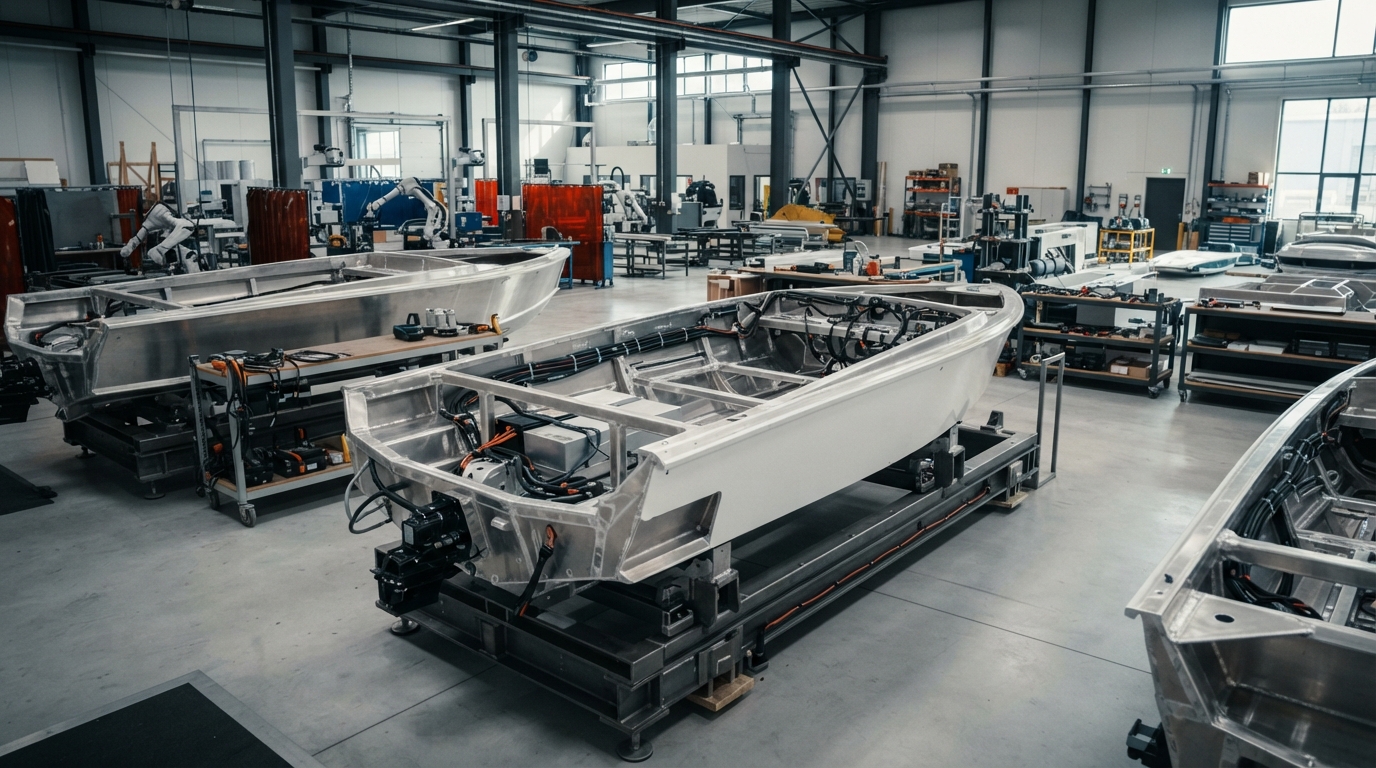
Professional electric designs integrate batteries into the hull architecture from the outset.
Lower-grade designs simply add batteries wherever space allows.
When comparing craft, look for:
- Centralised battery mass
- Low centre of gravity
- Symmetrical weight balance
- Structural reinforcement around battery zones
If battery placement looks like an afterthought, performance will be compromised — guaranteed.
Step Seven: Cooling Systems Are a Major Differentiator
Heat is the silent enemy of electric propulsion.
Motors, controllers, and batteries all generate heat under load. Poor cooling leads to:
- Automatic power throttling
- Reduced runtime
- Accelerated component wear
- Shortened battery lifespan
A proper comparison includes:
- Active vs passive cooling
- Water-assisted cooling channels
- Thermal isolation of battery packs
- Heat-sink integration
Craft designed for short recreational use may cope initially. Craft intended for professional, rescue, or extended recreational use require far more sophisticated thermal management.
Step Eight: Real-World Runtime — Not Marketing Runtime
Advertised runtime figures are often meaningless unless context is provided.
Always ask:
- At what speed was runtime measured?
- Under what load?
- In what water conditions?
- With what rider weight?
Electric watercraft should be compared using usable operating profiles, such as:
- Cruising runtime
- Mixed-use runtime
- High-load runtime
If a manufacturer only provides a single optimistic runtime number, assume best-case laboratory conditions — not Australian coastal reality.
Step Nine: Build Quality and Materials Still Matter
Electric propulsion does not eliminate traditional marine concerns.
Hull materials, fasteners, seals, wiring quality, and corrosion protection are still critical — arguably more so, given the sensitivity of electrical systems.
Compare:
- Marine-grade wiring standards
- Connector sealing
- Corrosion resistance
- Structural reinforcement
Professional electric craft are built from the inside out with longevity in mind. Consumer models often prioritise appearance over durability.
Step Ten: Manufacturer Transparency Is the Ultimate Indicator
Perhaps the most reliable comparison tool is not technical at all.
It is how openly the manufacturer or supplier explains their product.
Trustworthy suppliers will:
- Explain limitations honestly
- Provide real specifications, not just marketing terms
- Discuss maintenance expectations clearly
- Offer realistic performance scenarios
Suppliers who avoid detail, deflect questions, or rely heavily on buzzwords should be approached with caution.
Final Thoughts: Comparison Is a Discipline, Not a Shortcut
Electric watercraft reward informed buyers and punish rushed decisions.
A proper comparison is not about finding the fastest, cheapest, or most aggressively marketed option. It is about understanding how design choices translate into real-world ownership outcomes.
When electric watercraft are compared properly, the difference between professional-grade engineering and consumer-level compromise becomes unmistakably clear.
The electric era has arrived.
Those who learn how to compare properly will enjoy it.
Those who do not will pay for that lesson later.