
The Technology, Systems, and Design Principles Behind Modern Water Rescue
Remote control rescue devices represent one of the most important advances in water safety and emergency response in the past fifty years. Their purpose is simple in principle but sophisticated in execution: deliver immediate flotation and controlled assistance to a person in distress, without placing another human life at risk. To fully understand their value, it is essential to understand how they actually work—mechanically, electronically, and operationally—and why their design differs fundamentally from traditional rescue equipment.
This article explains remote control rescue devices from the ground up, stripping away marketing language and focusing on real-world function, reliability, and suitability for emergency use.
The Core Concept: Rescue Without Rescuer Entry
At the heart of every remote control rescue device is a single design philosophy: remove the rescuer from the water. Traditional rescues assume that help means physical presence—someone swimming, paddling, or piloting a craft to the victim. Remote control rescue devices break that assumption.
Instead, the rescuer remains on land, a structure, or a stable vessel, and the device itself becomes the physical interface with the victim. This immediately eliminates the most dangerous phase of water rescue: secondary exposure. The device carries flotation, propulsion, and control to the person in distress, not the rescuer.
This shift is not incremental. It is structural. It changes who can perform a rescue, where rescues can occur, and how quickly intervention can happen.
Primary Components of a Remote Control Rescue Device
Although designs vary, all effective remote control rescue devices share several core systems working together as a single platform.
At a high level, these systems include:
- A buoyant flotation body
- An electric propulsion system
- A sealed power supply
- A wireless remote-control interface
- A robust waterproof electronics system
- A human-centred rescue interface for the victim
Each of these elements must function reliably under stress, impact, immersion, and adverse environmental conditions.
Flotation Body: Stability Before Speed
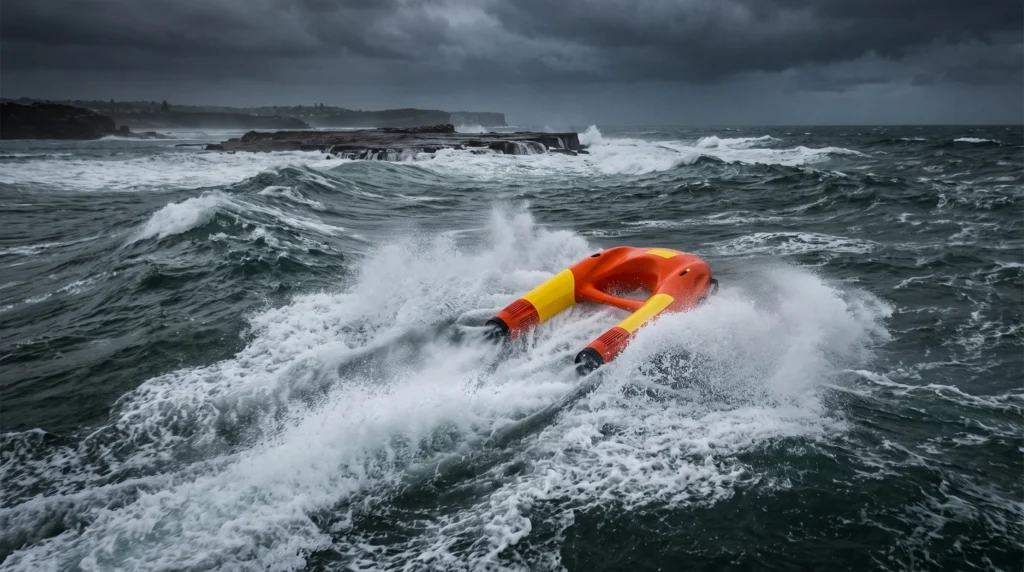
The flotation body is not simply a buoy; it is a carefully shaped rescue platform. Unlike recreational watercraft, remote rescue devices are designed first for stability, not agility.
Most designs use high-density polymer or reinforced composite shells filled with closed-cell buoyant material. This ensures positive buoyancy even if the outer shell is damaged. The shape is typically wide and flat, providing immediate stability when a victim makes contact.
This wide stance serves two purposes. First, it reduces the chance of rolling when a panicked person grabs the device. Second, it creates drag resistance that stabilises towing, preventing oscillation or yaw when the device pulls a person back to safety.
Importantly, flotation capacity is engineered to support not just average adults, but larger individuals, often while partially submerged and exhausted.
Electric Propulsion: Controlled Thrust, Not Raw Power
Remote control rescue devices rely on electric propulsion systems specifically tuned for water rescue. Unlike jet skis or boats, these motors are not designed for sustained high speed or manoeuvring performance. They are designed for predictable, linear thrust.
Most systems use twin-motor configurations. This provides redundancy—if one motor fails, the device remains functional—and allows differential thrust for steering without mechanical rudders. Differential thrust is particularly valuable in turbulent water where mechanical control surfaces can be ineffective or damaged.
The motors are typically brushless DC units, chosen for their efficiency, low maintenance requirements, and predictable torque delivery. Thrust levels are optimised to achieve rapid approach speeds while remaining safe for contact with a human body.
Crucially, propulsion is designed to operate effectively both unloaded and loaded. A rescue device must perform reliably when travelling empty to the victim and when towing a person who may be passive or unconscious.
Power Systems: Reliability Over Endurance
Battery systems are one of the most critical components in any rescue device. Unlike recreational products, rescue equipment cannot trade reliability for performance.
Most remote control rescue devices use lithium-based battery systems housed within pressure-resistant, waterproof enclosures. These enclosures are typically sealed using multiple barriers—gaskets, compression seals, and secondary internal containment—to ensure water cannot reach the cells.
Battery capacity is engineered to support multiple full-speed rescue runs, not extended cruising. This ensures consistent power delivery even as battery charge declines. Voltage management systems regulate output so that thrust remains predictable rather than fading unpredictably.
Importantly, modern rescue devices are designed with conservative operating margins. Batteries are rarely discharged to their theoretical limits, extending lifespan and reducing the risk of thermal or electrical failure.
Waterproofing and Pressure Management
Waterproofing in rescue devices is not the same as waterproofing in consumer electronics. Rescue equipment must survive:
- Full submersion
- Repeated wave impact
- Pressure fluctuations
- Thermal expansion and contraction
- Long-term exposure to saltwater
To achieve this, critical electronics are housed in sealed compartments that are isolated from both water and mechanical shock. Many designs use internal pressure equalisation systems that allow air expansion without permitting water ingress.
Connectors are minimised, and where they exist, they are typically internal rather than external. External charging ports, if present, are sealed behind mechanical barriers and gasketed covers.
This level of sealing ensures the device remains operational after months or years of standby deployment in harsh environments.
Remote Control Interface: Human Factors Matter
The remote control system is not a toy controller. It is a critical safety interface that must function reliably under stress, panic, and poor visibility.
Most remote rescue devices use simple, intuitive control layouts. Forward thrust, steering, and emergency stop functions are deliberately obvious. Fine control is prioritised over speed or complexity.
Wireless communication typically operates on dedicated frequencies optimised for line-of-sight reliability rather than bandwidth. Range is designed to exceed the maximum expected rescue distance, ensuring the operator never loses control mid-rescue.
Fail-safe behaviours are built into the system. If signal is lost, the device may default to neutral thrust or return slowly to a predefined state, rather than continuing uncontrolled movement.
Victim Interaction: Designed for Panic, Not Cooperation
A defining feature of effective rescue devices is their ability to assist people who are panicked, fatigued, or unconscious. This shapes every aspect of their design.
Handholds are large, textured, and positioned to be instinctively grasped. Surfaces are designed to avoid sharp edges or snag points. Buoyancy distribution ensures the device does not flip when weight is applied unevenly.
In many cases, the device can support a victim without requiring them to actively hold on. This is critical for near-drowning scenarios where strength or consciousness may be compromised.
The goal is not elegance, but inevitability: once the device reaches the person, survival becomes far more likely regardless of the victim’s state.
Deployment Process: Speed and Simplicity
One of the greatest strengths of remote control rescue devices is deployment speed. Unlike boats or craft that require launching procedures, these devices are typically deployed by simply placing them in the water.
From the moment an incident is identified, a trained operator—or even a trained member of the public—can have the device moving toward the victim within seconds.
This rapid response is essential. Drowning is not a prolonged struggle; it is often silent and brief. The ability to intervene immediately is the difference between rescue and recovery.
Operational Scenarios: Where They Excel
Remote control rescue devices are particularly effective in scenarios where traditional rescue methods are slow or dangerous:
- Unpatrolled beaches
- Rock platforms
- Flooded rivers
- Harbours and marinas
- Inland lakes and dams
- After-hours incidents
In these environments, the device acts as a first-response stabilisation tool. It buys time, reduces panic, and allows emergency services to arrive with a living patient rather than a fatality.
Integration with Emergency Response Protocols
Modern rescue devices are increasingly deployed as part of layered safety systems. They complement, rather than replace, professional responders.
While the device provides immediate flotation and retrieval, emergency services can be activated simultaneously. This parallel response model dramatically improves outcomes.
Some installations integrate visual identification, signage, and training protocols to ensure that bystanders know how and when to deploy the device.
Reliability Through Simplicity
One of the most overlooked aspects of remote rescue device design is intentional simplicity. Every additional feature is a potential failure point.
Successful rescue devices avoid unnecessary complexity. They do not attempt to be multi-purpose recreational products. Every component exists for a single reason: get flotation to a person in trouble and bring them back safely.
This focus is what allows them to operate reliably in the real world, not just in demonstrations.
Why They Are Not “Just a Remote Boat”
It is a mistake to think of these devices as small boats or toys with remotes. They are purpose-built safety tools governed by a different design logic.
They are built to be grabbed, abused, slammed by waves, and used by people under extreme stress. Their success is measured not by speed or appearance, but by whether they work when everything else has failed.
The Future of Remote Rescue Systems
As technology evolves, remote rescue devices will continue to improve. Battery energy density, motor efficiency, and electronics sealing will advance.
However, the core principles will remain unchanged.
Immediate deployment. No rescuer exposure. Predictable performance. Human-centred design.
These principles are now well established, and they represent the foundation of modern water rescue strategy.