
Introduction: When a Yacht Becomes a Statement of Intent
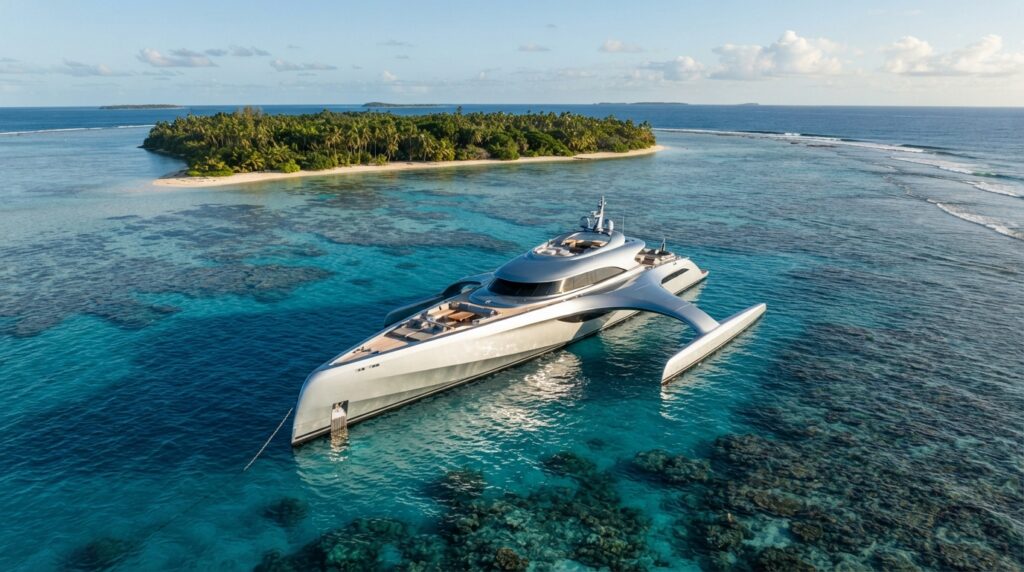
The Adastra trimaran is not simply a luxury yacht, nor is it merely an exercise in unconventional styling. It is a deliberate rejection of traditional monohull thinking, executed at the highest level of engineering, materials science, and design ambition. Conceived and built as a one-off superyacht, Adastra demonstrates what becomes possible when efficiency, stability, and performance are prioritised over convention.
At first glance, Adastra’s sleek, aircraft-like form appears almost futuristic. Yet beneath the dramatic exterior lies a deeply rational concept: a long-range, highly efficient ocean-capable yacht that uses trimaran architecture to achieve capabilities that conventional yachts struggle to match.
As an experimental and emerging watercraft, Adastra occupies a unique position. It is not a prototype, nor a mass-produced design. Instead, it is a proof of philosophy—showing what can be achieved when naval architecture is freed from tradition.
Origins of the Adastra Project
Adastra was commissioned by a private owner with a clear brief: create a yacht capable of long-distance cruising with exceptional efficiency, stability, and performance, while remaining unmistakably unique.
The project was led by John Shuttleworth, a British designer renowned for high-performance multihull yachts. Shuttleworth’s background in racing and fast cruising trimarans heavily influenced Adastra’s DNA. Rather than adapting a monohull for efficiency, the design began with the assumption that three hulls are fundamentally superior for certain missions.
Construction was undertaken by McConaghy Boats, a builder known for precision composite construction and performance-oriented vessels.
Why a Trimaran?
The decision to use a trimaran configuration was not aesthetic—it was functional.
Trimarans offer several inherent advantages over monohulls:
- Significantly reduced hydrodynamic drag
- Exceptional transverse stability
- Reduced rolling motion
- Increased efficiency at cruising speeds
- Ability to achieve higher speeds with lower power
Adastra’s central hull is long and slender, minimising wave-making resistance, while the two outer amas provide stability and load-carrying capacity without adding excessive drag.
This configuration allows Adastra to cruise efficiently at speeds that would require far more fuel in a conventional yacht.
Hull Geometry and Hydrodynamic Efficiency
Adastra’s hulls are shaped with extreme attention to hydrodynamic optimisation. Unlike bluff-bodied luxury yachts, the hulls are narrow, elongated, and carefully contoured to minimise resistance across a wide range of speeds.
Key design principles include:
- Fine bow entries to reduce wave impact
- Slender hull sections to reduce displacement drag
- Optimised hull spacing to minimise interference drag
The result is a yacht that moves through water with remarkable ease, particularly at cruising speeds where efficiency matters most.
Structural Engineering and Materials
Adastra is constructed almost entirely from advanced carbon-fibre composites, reflecting its performance-driven design brief.
Carbon fibre offers:
- Exceptional strength-to-weight ratio
- High stiffness, reducing flex and fatigue
- Long-term durability
The extensive use of composites allows Adastra to remain lightweight despite its size, directly contributing to its efficiency and speed.
Structural loads are distributed across the trimaran platform, reducing stress concentrations and improving overall longevity.
Propulsion Philosophy: Efficiency Before Excess
Rather than relying on massive engine power, Adastra employs a moderate but highly efficient propulsion system.
This approach delivers several advantages:
- Lower fuel consumption
- Extended cruising range
- Reduced mechanical stress
- Quieter operation
Adastra is capable of cruising at impressive speeds for its fuel burn, making it particularly suited to long-distance passages and extended voyages.
Range and Autonomy
One of Adastra’s most impressive attributes is its long-range capability.
Thanks to its efficient hull form and moderate propulsion demands, Adastra can travel thousands of nautical miles without refuelling. This autonomy transforms how the yacht can be used, enabling:
- Transoceanic crossings
- Remote cruising without fuel anxiety
- Reduced reliance on marinas and infrastructure
In an era where fuel availability and cost are increasingly relevant, this efficiency is more than a luxury—it is a strategic advantage.
Stability and Comfort at Sea
The trimaran platform delivers exceptional stability, both underway and at anchor.
Compared to monohulls:
- Rolling motion is dramatically reduced
- Pitching is more controlled
- Passenger comfort is significantly improved
This stability is particularly valuable on long passages, where motion fatigue can severely affect crew and guests.
Interior Design: Space Without Bulk
Despite its slender hulls, Adastra offers a surprisingly spacious interior. The wide beam created by the trimaran configuration allows for:
- Panoramic views
- Open-plan living spaces
- Seamless indoor-outdoor flow
The interior design is deliberately minimalist and modern, reflecting the yacht’s technical ethos rather than traditional luxury excess.
Advanced Systems and Control
Adastra incorporates advanced navigation, control, and monitoring systems, allowing the yacht to be operated efficiently with a relatively small crew.
Systems integration focuses on:
- Reliability
- Redundancy
- Ease of operation
The yacht’s design philosophy favours intelligent operation over brute force, aligning with its efficiency-first approach.
Remote and Autonomous Capability
One of Adastra’s more widely discussed features is its ability to be operated remotely over long distances. While not autonomous in the modern sense, this capability demonstrates the yacht’s advanced control architecture and systems integration.
It also hints at a future where large vessels may increasingly rely on remote monitoring and control.
Environmental Considerations
While Adastra is undeniably a luxury vessel, its efficiency represents a meaningful step toward more responsible yacht design.
Benefits include:
- Lower emissions per nautical mile
- Reduced fuel consumption
- Smaller environmental footprint compared to similarly sized monohulls
In this sense, Adastra foreshadows a future where sustainability and luxury are not mutually exclusive.
Market Position and Uniqueness
Adastra is a one-off yacht, and its value lies precisely in that uniqueness. It was never intended to define a mass-market category. Instead, it serves as:
- A design benchmark
- A technical demonstration
- A challenge to conventional yacht norms
For naval architects and yacht designers, Adastra is a case study in what becomes possible when efficiency leads design.
Why Adastra Is an Emerging Watercraft
Adastra belongs firmly in emerging watercraft and experimental concepts because it demonstrates:
- Non-traditional hull architecture at superyacht scale
- Radical efficiency compared to conventional yachts
- Advanced materials and systems integration
- A fundamentally different approach to luxury at sea
It does not refine the monohull paradigm—it bypasses it.
Influence on Future Yacht Design
While few owners may commission trimaran superyachts of this scale, Adastra’s influence is already visible in:
- Expedition yachts
- Performance cruising multihulls
- Hybrid and low-emission vessel design
As efficiency and sustainability become more important, the lessons embodied in Adastra are likely to grow in relevance.
Conclusion
The Adastra trimaran is not just a yacht—it is an argument.
It argues that tradition should not dictate design, that efficiency can coexist with luxury, and that the future of watercraft may look very different from the past. By embracing trimaran architecture, advanced composites, and efficiency-first thinking, Adastra stands as one of the most compelling experimental watercraft ever built.
In the context of emerging watercraft, Adastra is not a curiosity—it is a blueprint.
WWW,VECTORWATERCRAFT.COM.AU