
For most of modern marine history, progress in watercraft performance has been constrained as much by materials as by propulsion. Hull shapes evolved incrementally, weight reductions were marginal, corrosion remained an accepted cost of ownership, and durability often came at the expense of efficiency.
That balance is now being rewritten.
A new generation of materials—many borrowed from aerospace, automotive engineering, renewable energy, and advanced manufacturing—is fundamentally changing how watercraft are designed, built, and used. These materials are not simply lighter or stronger. They alter structural behaviour, thermal performance, durability, sustainability, and even how watercraft interact with digital systems.
In the context of electric and next-generation water sports craft, emerging materials are not a supporting actor. They are a primary driver of what becomes possible.
Why materials matter more than ever
In petrol-powered craft, excess weight could often be compensated for with more power. Structural inefficiencies were masked by engine output. Corrosion, vibration, and fatigue were tolerated as part of ownership.
Electric watercraft do not have that luxury.
Every kilogram affects range, acceleration, handling, and battery load. Structural inefficiencies translate directly into reduced endurance or increased cost. Materials are no longer a background consideration; they are a defining factor in system performance.
As electrification pushes designers to extract maximum efficiency from every component, materials science has moved from incremental improvement to central importance.
The decline of traditional marine materials
Traditional marine construction relied heavily on fibreglass, aluminium, steel, and timber. Each served its purpose well in a particular era, but each carries limitations that are increasingly exposed.
Fibreglass is versatile and relatively inexpensive, but it is heavy for its strength, prone to fatigue over time, and difficult to recycle. Aluminium offers corrosion resistance and strength, but suffers from fatigue issues and requires careful isolation to prevent galvanic corrosion. Steel is strong but heavy and maintenance-intensive. Timber is beautiful but inconsistent, labour-intensive, and vulnerable to long-term degradation.
None of these materials are disappearing entirely, but none can meet the full demands of next-generation electric and modular watercraft on their own.
Advanced composites reshape hull design
One of the most significant shifts in marine engineering is the adoption of advanced composite materials beyond traditional fibreglass.
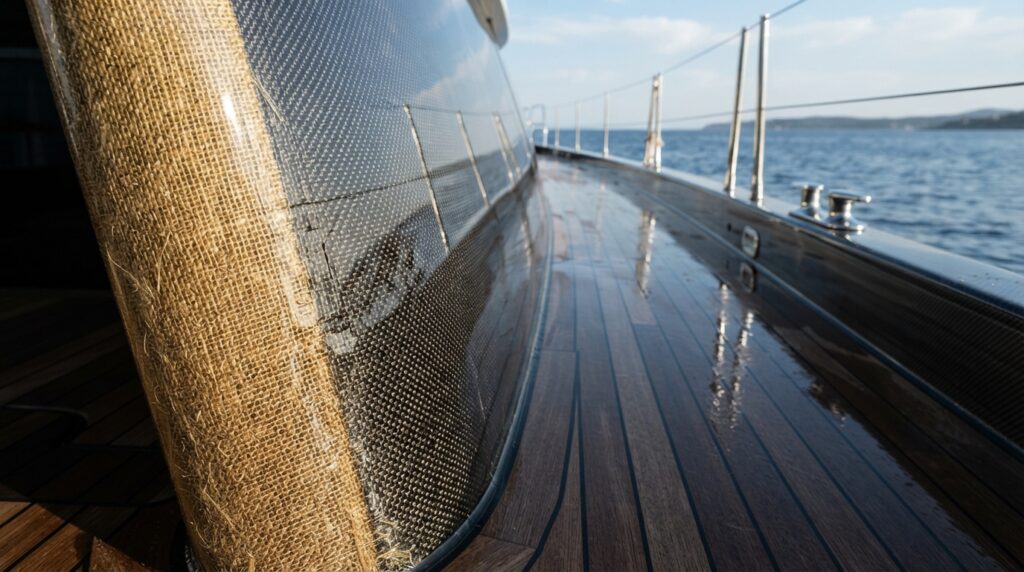
Carbon fibre, basalt fibre, aramid fibres, and hybrid composite laminates are increasingly used where performance, stiffness, and weight reduction are critical.
These materials allow engineers to place strength precisely where it is needed rather than uniformly across a structure. Load paths can be engineered with far greater precision, reducing unnecessary mass while improving rigidity.
For watercraft, this translates to:
- Lighter hulls with improved stiffness
- Reduced flex under dynamic loads
- Improved efficiency at lower power levels
- Greater control predictability
In electric craft, where torque delivery is immediate and continuous, this structural precision is particularly valuable.
Thermoplastics and recyclable composites
Sustainability pressures are accelerating the development of recyclable marine materials.
Traditional thermoset composites, once cured, cannot be reprocessed. This has long been a problem for end-of-life vessels.
New thermoplastic composites address this limitation. They offer comparable strength and stiffness to thermosets but can be reheated, reshaped, and recycled. Manufacturing cycles are faster, repairability is improved, and lifecycle environmental impact is reduced.
For water sports craft, especially those expected to evolve over time through modular upgrades, recyclable composites support a longer, more adaptable lifecycle.
High-density polymers and engineered plastics
High-density polyethylene (HDPE), reinforced polymers, and engineered plastics are increasingly used in hulls, flotation systems, and structural components.
These materials offer exceptional impact resistance, corrosion immunity, and low maintenance requirements. They are particularly well suited to rescue craft, training platforms, and utility watercraft where durability and abuse tolerance are critical.
Unlike traditional materials, engineered polymers can absorb impacts without cracking, making them safer in collision-prone environments. They also perform consistently across temperature ranges and require minimal surface protection.
As manufacturing techniques improve, these materials are moving beyond utilitarian applications into more refined, performance-oriented designs.
Foam cores and sandwich construction
One of the most important structural innovations in marine engineering is advanced sandwich construction.
By combining strong outer skins with lightweight foam or honeycomb cores, engineers achieve exceptional stiffness-to-weight ratios. This approach dramatically reduces mass while maintaining structural integrity.
Modern foam cores are closed-cell, water-resistant, and engineered for specific load profiles. They contribute not only to stiffness but also to buoyancy and vibration damping.
In electric watercraft, sandwich construction improves efficiency, reduces noise transmission, and enhances ride quality—factors increasingly valued by both recreational and professional users.
Corrosion-resistant alloys and coatings
Emerging materials are not limited to structural components. Advances in alloys and surface treatments are transforming longevity and reliability.
Marine-grade aluminium alloys with improved fatigue resistance, stainless steels engineered for saltwater environments, and advanced anti-corrosion coatings reduce maintenance burdens significantly.
Nanocoatings, ceramic treatments, and advanced anodising processes protect components without adding significant weight. These technologies extend service life and improve reliability, particularly in electrically powered craft where moisture ingress and corrosion can compromise electronic systems.
Durability is no longer achieved through overengineering alone. It is achieved through intelligent material selection and protection.
Materials designed for electrification
Electric watercraft impose unique material requirements that traditional marine engineering never faced.
Battery enclosures must manage heat, resist impact, and provide structural contribution. Motor mounts must handle high torque loads without transmitting vibration. Enclosures must provide electromagnetic shielding while remaining lightweight.
Emerging materials such as thermally conductive composites, electrically insulating polymers, and multi-functional laminates address these needs directly.
Materials are increasingly selected not for a single property, but for their ability to perform multiple roles simultaneously—structural, thermal, electrical, and protective.
Noise, vibration, and comfort materials
As watercraft become quieter through electrification, previously masked sources of noise and vibration become more noticeable.
This has driven the adoption of materials designed to damp vibration and absorb sound without adding mass. Elastomeric layers, composite damping structures, and tuned foams improve ride comfort and perceived quality.
In premium and professional craft, these materials contribute to reduced fatigue, improved control, and a more refined user experience.
Quiet craft demand refined materials.
Sustainability as a design constraint
Environmental considerations are no longer optional in marine engineering.
Regulators, buyers, and operators increasingly demand reduced environmental impact across the entire lifecycle of a craft—from material sourcing to end-of-life disposal.
Emerging materials support this shift through recyclability, reduced toxic content, longer service life, and lower maintenance requirements.
Lightweight materials reduce energy consumption. Durable materials reduce replacement frequency. Recyclable materials reduce waste.
Sustainability is becoming an engineering parameter rather than a marketing claim.
Manufacturing techniques evolve with materials
New materials would be meaningless without compatible manufacturing processes.
Advanced CNC machining, robotic layup, resin infusion, compression moulding, and additive manufacturing allow precise control over material placement and quality.
These techniques reduce waste, improve consistency, and support modular design. Components can be produced to tight tolerances and assembled efficiently, enabling scalable personalisation without compromising reliability.
Manufacturing is no longer about forcing materials into shape. It is about designing materials and processes together.
Repairability and modular replacement
One of the hidden advantages of emerging materials is improved repairability.
Modular composite panels, replaceable polymer components, and bonded structures designed for disassembly allow targeted repair rather than wholesale replacement.
For electric and modular watercraft platforms, this is critical. A damaged section does not require scrapping an entire hull. It can be replaced or repaired without compromising structural integrity.
This approach aligns with professional and institutional requirements for predictable maintenance and long service life.
How materials influence safety
Safety outcomes are directly influenced by material choice.
Impact-resistant polymers reduce injury risk in collisions. Energy-absorbing structures manage loads during groundings or surf impacts. Fire-resistant composites protect battery systems. Non-corrosive materials maintain structural integrity over time.
Emerging materials allow safety to be engineered proactively rather than reactively.
A lighter, stronger, more predictable structure is inherently safer than a heavier, fatigued one.
The gap between legacy and future craft
The divergence between legacy watercraft and next-generation platforms is increasingly defined by materials.
Older designs rely on mass and mechanical robustness. New designs rely on efficiency, precision, and adaptability.
This gap will widen as materials science continues to advance. Craft built around outdated material assumptions will struggle to compete on performance, safety, and lifecycle cost.
Materials are becoming a competitive differentiator, not a commodity.
Implications for manufacturers and buyers
For manufacturers, mastery of emerging materials is no longer optional. It requires investment in engineering capability, supplier relationships, and manufacturing infrastructure.
For buyers, material transparency becomes increasingly important. Understanding how a craft is built, not just how it looks, will define informed purchasing decisions.
Premium value will increasingly be judged by structural intelligence rather than cosmetic finish.
The long-term outlook
Marine engineering is entering a materials-led era.
As electrification, modularity, and digital control systems redefine what watercraft can do, emerging materials determine how well they can do it—and for how long.
The future of water sports technology will not be shaped by propulsion alone. It will be shaped by the materials that support, protect, and enhance every system on board.
Lightweight, durable, adaptable, and sustainable materials are not a trend. They are the foundation of the next generation of watercraft.
See More at www.vectorwatercraft.com.au