
How riders actually learn, why progress feels different, and what determines long-term success
Introduction: Why “Easy” and “Hard” Are the Wrong Questions
When people ask whether jet surfboards or foil boards are “easier to learn,” they are usually asking the wrong question. Learning any powered watercraft is not a single hurdle; it is a sequence of adaptation stages involving balance, perception, muscle memory, confidence, and risk tolerance.
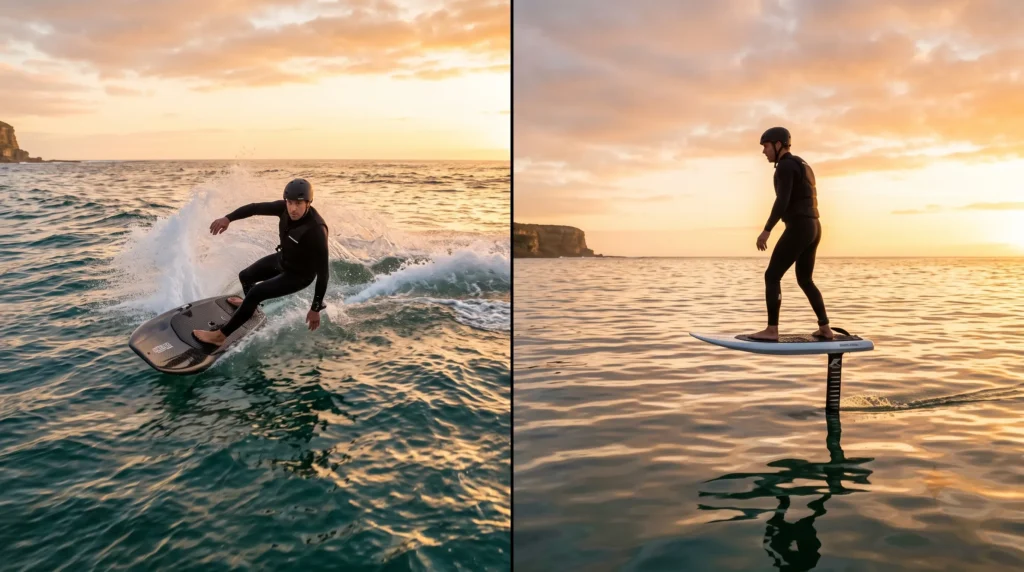
Jet surfboards and foil boards do not simply differ in difficulty. They differ in how the human nervous system learns to control them. Each platform engages the rider’s body and brain in a fundamentally different way. Understanding this distinction explains why some riders plateau quickly on one craft yet thrive on the other.
This article breaks learning down into clear, real-world stages, showing what riders actually experience from their first session through to confident, repeatable riding.
Learning Is a System, Not a Moment
No rider “learns” a board in one day. What actually happens is a progression through four phases:
- Orientation
- Control Acquisition
- Stability Integration
- Unconscious Competence
Jet surfboards and foil boards move riders through these phases at very different speeds and in different orders.
Phase One: Orientation — Getting the Body to Cooperate
Jet Surfboards: Familiar Reference Points
In the orientation phase, riders are simply trying to:
- Stay on the board
- Understand throttle response
- Orient themselves spatially
Jet surfboards benefit from familiar movement patterns. Riders already understand:
- Forward motion
- Surface contact
- Directional steering
Even riders with no board sports background can quickly map:
- Throttle = go
- Lean = turn
- Speed = stability
The body accepts the experience quickly because it resembles bicycles, jet skis, or even skateboards.
Foil Boards: Sensory Mismatch
Foil boards challenge the brain immediately. Orientation is harder because:
- The board behaves differently at different speeds
- Balance is not anchored to the water surface
- Visual feedback does not match expected motion
New riders often report:
- Feeling “behind” the board
- Overreacting to small movements
- Losing spatial reference once lift begins
This is not weakness or lack of talent — it is the nervous system recalibrating to three-dimensional balance control.
Phase Two: Control Acquisition — Throttle vs Balance Authority
Jet Surfboards: Control Through Inputs
On a jet surfboard, riders learn control primarily through:
- Throttle modulation
- Steering inputs
- Speed adjustment
Balance matters, but it is secondary to propulsion control. Riders can:
- Correct mistakes with throttle
- Slow down to regain control
- Sit or kneel when overwhelmed
This allows learning to proceed in manageable increments.
Foil Boards: Control Through Body Position
On a foil board, control comes primarily from:
- Weight placement
- Pitch awareness
- Micro-adjustments in stance
Throttle plays a supporting role rather than a dominant one. Riders must learn:
- How much lift is being generated
- How body movement affects foil angle
- When to resist the instinct to correct aggressively
This makes early learning mentally demanding, even when speeds are low.
Phase Three: Stability Integration — Where Most People Plateau
This is where the difference becomes stark.
Jet Surfboards: Stability Arrives Early
For jet surfboards, stability improves rapidly once riders:
- Reach planing speed
- Maintain consistent throttle
- Relax their stance
Many riders feel “comfortable” within:
- One to three sessions
- Sometimes the first outing
However, this early comfort can mask a limitation: progress slows once basic riding is achieved. Further improvement tends to be incremental rather than transformative.
Foil Boards: Stability Arrives Late — Then Accelerates
Foil boards often feel unstable for longer. Riders may:
- Spend multiple sessions falling repeatedly
- Feel inconsistent from ride to ride
- Question whether they are improving at all
Then something changes.
Once balance integration occurs:
- Corrections become subconscious
- The rider stops “thinking” about the foil
- Endurance increases dramatically
Progress after this point is rapid and deeply satisfying. Riders often leap from frustration to fluency within a short window.
Psychological Load: Why Mental Fatigue Differs
Jet Surfboards: Low Cognitive Load
Jet surfboards demand less continuous mental processing. Riders can:
- Relax once moving
- Focus on surroundings
- Enjoy the ride without constant adjustment
This makes them ideal for:
- Social riding
- Casual sessions
- Environments with distractions
Foil Boards: High Initial Cognitive Load
Foil riding initially consumes attention. Riders must:
- Monitor pitch continuously
- Anticipate lift changes
- Suppress instinctive corrections
This mental load is tiring at first but decreases sharply once unconscious competence develops.
Physical Demands: Different Muscles, Different Fatigue
Jet Surfboards
Physical strain is concentrated in:
- Legs for shock absorption
- Arms for steering input
- Core during acceleration
Fatigue comes from:
- Bracing against chop
- Repeated acceleration
- High-speed vibration
Foil Boards
Foil boards engage:
- Deep stabilising muscles
- Ankles and hips
- Core balance systems
Fatigue comes from:
- Continuous micro-adjustments
- Maintaining posture
- Fine motor control rather than impact
This is why many foil riders describe sessions as quietly exhausting rather than physically punishing.
The Role of Speed in Learning
Jet Surfboards: Speed Helps Learning
On jet surfboards:
- Low speeds feel unstable
- Moderate speed increases predictability
- Speed acts as a stabiliser
Beginners often progress faster once they stop being overly cautious.
Foil Boards: Speed Punishes Mistakes
On foil boards:
- Speed amplifies lift
- Errors scale quickly
- Confidence must precede acceleration
Learning requires patience and controlled progression rather than “pushing through”.
Environmental Influence on Learning
Jet Surfboards
Learning can occur in:
- Chop
- Rivers
- Windy conditions
- Variable water states
Environmental tolerance reduces dependency on perfect conditions.
Foil Boards
Learning benefits from:
- Flat water
- Consistent depth
- Minimal wind
- Clear visual reference
Poor conditions dramatically slow early learning.
Instruction vs Self-Discovery
Jet Surfboards
Many riders self-teach successfully because:
- Feedback is immediate
- Mistakes are intuitive
- Corrections are obvious
Instruction helps but is not essential.
Foil Boards
Instruction significantly shortens learning time. Small guidance cues can:
- Prevent bad habits
- Reduce frustration
- Improve safety
Foil learning is sensitive to early technique.
Long-Term Skill Ceiling
Jet Surfboards
Skill ceiling is defined by:
- Power
- Hull behaviour
- Rider tolerance
Advanced riding exists, but progression flattens earlier.
Foil Boards
Skill ceiling is high and layered:
- Efficiency refinement
- Control in varied conditions
- Endurance riding
- Precision manoeuvring
Progress can continue for years.
Why Some Riders Quit — And Others Don’t
Jet surfboard riders tend to quit because:
- Novelty wears off
- Sessions feel repetitive
- Physical strain accumulates
Foil board riders tend to quit because:
- Early frustration overwhelms
- Learning takes longer than expected
Those who persist with foiling often become long-term advocates.
Matching Personality to Platform
Jet surfboards suit riders who:
- Want quick results
- Prefer intuitive control
- Enjoy bursts of excitement
Foil boards suit riders who:
- Enjoy mastery
- Value efficiency
- Appreciate subtle control
Neither is superior — they reward different mindsets.
Learning Timeframes (Realistic Expectations)
- Jet surfboard standing competence: 30 minutes to 1 session
- Jet surfboard confidence: 1–3 sessions
- Foil board first controlled flight: 2–5 sessions
- Foil board confidence: 5–10 sessions
These are averages, not guarantees.
The Honest Takeaway
Jet surfboards teach riders how to use power effectively. Foil boards teach riders how to move efficiently through water.
- One rewards immediate engagement.
- The other rewards persistence and patience.
Understanding this difference prevents poor purchase decisions and mismatched expectations.
More about electric surfboards and foil boards on www.velocitywatercraft.com.au