
Why Simplicity, Standardisation, and Human Factors Matter More Than Heroics
As water rescue technology has evolved, so too has the philosophy surrounding training. Traditional rescue methods demanded extensive physical conditioning, technical skill, and repeated drills under harsh conditions. Modern rescue devices—particularly public access and remote-operated systems—have deliberately shifted the training burden away from strength and endurance toward recognition, decision-making, and correct deployment.
This article explains what training is actually required for modern rescue devices, why less can often be more, and how well-designed systems allow communities to respond effectively without creating new risks.
The Historical Training Model: Skill-Heavy and Exclusive
For much of history, effective water rescue was inseparable from intensive training. Lifesavers, rescue swimmers, and emergency responders were required to master:
- Surf swimming and endurance
- Victim approach and control techniques
- Equipment handling under load
- Environmental assessment under pressure
This training was—and remains—essential for professional responders. However, it also created a reality where only a small, highly trained group could safely intervene. Everyone else was expected to stand back, call for help, or attempt a rescue at their own peril.
Modern rescue technology challenges this model by asking a different question:
What training is required to stabilise a situation safely until professionals arrive?
The Shift in Training Philosophy
Modern rescue devices are designed around a fundamental assumption: the first person on scene is rarely a professional rescuer.
That person might be:
- A passer-by
- A council worker
- A fisherman
- A family member
- A bystander with no rescue background
Training requirements must reflect this reality. If a device demands extensive instruction, certification, or physical capability, it will not be used in time—or at all.
The goal of modern training is not mastery. It is competence under stress.
What “Training” Really Means in Modern Rescue Contexts
Training for modern rescue devices focuses on three core outcomes:
- Early recognition of distress
- Correct decision to deploy
- Safe, effective operation
This is a much narrower and more achievable scope than traditional rescue training.
Importantly, it recognises that technology performs the physically dangerous tasks, not the operator.
Recognition: The First and Most Important Skill
No rescue device, no matter how advanced, helps if it is deployed too late.
Training therefore begins with recognition:
- Understanding what real drowning looks like
- Recognising silent distress rather than dramatic splashing
- Identifying environmental hazards that escalate risk
This knowledge is universal and transferable. It does not require physical training, only awareness.
Many modern training programmes emphasise short, visual recognition modules rather than lengthy theoretical instruction. The aim is to remove hesitation at the moment of decision.
Decision-Making Under Stress
One of the greatest barriers to early intervention is uncertainty. People hesitate because they are unsure whether they should act.
Modern rescue training addresses this directly by:
- Defining clear deployment triggers
- Removing subjective judgement where possible
- Reinforcing “deploy first, reassess later” logic
If a device is safe to deploy and cannot worsen the situation, the correct decision becomes obvious.
This mirrors other public safety domains. Automated defibrillators are deployed based on simple cues, not medical diagnosis. Rescue technology follows the same principle.
Device Operation: Designed to Minimise Training Load
Modern rescue devices are engineered so that correct operation is:
- Intuitive
- Obvious
- Hard to misuse
Training therefore focuses on familiarisation, not skill acquisition.
Typical operational training includes:
- How to access the device
- How to activate it
- Basic directional control (if applicable)
- When to stop or retrieve
Controls are deliberately limited. There are no complex modes, sequences, or adjustments. This is intentional.
If a device requires explanation, it is already too complex.
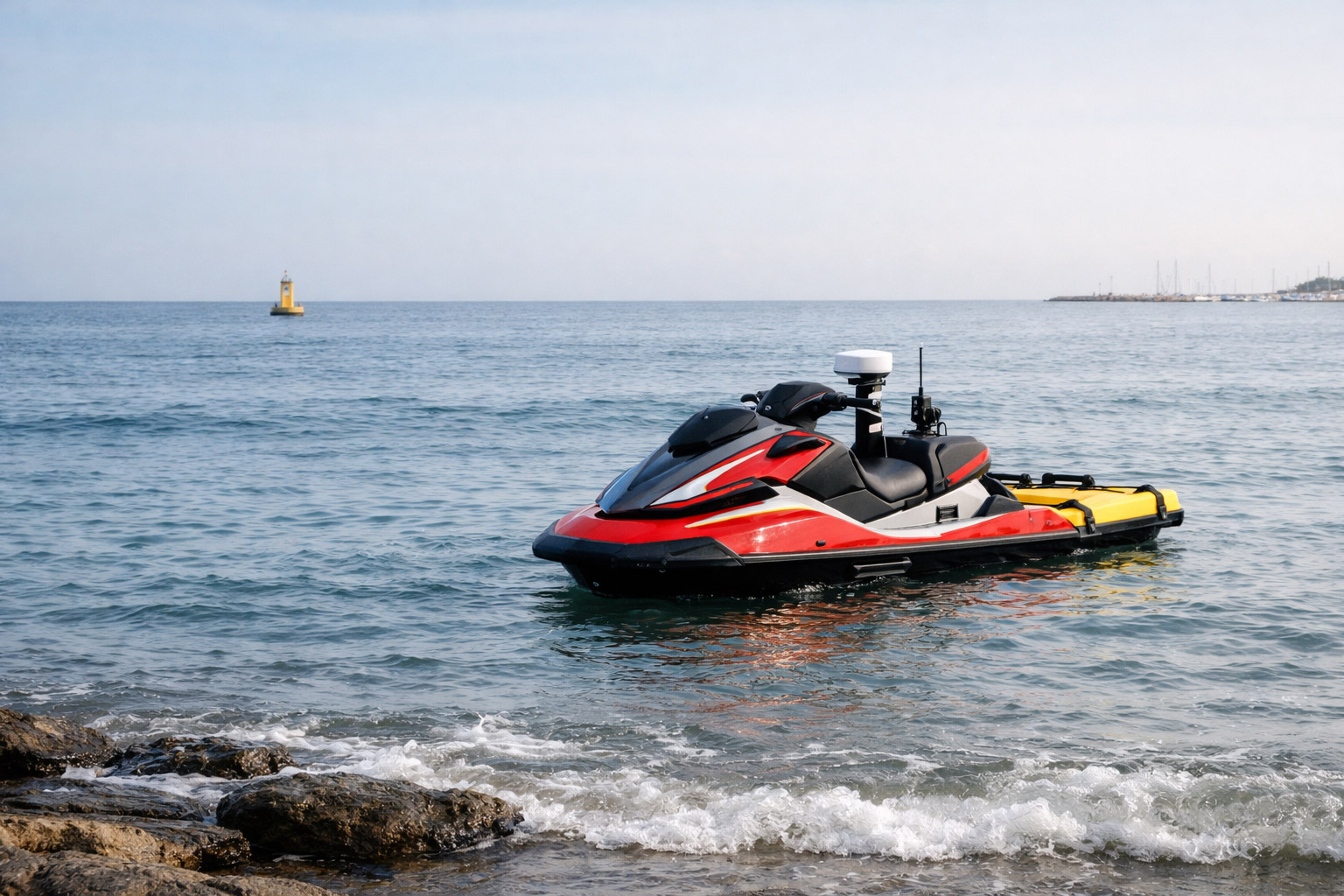
Remote Control Rescue Devices: Training in Practice
Remote-operated rescue devices are a useful case study in training optimisation.
Their training requirements are intentionally modest:
- Basic orientation to controls
- Understanding safe operating distances
- Awareness of line-of-sight requirements
- Familiarity with retrieval procedures
Most people can learn effective operation in minutes, not hours. This is not accidental—it is the result of extensive human-factors design.
The device does the hard work. The operator simply directs it.
Why Over-Training Can Be Counterproductive
It is tempting to believe that more training always leads to better outcomes. In public access rescue contexts, the opposite is often true.
Over-training can:
- Create hesitation (“Am Am I qualified to do this?”)
- Discourage bystander intervention
- Delay deployment while people search for trained staff
Modern rescue systems are designed so that permission to act is implicit. Training reinforces this, rather than restricting action to credentialed users.
The safest outcome is often achieved when the nearest capable person intervenes immediately, using a safe tool.
Training for Councils, Organisations, and Staff
While public users benefit from simplicity, organisations responsible for rescue equipment still require structured training programmes.
For councils and asset managers, training typically covers:
- Device overview and purpose
- Deployment scenarios
- Routine inspection procedures
- Battery and readiness checks
- Incident reporting protocols
This training ensures organisational confidence and accountability, without imposing unrealistic demands on staff.
Importantly, it separates maintenance responsibility from rescue authority. Staff are not required to be rescuers to support rescue infrastructure.
Professional Responders: Complementary, Not Redundant
Modern rescue devices do not eliminate the need for professional training. Instead, they change how professionals engage.
For trained responders, device training focuses on:
- Integration with existing rescue protocols
- Handover from public intervention to professional care
- Multiple-device coordination if available
- Post-rescue recovery and assessment
Professionals benefit because early stabilisation improves patient condition on arrival.
This is not a dilution of professional standards. It is an enhancement of overall system performance.
Training Frequency and Retention
Another advantage of modern rescue technology is low training decay. Traditional physical rescue skills degrade quickly without regular practice. Modern device operation, by contrast, is cognitively simple and retained far longer.
Short refresher sessions, visual reminders, and signage are often sufficient to maintain readiness.
This is critical for councils and organisations with high staff turnover or limited training budgets.
Signage as Passive Training
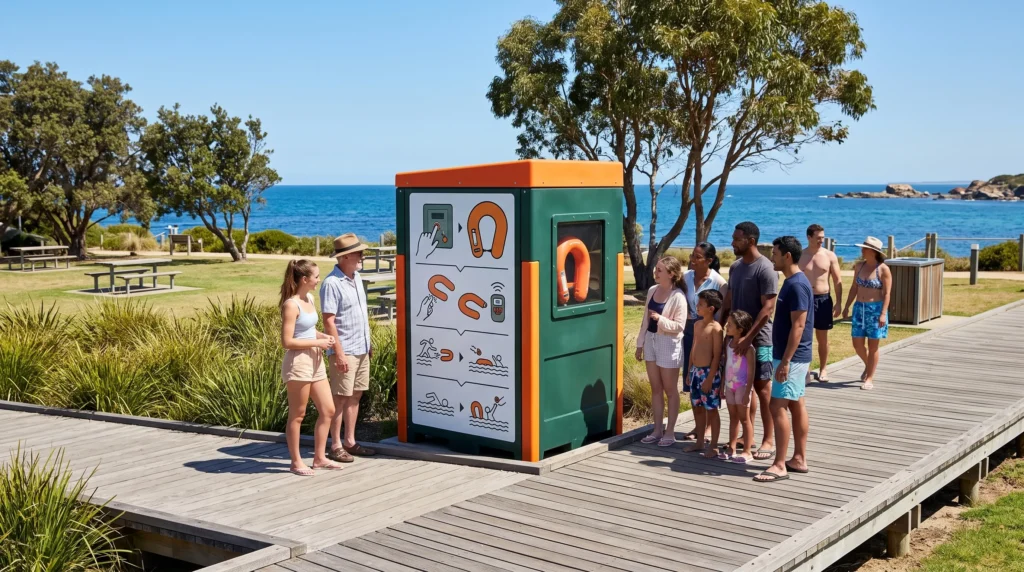
Effective rescue systems treat signage as part of the training ecosystem.
Well-designed signage:
- Reinforces recognition cues
- Demonstrates basic operation visually
- Reduces reliance on memory
This allows even untrained users to act correctly in the moment.
The objective is not to educate comprehensively, but to prompt correct action instantly.
Community Training and Awareness Sessions
Some jurisdictions supplement public access rescue installations with brief community awareness sessions.
These sessions typically:
- Explain why the equipment is installed
- Demonstrate basic deployment
- Reinforce that anyone may use it
Even minimal exposure significantly increases likelihood of correct use.
Importantly, these sessions avoid creating the impression that only attendees are permitted to act.
Avoiding the “Expert Only” Trap
One of the most dangerous myths in rescue is that only experts should intervene.
Modern rescue technology exists precisely because:
- Experts are not always present
- Waiting for experts costs lives
- Technology can perform dangerous tasks safely
Training must therefore reinforce inclusivity. If a system appears exclusive or intimidating, it has failed its purpose.
Psychological Safety for Operators
Another often overlooked aspect of training is psychological safety. People hesitate because they fear doing the wrong thing. Training should explicitly address this by making it clear that:
- Deploying rescue equipment is always preferable to inaction
- The device is designed to be safe
- There is no penalty for attempting to help
This reassurance is as important as any technical instruction.
Incident Review and Continuous Improvement
Modern rescue programmes treat training as adaptive rather than static. After incidents, organisations review:
- Time to deployment
- User interaction with the device
- Any confusion or hesitation observed
Training materials and signage are then refined accordingly.