
A Shift You Notice the Moment You Start
For decades, recreational boating has been defined by one unmistakable characteristic—noise. The sound of petrol engines has long been accepted as part of the experience, from the moment a boat starts through to full-speed operation across open water.
Electric propulsion changes that immediately.
The absence of engine noise is not simply a comfort feature. It alters how boats are used, where they are used, and how people behave on the water. It changes interactions between operators, passengers, other water users, and even the surrounding environment.
In the context of mini jet boats and compact recreational craft, this shift is particularly significant. Quiet electric propulsion is not just improving boating—it is redefining it.
The Immediate Impact: Removing Mechanical Noise
A Different Starting Experience
In a petrol-powered vessel, starting the engine is a deliberate and often noisy process. It signals the beginning of operation and sets the tone for everything that follows.
Electric propulsion removes this entirely:
- No engine cranking
- No vibration on startup
- No sudden noise surge
The boat moves from stationary to operational almost seamlessly.
This subtle change has a broader effect—it reduces the sense of mechanical complexity and makes the experience feel more controlled and approachable.
Continuous Quiet Operation
Once underway, electric mini jet boats maintain low noise levels across their operating range.
This results in:
- Minimal engine sound at cruising speeds
- Reduced vibration through the hull
- A smoother overall experience
The absence of noise changes how occupants perceive speed and movement, often making the experience feel more refined and less aggressive.
Behavioural Change on the Water
Slower, More Deliberate Operation
Interestingly, quieter propulsion tends to encourage more measured behaviour.
Without the auditory feedback of a loud engine:
- Operators are less likely to associate speed with excitement alone
- Movement becomes more deliberate
- Control becomes the focus rather than raw performance
This leads to a more considered style of boating, particularly in shared or family environments.
Improved Awareness
Noise can mask important environmental cues. With quieter propulsion:
- Operators can hear surrounding activity more clearly
- Communication between passengers is easier
- Awareness of other vessels or people improves
This heightened awareness contributes directly to safer operation.
Communication: A Practical Advantage
Onboard Interaction
In traditional boats, conversation often requires raised voices or pauses when the engine is running at higher speeds.
Electric propulsion allows:
- Normal conversation at most speeds
- Clear communication of instructions
- Easier supervision of less experienced passengers
For families, this is particularly valuable, as it enables:
- Continuous guidance for younger users
- Better coordination during manoeuvres
- A more relaxed environment overall
External Communication
Being able to hear and be heard by others on the water is equally important.
Quiet propulsion supports:
- Verbal communication with nearby boats
- Awareness of warnings or signals
- Interaction in shared waterways
This reduces the likelihood of misunderstandings or collisions.
Environmental Interaction
Reduced Disturbance
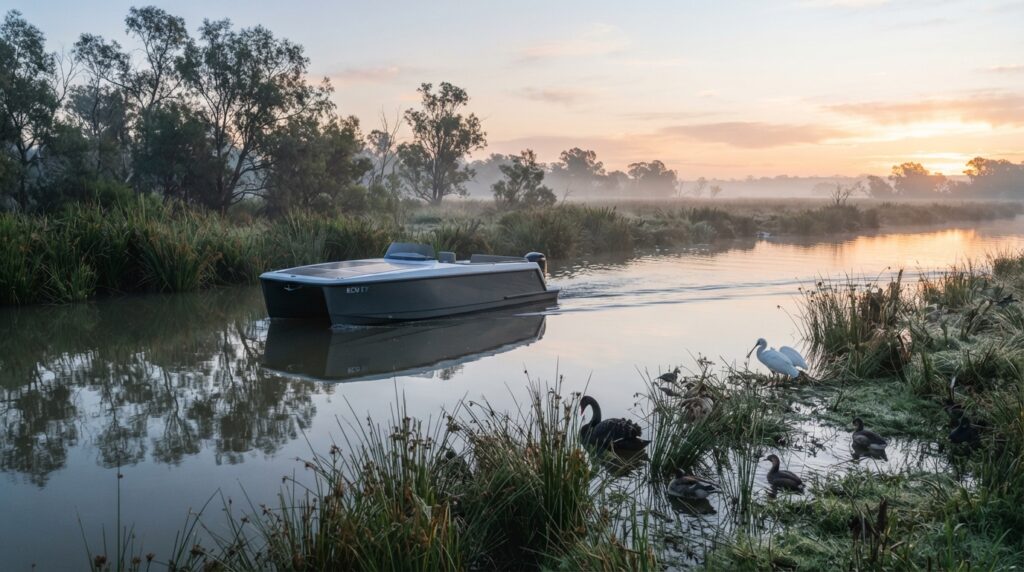
Lower noise levels have a noticeable effect on the surrounding environment.
This includes:
- Less disturbance to wildlife
- Reduced impact on other water users
- A more natural interaction with the water
In sensitive areas, this can make electric mini jet boats more suitable than traditional alternatives.
Access to Noise-Sensitive Areas
Certain waterways impose restrictions based on noise levels.
Quiet electric propulsion may allow:
- Access to areas where petrol engines are discouraged
- Operation closer to residential zones without disturbance
- Greater flexibility in location choice
This expands the practical use of mini jet boats.
The Psychological Effect of Quiet Operation
Reduced Stress Levels
Noise contributes to fatigue and stress, particularly over extended periods.
A quieter boating experience offers:
- A more relaxed atmosphere
- Reduced sensory overload
- Greater enjoyment of surroundings
This is especially important for:
- Family outings
- Leisure-focused use
- Longer periods on the water
Perception of Control
Without the distraction of engine noise, operators often feel more in control.
This is due to:
- Clearer feedback from the boat’s movement
- Better awareness of speed and direction
- Improved focus on handling
This contributes to safer and more confident operation.
Safety Implications
Better Situational Awareness
Quiet propulsion enhances the operator’s ability to:
- Detect nearby activity
- Respond to changes in the environment
- Avoid potential hazards
Reduced Aggressive Behaviour
High noise levels are often associated with high-performance operation and can encourage more aggressive use.
Quieter systems promote:
- More controlled driving
- Reduced emphasis on speed alone
- Safer interaction with other water users
A New Standard for Family Use
A More Inclusive Experience
Electric mini jet boats create an environment where:
- All passengers can participate comfortably
- Instructions can be given clearly
- The experience is accessible to a wider range of users
Encouraging Responsible Habits
The nature of quiet propulsion encourages:
- Consideration for others
- Respect for the environment
- Thoughtful operation
These behaviours are particularly important in shared waterways.
Efficiency and Performance Without Noise
Decoupling Noise from Power
In traditional boating, noise is often associated with power and performance.
Electric propulsion breaks this link:
- High performance is delivered without high noise
- Efficiency improves without added sound
- The experience becomes more refined
Smooth Power Delivery
Electric systems provide:
- Linear acceleration
- Consistent power output
- Reduced mechanical interruption
This contributes to a more controlled and predictable ride.
Industry Implications
Changing Expectations
As more users experience electric propulsion, expectations are shifting.
Buyers are beginning to prioritise:
- Quiet operation
- Ease of use
- Environmental compatibility
Raising Standards
Manufacturers are responding by:
- Focusing on integrated electric systems
- Improving design for low-noise operation
- Enhancing overall user experience
This is driving innovation across the category.
Australian Context
Compatibility with Local Conditions
Australia’s diverse waterways benefit from quieter boating solutions, particularly in:
- Residential areas near water
- Wildlife-sensitive environments
- Shared recreational spaces
Aligning with Future Trends
There is increasing emphasis on:
- Environmental responsibility
- Reduced noise pollution
- Sustainable recreational practices
Electric mini jet boats align with these trends, positioning them as a forward-looking choice.
Long-Term Behavioural Shift
Redefining Boating Culture
Over time, quiet propulsion is likely to influence broader boating culture by:
- Reducing tolerance for excessive noise
- Encouraging more respectful use of waterways
- Shifting focus from power to experience
A More Refined Experience
The boating experience becomes:
- More about enjoyment and connection
- Less about mechanical output
- More aligned with modern lifestyle expectations
Conclusion: Quiet Is More Than Comfort
Quiet electric propulsion is not simply a feature—it is a transformative element that changes how people interact with boats and waterways.
It improves:
- Communication
- Awareness
- Safety
- Comfort
And it encourages:
- More responsible behaviour
- Greater accessibility
- A more refined overall experience
In mini jet boats, where usability and control are paramount, this shift is particularly important.
The result is not just a quieter boat—but a fundamentally different, and in many ways better, way to enjoy the water.
See More at www.vectorwatercraft.com.au