
Why Weight Placement Is the Hidden Factor That Separates Safe, High-Performance Electric Boards from Poor Designs
Introduction: Why Balance Matters More Than Raw Power
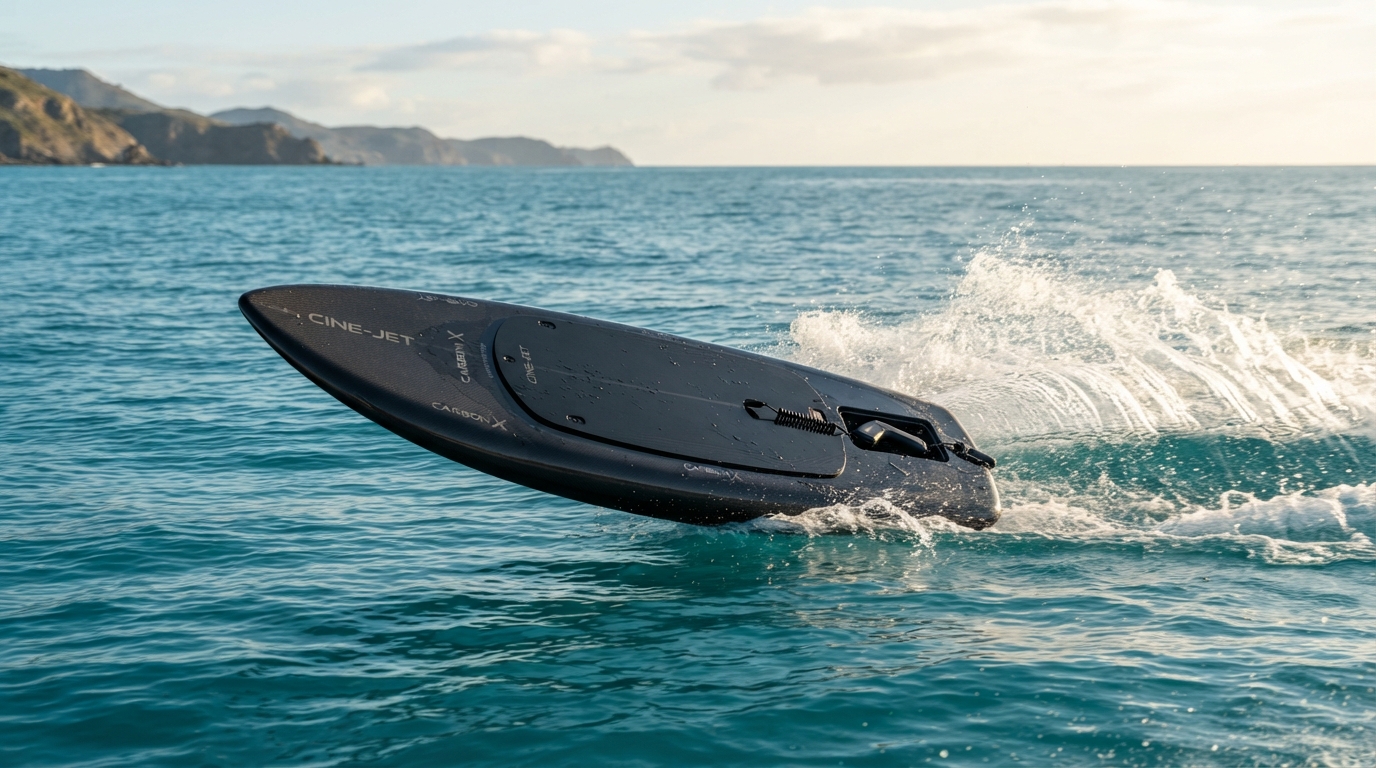
In electric jet surfboards and electric foil boards, battery technology tends to dominate the conversation. Buyers ask about capacity, range, charging time, and power output. Yet one of the most critical performance and safety factors is often overlooked entirely: battery weight distribution.
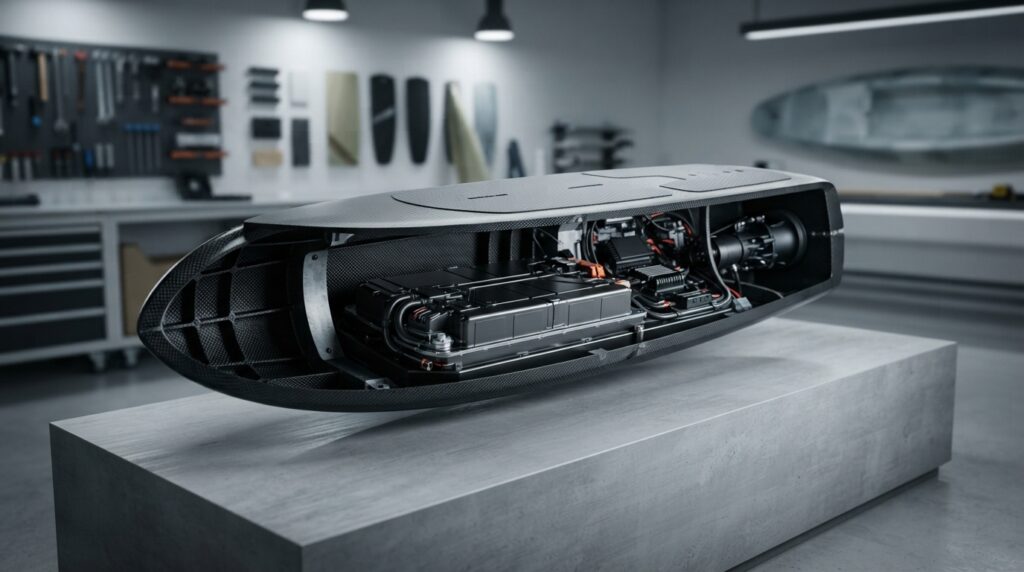
Unlike petrol-powered watercraft, electric boards carry their heaviest component—the battery—within the hull. Where that mass is positioned, how low it sits, how it is stabilised, and how it interacts with rider weight determines not only performance, but controllability, safety, fatigue, learning curve, and long-term durability.
Poor battery placement can make a board feel twitchy, unstable, nose-heavy, tail-dragging, or unpredictable at speed. Correct battery distribution, on the other hand, transforms an electric board into something that feels intuitive, forgiving, and confidence-inspiring—even for less experienced riders.
This article explains why battery weight distribution is fundamental, how it differs between jet surfboards and foil boards, what good engineering looks like, and why buyers should treat battery placement as a non-negotiable design requirement rather than an afterthought.
Understanding Mass in Electric Boards
Batteries Are the Single Heaviest Component
Modern lithium battery packs used in electric surfboards and foil boards typically weigh between 10 kg and 18 kg, depending on capacity and cell chemistry. That is often 30–45% of the total board weight, excluding the rider.
By comparison:
- Motors weigh relatively little
- Control electronics are negligible
- Hull materials are structurally light
This makes the battery the dominant mass influencing centre of gravity (CG), pitch, roll, and yaw.
Weight Distribution vs Total Weight
Many buyers focus on total board weight, assuming lighter is always better. In reality:
- A slightly heavier board with correct mass distribution will outperform a lighter board with poor balance
- Stability is governed by where weight is placed, not just how much weight exists
- Incorrect distribution amplifies rider errors and water conditions
This is why two boards with identical battery capacity can feel radically different on the water.
Centre of Gravity: The Core Concept
What Is Centre of Gravity?
The centre of gravity is the point where the combined mass of the board, battery, motor, and rider is effectively balanced.
In electric boards, ideal CG placement must:
- Sit low within the board
- Be centrally aligned between nose and tail
- Remain stable under dynamic load, not shifting during turns or acceleration
If the CG is too far forward, the nose digs in. Too far back, the tail squats and drag increases. Too high, the board becomes unstable and prone to oscillation.
Battery Placement in Electric Jet Surfboards
Jet Surfboards Operate on the Water Surface
Electric jet surfboards rely on planing across the surface rather than lifting above it. This creates specific weight-distribution requirements.
Optimal Placement Characteristics
In a properly designed jet surfboard:
- The battery is positioned low in the hull
- It sits close to the longitudinal centre
- Weight is aligned with rider stance, not ahead of it
- Battery is rigidly mounted to prevent movement under load
This ensures smooth acceleration, predictable carving, and stable straight-line tracking.
Effects of Poor Battery Placement in Jet Boards
When battery weight is mispositioned:
- Nose-heavy boards plough water and lose speed
- Tail-heavy boards struggle to plane efficiently
- High-mounted batteries increase roll sensitivity
- Riders experience rapid fatigue correcting imbalance
These flaws become more pronounced in chop, cross-winds, or variable throttle use.
Battery Weight Distribution in Electric Foil Boards
Foil Boards Operate Above the Water
Foil boards introduce an entirely different dynamic. Once foiling, the board is no longer supported by surface area—it is balanced on lift generated below the waterline.
This makes weight placement exponentially more critical.
The Vertical Axis Problem
On foil boards, battery placement affects:
- Pitch sensitivity
- Lift stability
- Stall behaviour
- Recovery after touchdowns
A battery mounted too high raises the CG, increasing the pendulum effect and making the board difficult to stabilise during take-off and landing.
Fore-Aft Balance and Foil Geometry
Foil lift is generated at a specific point relative to mast position. Battery mass must align with that lift centre.
If the battery is:
- Too far forward → nose-down instability
- Too far back → tail-heavy porpoising
- Not aligned with mast → uneven lift response
Advanced designs integrate battery placement around the foil mast position, not merely around internal convenience.
Rider Weight Interaction
Boards Must Balance for a Range of Riders
Electric boards are used by riders spanning:
- 60 kg beginners
- 85 kg intermediate riders
- 100 kg+ experienced users
Good battery distribution allows the board to remain balanced across this range, while poor designs require constant rider compensation.
Some advanced boards incorporate:
- Multiple battery mounting positions
- Modular internal layouts
- Adjustable foot-strap placement to fine-tune CG
These features indicate mature engineering rather than cosmetic design.
Dynamic Forces During Riding
Acceleration and Deceleration Loads
Under hard acceleration, battery mass generates rearward force. Under braking or throttle reduction, forward inertia dominates.
If battery mounts are poorly engineered:
- Micro-shifts occur under load
- Structural stress increases
- Handling becomes inconsistent
- Long-term fatigue cracks develop
This is why commercial-grade boards use reinforced mounting rails, vibration isolation, and fixed CG design.
Learning Curve and Safety Implications
Beginners Are Most Affected
New riders lack the instinctive compensation skills of experienced users. Poor battery distribution makes learning dramatically harder.
Consequences include:
- Increased falls
- Loss of control during take-off
- Higher injury risk
- Reduced confidence leading to abandonment
Proper weight balance shortens the learning curve and reduces early-stage accidents.
Battery Shape Matters as Much as Placement
Flat vs Tall Battery Packs
Battery geometry influences stability:
- Flat, wide battery packs lower CG
- Tall, narrow packs raise CG
- Centralised mass reduces rotational inertia
Premium boards design battery packs specifically for hydrodynamic balance rather than adapting off-the-shelf battery modules.
Structural Integration and Hull Design
Battery placement cannot be separated from hull engineering.
Well-designed boards integrate:
- Battery as a structural element
- Reinforced load paths
- Water-tight isolation chambers
- Thermal management without shifting mass
Cheap boards treat the battery as a removable accessory, compromising balance and integrity.
Long-Term Performance and Durability
Incorrect battery distribution leads to:
- Uneven hull stress
- Premature delamination
- Cracked internal mounts
- Water ingress at stress points
Over time, even small imbalances multiply into significant failures.
What Buyers Should Look For
Before purchasing an electric surfboard or foil board, buyers should ask:
- Where is the battery positioned relative to rider stance?
- Is the battery mounted low in the hull?
- Is weight aligned with foil mast or jet thrust line?
- Is the battery fixed or able to shift under load?
- Has the board been designed around the battery, or vice versa?
Manufacturers who can clearly explain these answers typically understand real-world performance.
Why Battery Weight Distribution Separates Professional-Grade Equipment
Professional-grade electric boards prioritise:
- Balanced CG under dynamic conditions
- Predictable handling across rider weights
- Structural longevity
- Reduced fatigue and improved safety
Consumer-grade boards often prioritise visual appeal, headline specs, or cost savings—at the expense of balance.
The Future of Battery Integration in Water Sports
Future developments will include:
- Custom-shaped battery cells
- Lower-profile battery housings
- Adaptive CG systems
- Smart mass distribution algorithms
- Integrated structural battery designs
As electric water sports mature, battery placement will become a defining performance differentiator rather than an invisible engineering detail.
Final Thoughts
Battery weight distribution is not a minor technical consideration—it is the foundation of electric board performance.
A powerful motor cannot compensate for poor balance. High capacity cannot overcome instability. Only correct mass placement delivers:
- Smooth acceleration
- Predictable control
- Safer learning
- Long-term durability
- Genuine riding enjoyment
For buyers serious about performance, safety, and value, battery placement should be evaluated with the same scrutiny as motor power or range.
See More at www.vectorwatercraft.com.au