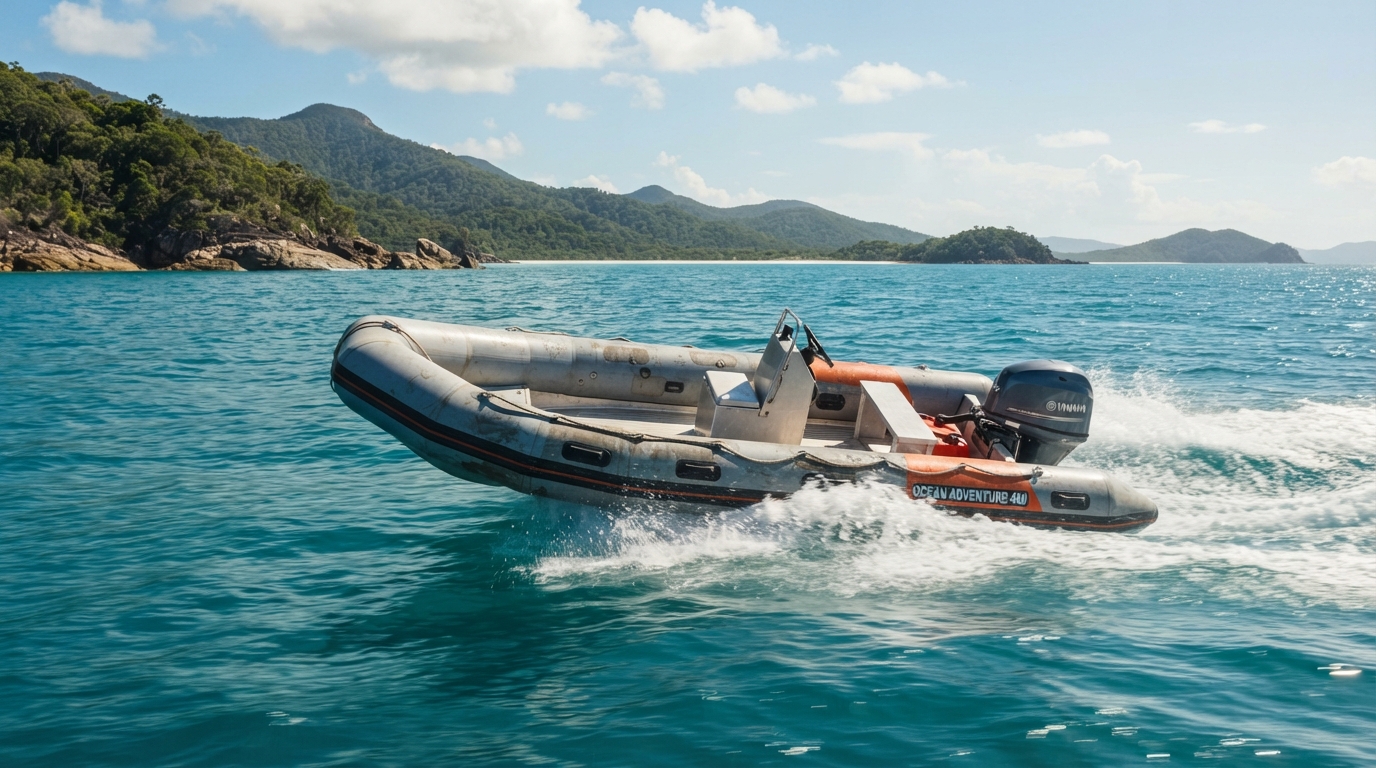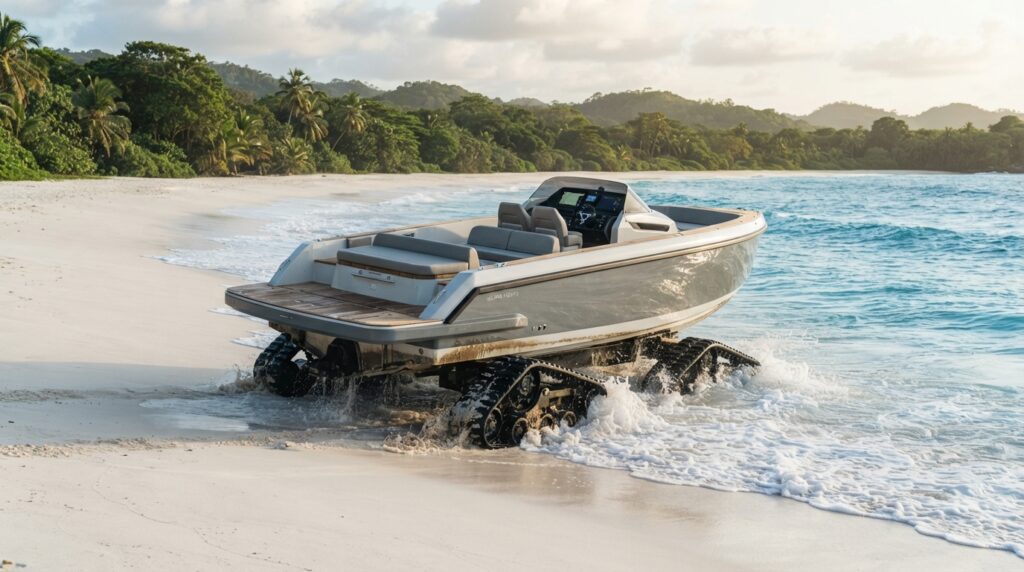

A high-resolution image of an Iguana Sport amphibious boat transitioning from water to land, with its distinctive retractable track system deployed, climbing smoothly up a sandy beach or boat ramp.
Introduction: Solving a Problem Boaters Have Lived With for a Century
Since the earliest days of recreational boating, one problem has remained stubbornly unresolved: how to move seamlessly between water and land without trailers, cranes, or marina infrastructure. Boats float superbly, but the moment land intervenes, complexity begins—trailers, ramps, waiting tides, and limited access points.
The Iguana Sport, developed in France, addresses this long-standing limitation not incrementally, but decisively. By integrating a fully retractable amphibious track system into a high-performance rigid inflatable boat (RIB), Iguana created a craft that can drive itself out of the water, across land, and back again—without assistance.
Within Emerging Watercraft And Experimental Concepts, Iguana Sport stands out as one of the rare designs where experimental engineering has matured into a genuinely practical, operational solution.
Origins of the Iguana Concept
The Iguana project began in France with a clear objective: eliminate the dependency on shore-side infrastructure while preserving on-water performance. Early amphibious boats existed, but most suffered from severe compromises—slow, heavy, unreliable, or impractical in real marine conditions.
French engineers behind Iguana recognised that the key was not to build a land vehicle that floats, but a true boat that temporarily gains land mobility when required.
This distinction shaped every design decision that followed.
What Is the Iguana Sport?
At its core, the Iguana Sport is a high-performance RIB—fast, stable, and seaworthy. What makes it exceptional is what happens when it reaches shore.
Key defining features include:
- A fully integrated retractable tracked undercarriage
- Standard outboard propulsion for water operation
- RIB hull geometry optimised for speed and stability
- Seamless transition between waterborne and land-borne modes
When deployed, the tracks allow the boat to climb beaches, traverse ramps, and reposition itself on land—then retract completely to restore clean hydrodynamics.
The Amphibious Track System
The Iguana’s most distinctive feature is its tracked landing gear, which deploys from within the hull structure.
Unlike wheeled amphibious boats, tracks were chosen because they:
- Distribute weight over a larger surface area
- Operate effectively on sand, gravel, and uneven terrain
- Provide superior traction on slippery ramps
- Reduce ground pressure
The tracks are hydraulically actuated and controlled from the helm, allowing precise, deliberate movement both on land and during launch or recovery.
Crucially, when retracted, the system does not compromise hull integrity or performance.
Hydrodynamics Without Compromise
One of the greatest engineering challenges was ensuring that amphibious capability did not degrade on-water performance.
Iguana Sport addresses this by:
- Fully enclosing the track system within the hull when retracted
- Preserving clean planing surfaces
- Maintaining optimal centre of gravity
- Avoiding appendages that create drag or turbulence
As a result, the Iguana Sport behaves like a conventional high-quality RIB at speed—stable, predictable, and efficient.
Performance on Water
In water mode, the Iguana Sport delivers the characteristics expected of a premium RIB:
- Strong acceleration
- High cruising speeds
- Predictable behaviour at rest and underway
The amphibious system adds weight, but careful engineering ensures this does not compromise usability or safety. For operators, it still feels like a boat—not a hybrid contraption.
Performance on Land
On land, the Iguana Sport is not intended to replace a vehicle. Instead, it performs specific, high-value tasks extremely well.
Land-mode capabilities include:
- Self-launching and recovery without a trailer
- Beach landings in areas without ramps
- Repositioning on shore for storage or security
- Accessing remote or tidal locations
Speed on land is deliberately low, prioritising control and safety over pace.
Materials and Construction
The Iguana Sport is built using commercial-grade marine construction techniques, reflecting its origins in professional and defence markets as well as recreational use.
Key construction elements include:
- Reinforced composite hull structures
- Heavy-duty hydraulic systems
- Corrosion-resistant components
- Shock-resistant mechanical assemblies
Everything is designed for repeated cycles between saltwater immersion and land exposure—an environment that destroys poorly engineered systems.
Use Cases and Applications
The Iguana Sport’s amphibious capability unlocks use cases that conventional boats simply cannot address.
Recreational BoatingOwners gain independence from marinas, trailers, and ramps.
Coastal PropertiesDirect access from private beaches without infrastructure.
Rescue and Emergency ServicesRapid deployment in tidal zones, flood areas, and remote shorelines.
Military and Security OperationsStealthy beach landings and rapid extraction.
These applications highlight why Iguana is more than a novelty—it solves real problems.
Comparison With Traditional Amphibious Boats
Earlier amphibious boats often relied on wheels, creating severe compromises:
- Reduced seaworthiness
- Poor traction on sand
- High mechanical exposure
- Complex maintenance
Iguana’s tracked approach avoids these pitfalls, making it one of the few amphibious designs to succeed commercially.
Stability and Safety Considerations
Safety was a central design priority.
On water:
- The RIB configuration provides inherent buoyancy and stability
- Track systems are fully sealed and secured
On land:
- Low centre of gravity prevents tipping
- Controlled hydraulic movement ensures predictable behaviour
The transition between modes is slow, deliberate, and highly controlled—reducing risk.
Why Iguana Sport Is an Experimental Watercraft
Despite its commercial success, Iguana Sport belongs firmly within Emerging Watercraft And Experimental Concepts because it introduces:
- A new amphibious architecture
- Integrated land mobility without hydrodynamic penalty
- A re-definition of boat access and deployment
It challenges the assumption that boats must rely on fixed infrastructure—and proves otherwise.
Broader Impact on Marine Design
Iguana’s success has influenced broader thinking across the marine sector:
- Greater focus on self-deploying vessels
- Interest in amphibious rescue craft
- Rethinking access in remote coastal areas
As climate change alters coastlines and infrastructure availability, this kind of adaptability becomes increasingly relevant.
Limitations and Trade-Offs
As with all advanced systems, there are compromises:
- Higher purchase cost
- More complex maintenance than standard RIBs
- Added weight compared to non-amphibious craft
However, for operators who value independence and access, these trade-offs are often justified.
The French Engineering Signature
Iguana Sport reflects a distinctly French approach to innovation—practical, elegant, and unapologetically technical. It does not chase spectacle, but quietly delivers a solution many thought impossible without compromise.
Why It Belongs in Emerging Watercraft And Experimental Concepts
Iguana Sport earns its place because it:
- Successfully merges land and sea operation
- Retains true boating performance
- Solves long-standing logistical challenges
- Demonstrates mature experimental engineering
It is experimental not because it is unfinished—but because it redefines what a boat can do.
Conclusion: Freedom From Infrastructure
The Iguana Sport represents a quiet revolution. It removes dependence on ramps, trailers, and marinas, giving operators direct, autonomous access to the water.
In doing so, it challenges one of boating’s oldest assumptions—that land and sea must remain separate domains.
That achievement alone secures its position as one of the most important emerging watercraft concepts of the modern era.
See more at www.vectorwatercraft.com.au