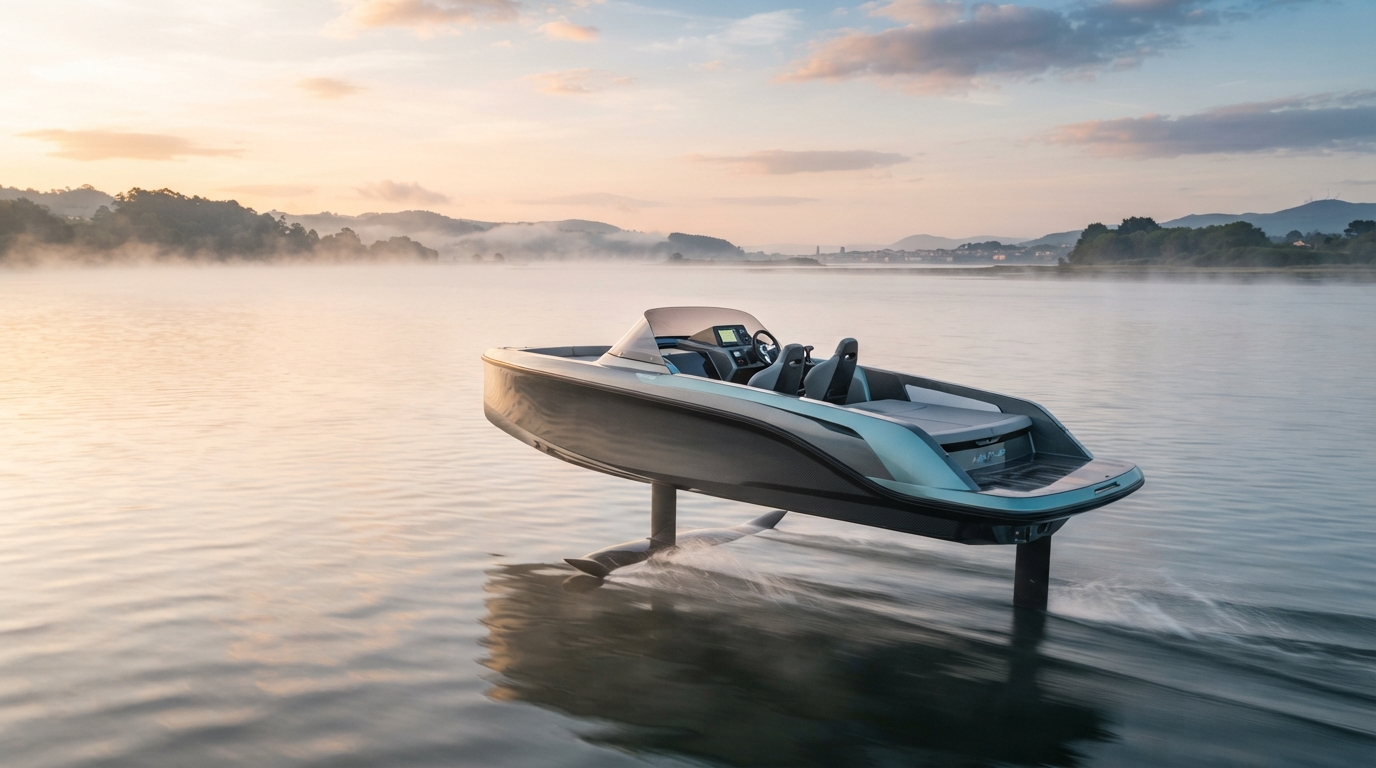
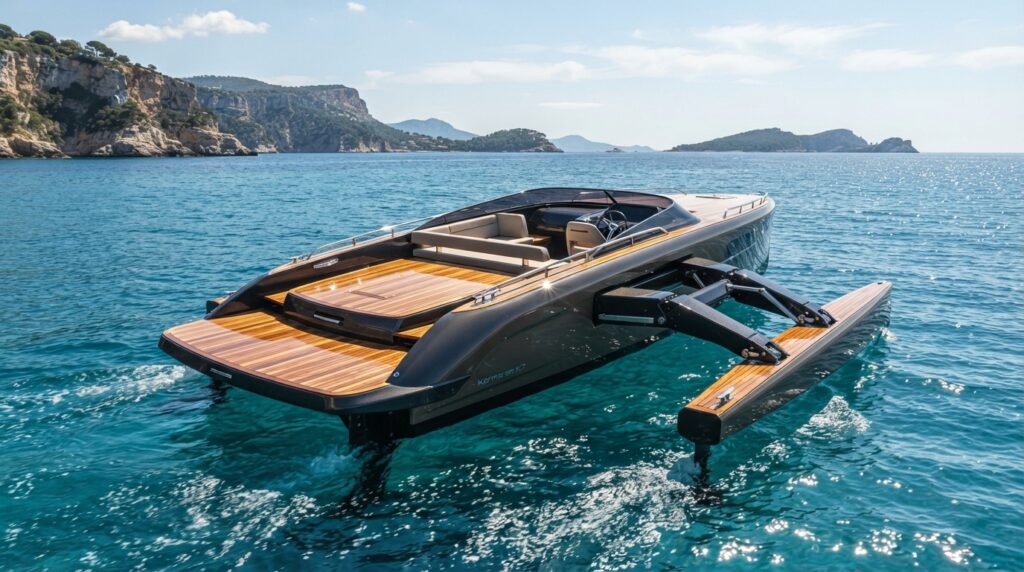

A high-quality image of the Kormaran K7 underway, showing the distinctive folding trimaran configuration with the outer hulls extended, slicing through calm water at speed, highlighting its futuristic lines and carbon-fibre construction.
Introduction: When Engineering Precision Meets Radical Marine Design
Most breakthroughs in watercraft design emerge from a single driving force—speed, luxury, efficiency, or stability. The Kormaran K7, developed in Austria, is exceptional because it successfully integrates all four into one radically unconventional platform.
Rather than refining the monohull yacht or simply enlarging the multihull concept, Kormaran approached the challenge from a clean sheet of paper. The result is a transformable trimaran power yacht capable of altering its hull configuration while underway, shifting seamlessly between displacement, planing, and foiling-like efficiency.
In the context of Emerging Watercraft And Experimental Concepts, the Kormaran K7 stands apart as a genuine bridge between experimental engineering and real-world usability.
The Origins of the Kormaran Concept
The Kormaran project was born from frustration with compromise. Traditional monohull power yachts offer interior volume and comfort but sacrifice efficiency and stability at speed. Catamarans and trimarans improve stability and efficiency but often impose limitations in docking, aesthetics, or interior layout.
Kormaran’s founders—working with Austrian naval architects and advanced composite engineers—set out to create a vessel that could change its physical geometry to suit conditions and use cases, rather than forcing the owner to choose one hull type forever.
This thinking placed the K7 firmly in experimental territory from the outset.
Transformable Trimaran Architecture
The defining feature of the Kormaran K7 is its movable outer hulls, which can be raised or lowered hydraulically.
In narrow mode:
- The outer hulls fold upward
- The beam is reduced dramatically
- The yacht behaves more like a slender monohull
- Docking in standard marinas becomes straightforward
In wide mode:
- The outer hulls deploy outward
- The beam expands significantly
- Stability increases exponentially
- Hydrodynamic resistance drops
This transformation is not cosmetic. It fundamentally alters how the yacht interacts with the water.
Hydrodynamic Efficiency and Performance
When operating in its expanded trimaran configuration, the Kormaran K7 benefits from:
- Reduced wetted surface per unit displacement
- Exceptional transverse stability
- Improved fuel efficiency at cruising speeds
- Higher potential top speed with less power
Unlike conventional yachts that rely on brute engine output, the K7 leverages geometry and physics. The hulls are slender and optimised for minimal wave-making resistance, allowing the vessel to cruise efficiently at speeds that would be inefficient or uncomfortable for a comparable monohull.
Materials and Construction
The Kormaran K7 is constructed using advanced carbon fibre composites, aerospace-grade resins, and precision-engineered load paths.
Key construction attributes include:
- Carbon composite hull and superstructure
- Lightweight but extremely stiff framework
- Corrosion-resistant systems
- Weight savings that directly translate into performance
This approach allows the K7 to achieve performance figures that would otherwise require significantly larger engines and fuel loads.
Power and Propulsion Options
The Kormaran K7 is designed to be propulsion-agnostic, accommodating a range of power systems.
Configurations include:
- Twin high-performance petrol or diesel engines
- Hybrid propulsion systems
- Fully electric or extended-range electric concepts
This flexibility places the K7 ahead of its time, particularly as marine electrification accelerates globally. The trimaran platform is especially well suited to electric propulsion due to its reduced drag and improved efficiency envelope.
Interior Design Without Compromise
One of the traditional criticisms of multihulls is compromised interior space or awkward layouts. The Kormaran K7 addresses this directly.
Despite its advanced hull geometry, the interior offers:
- Full-beam master accommodation
- High-end finishes consistent with luxury yachts
- Generous glazing for natural light
By allowing the hulls to retract in harbour, the designers avoided the “wide-body penalty” that often limits multihull adoption in luxury marinas.
Stability and Safety Advantages
Stability is one of the K7’s most compelling attributes.
In its deployed trimaran mode, the vessel exhibits:
- Exceptional resistance to roll
- Improved safety at speed
- Reduced motion in beam seas
- Greater passenger comfort
Unlike gyro stabilisers or active fins, this stability is inherent in the vessel’s geometry rather than added systems.
Docking, Storage, and Practicality
A major obstacle to multihull adoption has always been marina infrastructure. The Kormaran K7’s folding hulls address this elegantly.
With hulls retracted:
- Beam is comparable to conventional monohulls
- Standard marina berths can be used
- Storage and transport become feasible
This practical advantage transforms what would otherwise be an exotic concept into a realistic ownership proposition.
Why the Kormaran K7 Is Not Just a Luxury Yacht
Although luxurious, the K7 is fundamentally an engineering demonstrator. It proves that watercraft do not need to be fixed in form to be functional.
Its design philosophy challenges assumptions that have governed yacht design for over a century:
- That hulls must be static
- That efficiency and luxury are mutually exclusive
- That performance demands excess power
In this sense, the K7 belongs firmly in Emerging Watercraft And Experimental Concepts, even as it edges toward production reality.
Influence on Future Marine Design
The Kormaran concept has already influenced broader thinking in:
- Adaptive hull geometry
- Modular marine architecture
- Hybrid and electric yacht efficiency
- Performance-focused luxury design
As fuel efficiency regulations tighten and environmental considerations rise, transformable platforms like the K7 may become less experimental and more essential.
Limitations and Challenges
Despite its brilliance, the Kormaran K7 faces challenges typical of advanced experimental craft:
- High production cost
- Complex hydraulic systems
- Specialised maintenance requirements
- Limited production scale
These factors currently confine it to the ultra-premium end of the market.
Cultural and Industry Impact
The K7 represents a distinctly European approach to innovation—precision engineering, disciplined design, and long-term thinking rather than short-term spectacle.
It has attracted attention not through mass marketing, but through quiet confidence and demonstrable performance.
Why the Kormaran K7 Belongs in Emerging Watercraft And Experimental Concepts
The Kormaran K7 earns its place in this category because it expands the boundaries of what a power yacht can be. It introduces adaptability as a core design principle and proves that radical innovation can coexist with real-world usability.
It is neither a concept sketch nor a novelty—it is a functioning, operational vessel that hints strongly at the future.
Conclusion: A Blueprint for Adaptive Watercraft
The Kormaran K7 is more than a yacht. It is a blueprint for adaptive marine design—one where vessels respond to conditions and requirements rather than forcing owners to compromise.
As the marine world moves toward efficiency, electrification, and smarter design, the Kormaran K7 stands as a compelling demonstration that the future of watercraft may not be fixed in form at all.
See more at www.vectorwatercraft.com.au