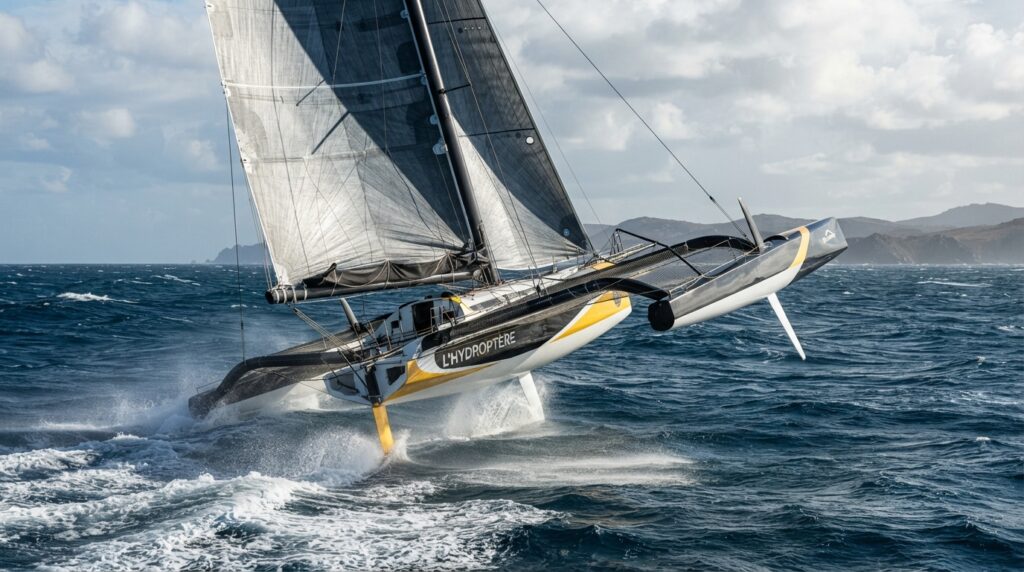

A dramatic image of L’Hydroptère flying clear of the water at speed, with its central hull and amas lifted entirely on hydrofoils, spray exploding beneath the foils and the towering wing mast canted under extreme load.
Introduction: When Sailing Left the Water Behind
For most of sailing history, speed was constrained by a simple truth: hulls drag through water. Designers refined shapes, reduced displacement, and added sail area, but water resistance remained the dominant limiting factor. L’Hydroptère, conceived and built in France, shattered that paradigm by proving that a large, ocean-capable sailing craft could rise completely above the surface and sustain extreme speeds.
This was not incremental progress. It was a fundamental break from traditional naval architecture—one that permanently altered how sailors, engineers, and designers think about performance sailing.
Under the banner of Emerging Watercraft And Experimental Concepts, L’Hydroptère stands as one of the most influential experimental vessels ever built.
Origins of L’Hydroptère
The Hydroptère project was led by French yachtsman and visionary Alain Thébault, whose obsession with speed and flight on water began decades earlier. Inspired by aeronautics and the pioneering hydrofoil work of American engineer David Keiper, Thébault believed that sailing’s future lay not in lighter hulls, but in eliminating hull drag altogether.
Development began in the 1990s, with years of prototypes, failures, and redesigns. Unlike many experimental concepts that remain theoretical, L’Hydroptère was relentlessly pursued as a full-scale, ocean-capable craft—not a model, not a one-off sprint machine, but a real vessel designed to survive extreme forces.
Radical Trimaran Configuration
At its core, L’Hydroptère is a trimaran—but only in the most basic sense.
Key elements include:
- A slender central hull
- Two wide-set amas (outrigger hulls)
- Large, fully submerged hydrofoils mounted on the amas
- A smaller stabilising foil on the rudder
Once airborne, the hulls no longer provide buoyancy. Instead, the entire vessel rides on hydrodynamic lift generated by the foils, transforming the trimaran into something closer to a low-flying aircraft than a conventional boat.
Hydrofoil Technology at Scale
Hydrofoils had been used before on small craft, but L’Hydroptère was revolutionary because it applied hydrofoiling to a large, heavily loaded sailing platform.
Each foil had to:
- Generate immense lift
- Remain stable at speeds exceeding 45 knots
- Withstand violent impacts from waves
- Operate in aerated, turbulent water
The foils were constructed from advanced composites and titanium components, reflecting aerospace rather than marine engineering standards. At speed, they carried loads measured in multiple tonnes, concentrated into relatively small structural elements.
Flight on Water: How L’Hydroptère Sails
As wind strength increases, L’Hydroptère accelerates conventionally until the foils begin generating lift. At a critical speed, the hulls rise clear of the surface, leaving only the foils and rudder in contact with the water.
Once fully airborne:
- Wetted surface area drops dramatically
- Drag is reduced by orders of magnitude
- Speed increases exponentially with wind power
However, this flight regime is inherently unstable. Any imbalance in lift, wave impact, or wind gust can trigger violent oscillations or catastrophic crashes—something the Hydroptère team experienced repeatedly during development.
Wing Mast and Sail Power
Unlike Sailrocket’s rigid wing, L’Hydroptère retained a more conventional sail plan—but pushed it to extremes.
Its towering mast and high-aspect sails delivered enormous power, while sophisticated control systems allowed fine adjustment under load. At full speed, aerodynamic forces approached those seen in high-performance aircraft wings.
The challenge was not generating power—it was controlling it without destroying the platform.
Structural Engineering Under Extreme Load
L’Hydroptère’s structure endured some of the highest stresses ever recorded on a sailing vessel.
Engineering challenges included:
- Foil cavitation at extreme speeds
- Torsional loads across the wide beam
- Shock loads from re-entry after foil ventilation
- Fatigue under repeated high-speed runs
Multiple structural failures during early trials forced continuous redesign. These failures were not setbacks—they were essential data points that pushed marine engineering forward.
Record-Breaking Achievements
In 2009, L’Hydroptère achieved what many had considered impossible.
Key records include:
- World sailing speed record over 500 metres: 51.36 knots
- Sustained foiling at speeds previously unattainable for sailing craft
- Proof that large foiling vessels could operate beyond sheltered waters
These records were not symbolic—they rewrote the limits of wind-powered motion.
The Human Factor
Unlike many experimental speed craft, L’Hydroptère carried a crew. These sailors operated in conditions of extreme noise, vibration, and acceleration, often enclosed within protective pods.
At full speed:
- Reaction times were minimal
- Crashes were violent and sudden
- Safety systems were critical
The human cost of pushing boundaries was ever-present, underscoring the seriousness of the project.
Why L’Hydroptère Is Not a Production Boat
Despite its success, L’Hydroptère was never intended for commercialisation.
Limitations include:
- Narrow operating window
- Extreme sensitivity to sea state
- High maintenance and repair demands
- Specialist crew requirements
Its value lay not in mass adoption, but in knowledge creation.
Influence on Modern Foiling Craft
The legacy of L’Hydroptère is enormous.
Its breakthroughs directly influenced:
- America’s Cup foiling catamarans
- Offshore racing trimarans
- High-speed foiling ferries
- Electric hydrofoil watercraft
What was once experimental is now mainstream—proof of the Hydroptère’s enduring impact.
Cultural and Technological Significance
L’Hydroptère represents a distinctly French approach to innovation: intellectual, relentless, and uncompromising. It combined theoretical physics, real-world testing, and sheer human determination in a way few projects ever have.
It demonstrated that sailing still had frontiers left to explore.
Why L’Hydroptère Belongs in Emerging Watercraft And Experimental Concepts
L’Hydroptère earns its place in this category because it:
- Redefined the upper limits of sailing speed
- Proved large-scale hydrofoiling was viable
- Created a technological bridge between sailing and aviation
- Changed the future trajectory of marine design
It was not an evolution—it was a leap.
Conclusion: The Moment Sailing Took Flight
L’Hydroptère will be remembered as the craft that finally freed sailing from water resistance. Its achievements echo through every foiling vessel that followed, from elite racing yachts to electric commuter craft.
In the history of watercraft, few vessels can claim to have changed the rules of the game. L’Hydroptère did exactly that—at 50 knots, on foils, above the sea.
See more at www.vectorwatercraft.com.au