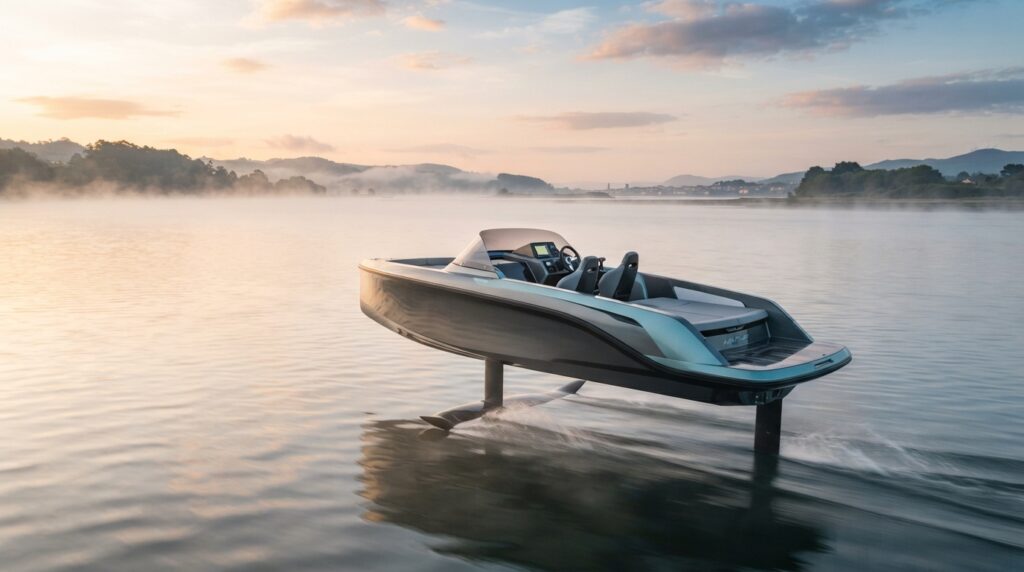

Introduction: Why “What Is a Watercraft?” Is Becoming a Hard Question
For decades, water sports categories have been neat and separate.
A boat was a boat.
A board was a board.
A rescue device was a rescue device.
A personal watercraft was a personal watercraft.
Those lines were never just cultural — they were enforced by the limitations of petrol engines, traditional hull design, mechanical controls, and long-standing regulation. In that world, a jet ski could not easily become a rescue tool, a board could not easily behave like a boat, and a small craft could not become both a toy and a serious piece of equipment.
In the electric era, those walls are falling.
The future of water sports technology is increasingly shaped by a single phenomenon: convergence — where boards, boats, and specialised devices begin to overlap in purpose, design, and capability. This is more than a trend. It’s an engineering outcome, a market outcome, and a regulatory challenge all at once.
Why Categories Stayed Separate in the Petrol Era
To understand convergence, it helps to understand why categories remained separate for so long.
Petrol systems impose fixed constraints:
• Engines are heavy and bulky
• Fuel storage requires volume and safety clearance
• Exhaust, noise, and heat must be managed
• Maintenance complexity discourages multi-purpose design
• Power delivery is less controllable at small scale
As a result, manufacturers built distinct products with limited overlap:
• Boats carried engines and fuel, offering range and capacity
• Jet skis offered speed but required space, trailer logistics, and noise tolerance
• Boards relied on human power or small auxiliary systems
• Rescue devices remained separate because reliability and simplicity were essential
In short: petrol technology kept form and function locked together.
Electric Power Breaks the Link Between Form and Function
Electric power changes the rules because it scales down far better than petrol.
Small electric motors deliver:
• High torque at low speeds
• Smooth controllable output
• Compact packaging
• Minimal noise
• Reduced maintenance complexity
This makes it practical to embed meaningful propulsion into:
• Boards
• Compact craft
• Rescue devices
• Hybrid platforms
• Modular units that can move between form factors
When power is compact, quiet, and controllable, design can become more fluid — and categories begin to merge.
Convergence Is Really About Platforms
In the future, the dominant concept will not be “models” but platforms.
A platform is a system architecture that can support multiple uses by changing:
• Controls
• Software limits
• Attachments
• Battery modules
• Hull or body shell components
This is how convergence occurs.
Instead of owning five separate products for five separate uses, users begin to adopt:
• One platform that adapts
• One battery system shared across devices
• One control ecosystem
• One maintenance approach
• One training pathway
That is the same evolution seen in modern tools (battery tool platforms), vehicles (EV skateboard chassis), and consumer electronics (ecosystems).
Water sports will follow.
The Board That Behaves Like a Craft
The clearest example of convergence is the modern powered board.
Boards are no longer purely:• Wave-driven• Paddle-driven• Wind-driven
Now they can be:
• Motor-assisted
• Fully propelled
• Stability-managed
• Range-planned
• Software-limited by rider profile
This turns a board into something approaching a craft — not in legal definition necessarily, but in practical capability:
• It can travel meaningful distances
• It can carry equipment
• It can be used in low-wind, no-wave conditions
• It can serve training and rescue roles in certain contexts
As systems mature, “board” becomes a shape, not a limitation.
The Small Boat That Behaves Like a Board
Convergence works the other way too.
Small electric craft are increasingly:
• Lightweight
• Highly manoeuvrable
• Simple to transport
• Quick to deploy
• Stable at low speeds
These attributes have traditionally been associated with boards, not boats.
As a result, compact electric boats begin to compete with boards on:
• Convenience
• Setup time
• Learning curve
• Use in tight waterways
• Spontaneous “grab and go” ownership
This disrupts the old assumption that boats require effort, planning, trailers, and complexity.
The Rescue Device That Behaves Like a Watercraft
Perhaps the most important convergence — especially in Australia — is where safety devices begin to resemble watercraft.
A rescue buoy used to be:• Passive• Stationary• Dependent on a swimmer
Now, remote-controlled rescue devices can be:
• Powered
• Directed at speed
• GPS-aware
• Capable of carrying loads
• Deployable by non-swimmers
This begins to blur categories:
Is it a buoy?Is it a craft?Is it equipment?Is it a vehicle?
From a practical standpoint, it becomes a new category entirely — and it drags regulation, procurement, and training into new territory.
Why Control Systems Are the Glue of Convergence
Convergence accelerates because control systems are now:
• Digital
• Configurable
• Profile-based
• Safety-governed
• Updateable
Instead of designing one mechanical control for one use, modern platforms can offer:
• Beginner profiles
• Training profiles
• Rescue profiles
• Performance profiles
• Shared-use rental profiles
This allows the same physical product to behave like different categories depending on context.
In the petrol era, this was nearly impossible without mechanically redesigning the product.
Battery Ecosystems Will Pull Categories Together
As batteries become standardised within brands and platforms, convergence accelerates.
Owners will expect:
• A shared battery across multiple devices
• Common charging systems
• Similar storage and transport solutions
• A single “energy system” for the household or organisation
This is familiar territory in other industries:• Power tools• E-bikes• Home solar storage
Once battery ecosystems take hold, the market shifts from “buying a watercraft” to “buying into a system”.
Convergence Changes How People Buy
Traditional buying decisions were category-based:
• “Do I want a boat or a jet ski?”
• “Do I want a surfboard or a kayak?”
Converged buying becomes problem-based:
• “Do I want something portable that launches easily?”
• “Do I want something quiet that I can use near homes?”
• “Do I want something my family can learn safely?”
• “Do I want something that can serve recreation and safety roles?”
The question changes from what the thing is to what it can do.
That’s a big shift, and it’s exactly how disruptive categories develop.
The Regulatory Challenge: Old Boxes Don’t Fit New Products
Regulation tends to be built around historical categories:
• Boat registration rules
• PWC rules
• Safety equipment lists
• Operator licensing requirements
• Speed and operating zones
Converged products don’t fit neatly into those boxes.
What happens when a device:
• Is smaller than a boat but faster than a buoy?
• Is used for rescue but purchased for recreation?
• Operates like a craft but carries like a board?
• Is remotely controlled rather than ridden?
Regulators and local authorities will be forced to adapt, which will create:
• Early uncertainty
• Gradual standard setting
• Eventual normalisation
The companies that help shape safe, sensible standards will gain enormous credibility and market advantage.
Convergence Changes Training and Safety Culture
Traditional training is category-specific:
• Boat licences
• Jet ski handling
• Surf skills
• Lifesaving certifications
Converged platforms create new needs:
• Device literacy (controls, modes, systems)
• Battery and charging competence
• Waterway etiquette in silent craft
• Emergency protocols for powered devices
• Shared-use safety instruction
This creates opportunity for brands that provide:
• Excellent manuals and guides
• Formal training pathways
• Safety-first positioning
• Consistent standards across products
It also makes EEAT-style education content genuinely valuable, not just SEO.
The Winner Will Be the Brand That Owns the Middle
In most convergence waves, the winners are not always the most extreme “performance” players.
They are the brands that dominate the middle ground:
• Most usable performance
• Best safety and predictability
• Broadest access
• Strongest platform ecosystem
• Clearest training and support
In other words, the future of water sports will increasingly reward:
• Practicality
• Reliability
• System intelligence
• Customer support
• Platform consistency
The era of relying purely on spectacle is fading.
Conclusion: Categories Are Collapsing — and That’s the Point
The future of water sports technology is converging because electric propulsion, modern control systems, and battery ecosystems make it possible.
Boards will become craft-like.
Craft will become board-like.
Rescue devices will become vehicle-like.
The old category boundaries were built for petrol-era limitations. Those limitations are disappearing — and the products are changing shape accordingly.
The most important takeaway is this:
In the coming decade, the question will no longer be “What category is it?”
The question will be “What role can it play?”
That is the real future.
See More at www.vectorwatercraft.com.au