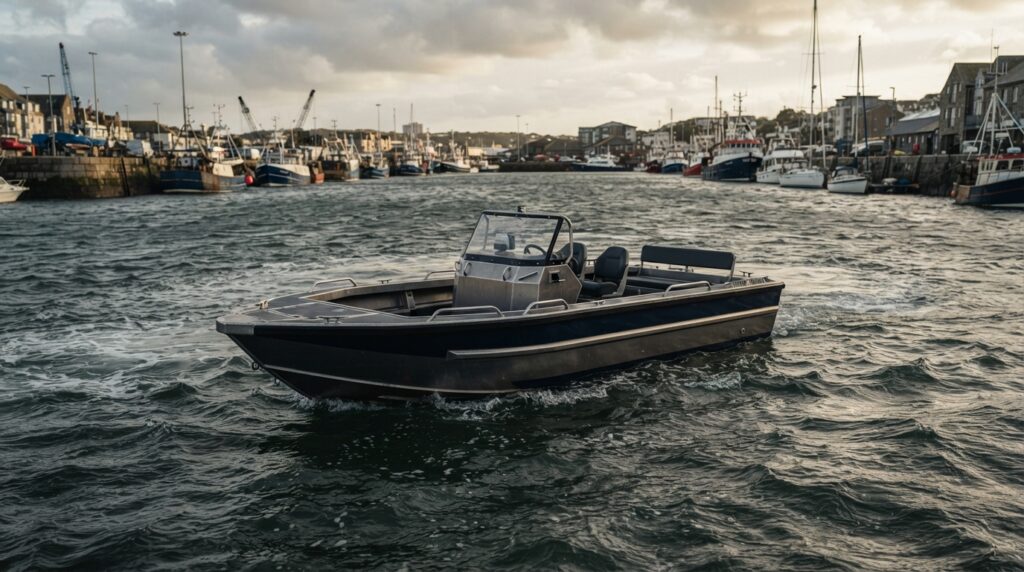

Stability Is the Foundation of Safe Boating
When buyers consider a mini jet boat, attention often goes to speed, power, or design appearance. While these elements are important, they are secondary to one critical factor that underpins the entire boating experience—stability.
Stability determines how a boat behaves in the water at rest, during acceleration, at speed, and through turns. It affects safety, confidence, passenger comfort, and overall usability. In compact craft such as mini jet boats, where size and power are closely balanced, stability becomes even more important.
This article explains what stability really means in the context of mini jet boats, the factors that influence it, and what buyers should understand before making a decision.
What Stability Means in a Mini Jet Boat
More Than Just Staying Upright
Stability is often misunderstood as simply the ability of a boat to avoid tipping over. In reality, it encompasses a broader range of behaviours, including:
- Balance at rest
- Response to movement and weight shifts
- Behaviour during acceleration and deceleration
- Control and predictability during turns
A stable mini jet boat is one that behaves consistently and remains manageable across all of these conditions.
Primary and Secondary Stability
Stability can be broadly divided into two types:
Primary Stability (Initial Stability)
- How stable the boat feels when stationary or moving slowly
- Important for boarding, loading, and low-speed manoeuvring
Secondary Stability (Dynamic Stability)
- How the boat behaves when tilted or under dynamic forces
- Critical during turns, acceleration, and higher-speed operation
Both forms of stability must be considered when evaluating a mini jet boat.
Hull Design: The Primary Driver of Stability
Width and Beam
The width of the hull plays a significant role in stability.
- Wider hulls generally provide greater primary stability
- Narrower hulls may offer higher speed but less initial stability
For buyers, this represents a trade-off between:
- Comfort and confidence
- Performance and agility
Hull Shape and Profile
Key elements of hull shape include:
- Flat sections that provide lift
- Angled surfaces that influence water flow
- Chine design that affects grip in turns
A well-designed hull balances these factors to provide both stability and performance.
Deadrise Angle
The deadrise angle—the angle between the hull bottom and the horizontal plane—affects how the boat interacts with water.
- Lower deadrise (flatter hull): more stable, less forgiving in rough water
- Higher deadrise (more angled hull): smoother ride, potentially less initial stability
Mini jet boats typically use designs that favour stability and shallow water capability.
Weight Distribution and Centre of Gravity
The Importance of Balance
Stability is heavily influenced by how weight is distributed within the boat.
Key factors include:
- Placement of the motor and battery
- Position of passengers
- Overall weight of the vessel
Centre of Gravity
The centre of gravity determines how the boat responds to movement.
- A low centre of gravity improves stability
- A high or poorly positioned centre of gravity increases the risk of tipping or instability
In professionally engineered mini jet boats, component placement is optimised to achieve a stable centre of gravity.
The Role of Power and Acceleration
Controlled Versus Excessive Power
Power influences stability, particularly during acceleration.
A balanced system provides:
- Smooth, controlled acceleration
- Predictable transition onto plane
- Stable behaviour under throttle changes
The Effect of Overpowering
Excessive power can:
- Lift the bow too quickly
- Reduce contact with the water
- Create instability at speed
This highlights the importance of matching power to hull design.
Stability at Speed
Planing and Lift
At higher speeds, mini jet boats plane on the surface of the water.
This reduces drag but also changes stability characteristics:
- Less hull in contact with the water
- Greater reliance on balance and control
- Increased sensitivity to input
Directional Stability
A stable boat at speed should:
- Track straight without constant correction
- Respond predictably to steering input
- Maintain control during acceleration and deceleration
Poor stability at speed can result in:
- Wandering or drifting
- Oversteering
- Difficulty maintaining course
Turning Stability
Lateral Forces
When a mini jet boat turns, lateral forces act on the hull.
A stable design ensures that:
- The boat leans appropriately into the turn
- Grip is maintained in the water
- Control is not lost
Risks of Poor Stability in Turns
Instability during turning can lead to:
- Sliding or skidding
- Sudden directional changes
- Increased rollover risk in extreme cases
This is particularly important in confined or busy waterways.
Passenger Movement and Load Sensitivity
The Impact of Movement
In small boats, passenger movement can significantly affect stability.
Shifting weight can:
- Alter balance
- Change handling characteristics
- Affect centre of gravity
Load Capacity and Limits
Every mini jet boat is designed with a specific load capacity.
Exceeding this capacity can:
- Reduce stability
- Increase stress on the hull
- Compromise safety
Buyers should understand and respect these limits.
Environmental Factors
Water Conditions
Stability is influenced by the environment, including:
- Wind
- Waves
- Currents
A stable boat should maintain control under typical operating conditions.
Shallow Water Effects
In shallow water:
- Water flow beneath the hull changes
- Stability may be affected
- Reaction time becomes critical
Mini jet boats are well suited to shallow water, but stability must still be managed carefully.
The Importance of Testing
Real-World Validation
Professionally engineered mini jet boats are tested to ensure:
- Stability across different loads
- Predictable handling
- Safe operation under various conditions
The Risk Without Testing
In untested or improvised builds:
- Stability characteristics may be unknown
- Behaviour may vary unexpectedly
- Safety margins are unclear
This uncertainty increases risk for the operator.
Choosing the Right Model
What Buyers Should Look For
When evaluating a mini jet boat, buyers should consider:
- Hull width and design
- Weight distribution and component placement
- Evidence of engineering and testing
- Intended use and environment
Avoiding Common Mistakes
Common errors include:
- Focusing only on power or speed
- Ignoring stability characteristics
- Choosing based on appearance rather than design
A balanced approach ensures a better outcome.
Confidence Through Stability
The Psychological Aspect
Stability is not only a physical characteristic—it affects how the operator feels.
A stable boat provides:
- Confidence in handling
- Reduced stress during operation
- Greater enjoyment
Building Skills Safely
For new users, stability allows:
- Gradual skill development
- Safe learning experiences
- Increased willingness to use the boat
Long-Term Ownership Benefits
Reduced Wear and Tear
Stable boats experience:
- Less stress on components
- Lower maintenance requirements
- Greater durability over time
Stronger Resale Value
Buyers recognise the importance of stability, making well-designed boats more attractive in the secondary market.
Conclusion: Stability Defines the Experience
In mini jet boats, stability is not an optional feature—it is the foundation of safe and enjoyable operation.
It influences:
- How the boat feels at rest
- How it performs at speed
- How it responds to input
- How safe it is under real-world conditions
Buyers who understand stability—and prioritise it in their decision-making—are far more likely to choose a boat that delivers not only performance, but confidence and reliability.
In the end, a stable mini jet boat is not just easier to operate—it is the difference between uncertainty and control.
See More at www.vectorwatercraft.com.au