
Introduction: Rethinking the Geometry of Yachts
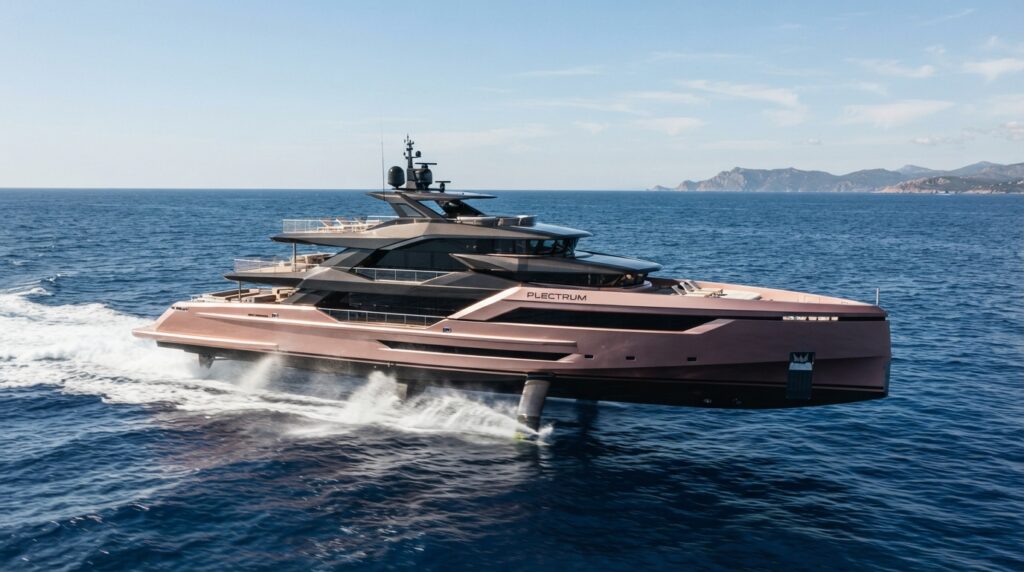
The Plectrum superyacht concept stands as one of the most intellectually disruptive yacht designs of the modern era. Unlike incremental innovations that refine propulsion, materials, or onboard technology, Plectrum questions something far more fundamental: the assumption that a yacht must be symmetrical.
For centuries, symmetry has been treated as an immutable law of naval architecture. It simplifies balance calculations, construction, and visual expectations. Yet symmetry is not inherently hydrodynamic. Water does not require it. The Plectrum concept exists to explore what happens when designers abandon tradition and allow physics, efficiency, and motion to dictate form.
As an experimental watercraft concept, Plectrum belongs firmly in the category of emerging watercraft, not because it introduces a new gadget, but because it challenges the foundational thinking behind large-scale marine design.
Conceptual Origins and Design Intent
The Plectrum concept was developed by forward-thinking naval architects who recognised that modern superyachts face persistent compromises:
- Excessive wave-making resistance
- Inefficient fuel consumption at realistic cruising speeds
- Passenger discomfort in moderate seas
- Hull shapes driven more by aesthetics than hydrodynamics
Rather than accepting these compromises, the designers pursued a clean-sheet approach. The central question was simple but radical:
If we removed symmetry entirely, how would a hull evolve if it were shaped purely by fluid dynamics?
The resulting form is neither gimmick nor art project. Every line, asymmetry, and structural decision is supported by computational fluid dynamics (CFD) modelling and seakeeping analysis.
Asymmetry as a Functional Advantage
The most striking feature of the Plectrum is its deliberate asymmetry. This is not imbalance; it is differentiation of function.
In traditional yachts:
- Both sides of the hull perform identical hydrodynamic roles
- Compromises are made to satisfy mirrored geometry
In the Plectrum:
- Each side of the hull is shaped for a specific hydrodynamic purpose
- One side prioritises wave penetration
- The other manages displacement, stability, and lift
This allows the hull to interact with waves more intelligently, reducing vertical acceleration and slamming forces that contribute to discomfort and structural fatigue.
Wave-Piercing Bow Geometry
Central to the Plectrum’s performance philosophy is its wave-piercing bow, a feature more commonly associated with offshore ferries and ocean-racing multihulls than luxury yachts.
Traditional yachts attempt to ride over waves, which leads to:
- Increased pitching
- Energy loss
- Reduced average cruising speeds
The Plectrum instead cuts through waves, maintaining momentum and reducing the violent motion that causes seasickness and crew fatigue. This design approach enables higher sustained speeds in real sea conditions rather than theoretical flat-water performance.
Hull Hydrodynamics and Resistance Reduction
The asymmetrical hull reduces resistance in several ways:
- Lower wave-making resistance due to fine entry angles
- Reduced wetted surface area at cruising speeds
- Improved flow attachment along the hull sides
CFD simulations suggest that such a hull could achieve meaningfully lower fuel consumption at comparable speeds to conventional yachts of similar displacement.
This is particularly significant as fuel efficiency and environmental responsibility become increasingly important in the superyacht sector.
Structural Engineering and Materials
Although Plectrum remains a concept, its proposed construction is grounded in established superyacht engineering practices.
Likely materials include:
- Advanced composite laminates
- Carbon fibre reinforcement in high-load zones
- Aluminium or hybrid composite superstructures
The asymmetrical structure would demand extreme precision in construction, but modern CNC moulding, digital modelling, and vacuum infusion techniques make such builds entirely feasible.
Importantly, asymmetry does not imply structural weakness. In many respects, the differentiated load paths allow for more efficient material distribution.
Stability and Seakeeping
A common concern regarding asymmetrical vessels is stability. The Plectrum addresses this through a combination of:
- Carefully distributed mass
- Hull geometry that balances hydrodynamic forces
- Active stabilisation systems
Rather than relying solely on static symmetry, the yacht achieves stability dynamically, adapting to speed and sea state.
This represents a broader shift in marine design philosophy: from passive balance to active control.
Propulsion Concepts and Efficiency Goals
The Plectrum is not conceived as a high-speed yacht chasing headline top speeds. Its performance objective is efficient, comfortable cruising at higher average speeds.
Proposed propulsion configurations include:
- High-efficiency diesel engines
- Hybrid diesel-electric systems
- Pod drives optimised for the hull form
By reducing drag and wave resistance, the Plectrum could achieve efficiency figures that would be unattainable for a conventional symmetrical yacht of comparable size.
Interior Layout Freed from Symmetry
One of the less obvious but most compelling advantages of asymmetry lies inside the yacht.
Traditional yachts are constrained by mirrored layouts, often wasting volume to maintain balance and visual order. The Plectrum allows designers to:
- Allocate space where it is most useful
- Create non-linear interior layouts
- Optimise sightlines and natural light
Cabins, lounges, and circulation areas can be shaped around human experience, not geometric convention.
Comfort and Human Factors
Comfort is not merely a luxury concern; it directly affects how a vessel is used.
By reducing pitching and slamming:
- Passengers remain comfortable for longer passages
- Crew fatigue is reduced
- Noise and vibration levels decrease
The Plectrum’s hull form is explicitly designed to improve real-world comfort, not just theoretical performance metrics.
Safety and Regulatory Considerations
Despite its unconventional appearance, the Plectrum concept does not ignore regulatory realities.
Any real-world implementation would need to meet:
- International stability standards
- Structural safety margins
- Redundancy requirements for propulsion and steering
The wave-piercing bow may actually enhance safety by reducing violent motion in head seas, a major contributor to onboard accidents.
Market Positioning and Target Audience
The Plectrum is not aimed at the traditional superyacht buyer seeking familiarity or resale predictability.
Instead, it appeals to:
- Visionary owners
- Technologists and innovators
- Clients seeking a statement vessel
- Buyers prioritising efficiency over tradition
Its value lies as much in intellectual leadership as in luxury.
Influence on Broader Marine Design
Even as a concept, the Plectrum has influenced discussion within naval architecture circles.
It demonstrates that:
- Asymmetry can be viable at large scale
- Comfort and efficiency need not conflict
- Luxury design can be performance-led
As environmental pressures increase, ideas once considered radical may become mainstream.
Relevance to Emerging Watercraft
While the Plectrum is a superyacht rather than a recreational craft, it belongs in emerging watercraft because it challenges foundational assumptions.
Its philosophy is likely to influence:
- High-performance cruising yachts
- Expedition vessels
- Advanced multihulls
- Future hybrid and electric craft
Innovation often begins at the extremes before filtering down.
Conclusion
The Plectrum superyacht concept is not simply an unusual shape; it is a provocation. By abandoning symmetry and prioritising hydrodynamic reality over tradition, it forces the marine industry to confront long-held assumptions.
Whether or not it is ever built, the Plectrum succeeds in its most important role: expanding the boundaries of what watercraft design can be.