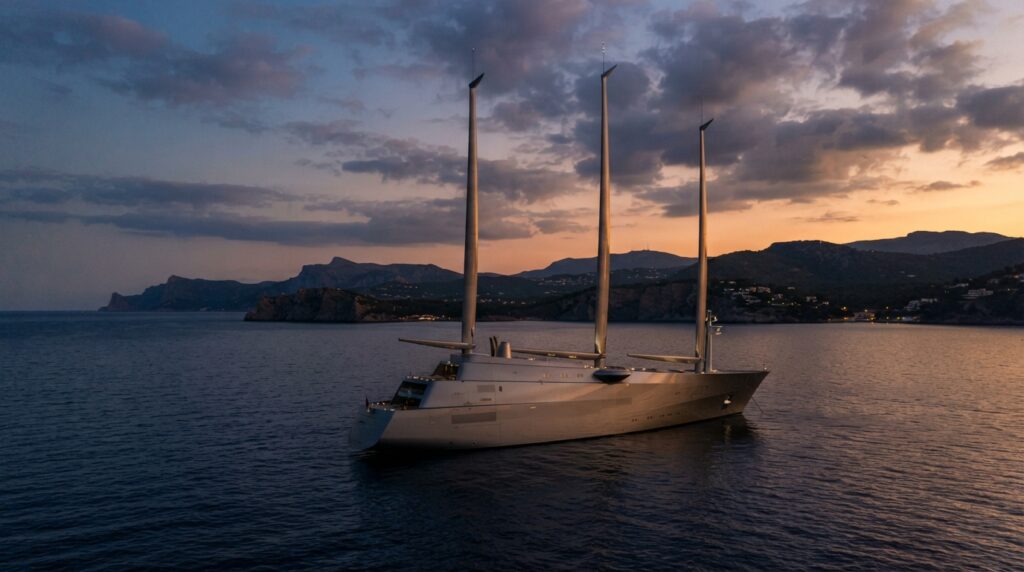

A high-resolution image of Sailing Yacht A underway or at anchor, showing its unmistakable angular hull, towering carbon masts, and dark, faceted superstructure rising starkly from the water.
Introduction: A Sailing Yacht That Broke Every Rule at Once
In the world of sailing yachts, tradition runs deep. Graceful sheer lines, classic proportions, and visual references to centuries of maritime heritage are the norm—even in the most advanced modern designs. Sailing Yacht A shattered that lineage in a single, uncompromising stroke.
Conceived not as an evolution of sailing yachts but as a complete re-invention, Sailing Yacht A stands as one of the most controversial and technically ambitious wind-powered vessels ever built. Its stark, almost militaristic appearance, unprecedented mast structure, and engineering-first philosophy place it firmly within Emerging Watercraft And Experimental Concepts.
This is not a yacht designed to please everyone. It is a yacht designed to challenge assumptions—about aesthetics, propulsion, automation, and the very definition of what a sailing vessel can be in the 21st century.
Origins: Vision Without Compromise
Sailing Yacht A was commissioned by a private owner known for demanding radical design and technical ambition. The project brought together:
- Philippe Starck, responsible for exterior and interior concept design
- Naval architects and marine engineers at the absolute top tier of superyacht design
- A construction programme that spared no expense, time, or complexity
From the outset, the brief was clear: create the most advanced sailing yacht ever built, free from stylistic nostalgia and unconstrained by convention.
The result was not a “beautiful” yacht in the classical sense, but something far rarer—a genuinely new archetype.
Exterior Design: Purpose Before Beauty
Sailing Yacht A’s appearance is immediately confronting.
Key visual characteristics include:
- A sharply raked, almost vertical bow
- Flat, faceted surfaces rather than flowing curves
- Dark, low-visibility colour schemes
- An overall silhouette more akin to a naval vessel than a leisure yacht
Every surface is driven by function: radar signature reduction, wind flow control, structural efficiency, and visibility management. There is little decorative flourish. Instead, the yacht presents a deliberately austere, almost intimidating presence.
This was intentional. The design rejects romanticism in favour of honesty—form dictated by engineering.
The Mast System: Engineering at Unprecedented Scale
The most extraordinary feature of Sailing Yacht A is its three freestanding carbon-fibre masts, among the tallest ever installed on a sailing vessel.
These masts:
- Rise over 100 metres above the waterline
- Are fully freestanding, with no standing rigging
- Are constructed from advanced carbon composites
- Support fully automated sail systems
Each mast is effectively a vertical cantilever beam, carrying immense compressive and bending loads while remaining rigid enough to control sail shape precisely.
This mast configuration alone places Sailing Yacht A closer to an experimental aerospace structure than a traditional sailing yacht.
Automated Sail Handling: Sailing Without Sailors on Deck
Sailing Yacht A was designed so that sails can be set, trimmed, reefed, and stowed with minimal human intervention.
Key elements include:
- Fully automated sail deployment systems
- Computer-controlled trimming based on wind data
- Enclosed sail storage within the masts
- Centralised control from the bridge
This level of automation is not about convenience—it is about safety, efficiency, and scale. At this size, traditional sail handling would be impractical and dangerous.
The yacht effectively treats wind as a controllable energy input, managed by software rather than muscle.
Hull Design and Hydrodynamics
Despite its visual severity, the hull of Sailing Yacht A is a highly refined piece of naval architecture.
Key hydrodynamic considerations include:
- A long, slender waterline for reduced resistance
- Optimised bulb keel geometry for righting moment
- Careful weight distribution to maintain trim
- Stability engineered for both sail and motor operation
The hull is designed to operate efficiently across a wide range of speeds and conditions, from long-distance ocean passages to precise manoeuvring in confined waters.
Hybrid Propulsion Philosophy
While fundamentally a sailing yacht, Sailing Yacht A incorporates advanced hybrid propulsion systems.
These include:
- High-efficiency diesel engines
- Electric propulsion assistance
- Energy recovery systems
- Integrated power management across all onboard systems
The philosophy is pragmatic rather than ideological. Wind power is used when it makes sense; engines are used when required. The goal is range, reliability, and operational flexibility, not adherence to purity.
Interior Design: Minimalism at Superyacht Scale
Inside, Philippe Starck’s approach continues the exterior philosophy—minimal, controlled, and deliberately non-traditional.
Interior spaces feature:
- Vast, open volumes
- Minimal ornamentation
- Carefully controlled lighting
- A restrained palette of materials and textures
Rather than opulence through decoration, the interior expresses luxury through space, silence, and precision. It feels more like a modern architectural gallery than a floating palace.
Command and Control: A Ship, Not a Toy
Sailing Yacht A is operated more like a naval vessel than a pleasure yacht.
Key operational features include:
- Advanced bridge systems with full situational awareness
- Integrated weather routing and sail optimisation
- Redundant safety and navigation systems
- Crew workflows designed around automation
The yacht’s scale and complexity demand a professional, systems-driven approach to operation. This is not a boat that can be “sailed by feel” alone.
Controversy and Public Reaction
Few yachts have provoked as much debate.
Criticisms often focus on:
- Its aggressive, non-traditional appearance
- Perceived lack of “romance” associated with sailing
- The stark contrast with classic yacht aesthetics
Supporters counter that Sailing Yacht A represents true innovation, not nostalgia disguised as progress.
Regardless of opinion, the yacht succeeded in one crucial respect: it forced the entire marine world to re-examine its assumptions.
Why Sailing Yacht A Is an Experimental Watercraft
Despite its immense cost and luxury trappings, Sailing Yacht A is fundamentally an experimental platform.
It tests:
- Large-scale freestanding mast technology
- Fully automated sail systems
- Hybrid propulsion integration
- Radical form-follows-function design philosophy
Many of its solutions are not yet scalable or economical for broader adoption—but that is precisely the role of experimental craft.
Influence on Future Yacht Design
While few owners will commission a direct imitation, Sailing Yacht A has already influenced:
- Mast and sail automation development
- Hybrid propulsion acceptance in sailing yachts
- Structural use of large-scale carbon components
- Greater willingness to abandon traditional styling
It expanded the design envelope, even for those who choose not to follow its path.
Limitations and Trade-Offs
Innovation at this scale comes with compromises:
- Extremely high build and maintenance costs
- Complex systems requiring specialist crew
- Limited marina compatibility due to size and mast height
These constraints confine Sailing Yacht A to the very top of the market—but that was always its intent.
Cultural Significance
Sailing Yacht A reflects a broader cultural shift in design: a move away from comforting tradition toward bold, sometimes uncomfortable experimentation.
Like certain landmark buildings or aircraft, it may not be universally loved—but it is undeniably important.
Why It Belongs in Emerging Watercraft And Experimental Concepts
Sailing Yacht A earns its place in this category because it does not refine the past—it rejects it outright in favour of a new design language and engineering philosophy.
It is a proof-of-concept on a monumental scale, demonstrating what is possible when cost, convention, and criticism are not limiting factors.
Conclusion: The End of Nostalgia, the Beginning of Possibility
Sailing Yacht A is not a yacht for dreamers of the past. It is a yacht for those willing to imagine a future where sailing is defined by data, automation, and engineering precision rather than tradition.
Whether admired or criticised, it stands as one of the most significant experimental sailing vessels ever built—a reminder that progress in watercraft design sometimes requires burning the rulebook entirely.
See more at www.vectorwatercraft.com.au