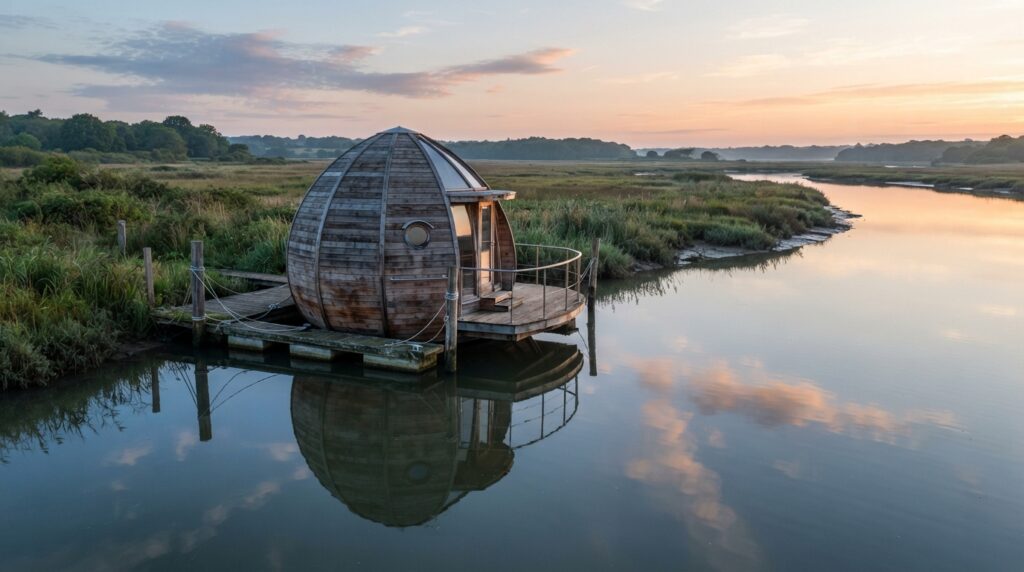

A high-resolution image of the Exbury Egg moored in a tidal estuary, showing its smooth, ovoid timber hull sitting low in the water, with marshland and shifting tides around it.
Introduction: Why the Exbury Egg Matters
In the long history of watercraft design, progress has usually followed one of two paths: greater speed or greater capacity. Occasionally, however, a project appears that deliberately steps away from those traditional objectives and asks a more fundamental question—how should humans live with water, rather than merely travel across it?
The Exbury Egg, conceived and built in Great Britain, belongs firmly in this second category. It is not a yacht, not a houseboat in the conventional sense, and certainly not a commercial vessel. Instead, it is an experimental, inhabitable floating structure designed to explore sustainability, minimal environmental impact, and the relationship between human habitation and tidal waterways.
Although modest in size and speed (it has none), the Exbury Egg has earned international attention because it challenges entrenched assumptions about watercraft, architecture, and the way people interact with rivers, estuaries, and coastlines. In doing so, it earns its place under Emerging Watercraft And Experimental Concepts—not because it represents the future of mass boating, but because it represents a future way of thinking.
Origins of the Exbury Egg
The Exbury Egg was developed by artist and designer Stephen Turner, working in collaboration with naval architects, boatbuilders, environmental scientists, and local authorities in southern England. Turner’s intention was not to create a product, but a living experiment—a structure in which he would personally live for an extended period while studying the rhythms of a tidal river.
The project was launched on the Beaulieu River in Hampshire, a protected tidal estuary known for its ecological sensitivity. This choice of location was deliberate. The Beaulieu River experiences constant tidal movement, changes in salinity, and diverse wildlife activity, making it an ideal testbed for a floating habitat intended to coexist gently with nature.
From the outset, the Exbury Egg was conceived as:
- A temporary dwelling, not a permanent installation
- A non-invasive structure, leaving no lasting footprint
- A self-contained living space, with minimal external inputs
- A platform for observing human impact on sensitive waterways
Design Philosophy: Form Follows Environment
At first glance, the Exbury Egg’s shape is striking—an elongated ovoid, smooth and organic, with no sharp edges or conventional superstructure. This form is not aesthetic indulgence; it is functional.
The egg-like shape was chosen because:
- It distributes loads evenly
- It resists tidal forces from multiple directions
- It sheds debris rather than catching it
- It presents minimal surface area to currents and waves
In maritime terms, the Exbury Egg behaves more like a buoyant organism than a vessel. It neither cuts through the water nor planes across it. Instead, it rises and falls with the tide, rotating gently as currents change.
This passive relationship with water is central to the project’s philosophy. The Egg does not fight the environment—it yields to it.
Construction and Materials
The Exbury Egg was built using traditional wooden boatbuilding techniques, combined with modern sustainability principles. Its hull consists of laminated timber planking over a carefully engineered internal frame.
Key construction features include:
- Marine-grade plywood and hardwood laminates, chosen for durability and renewability
- Natural oils and sealants rather than toxic antifouling paints
- Insulation materials selected for thermal performance and low environmental impact
- No permanently fixed foundations or anchors
The interior was fitted out using reclaimed timber and minimal fixtures. Every material choice was scrutinised not only for performance, but for what would happen after the project ended. The Egg was designed to be dismantled, reused, or returned harmlessly to the environment.
Living Inside the Exbury Egg
The interior of the Exbury Egg is deliberately compact. Space is not wasted, and nothing is decorative for its own sake. Inside, Turner lived with:
- A small sleeping platform
- Basic cooking facilities
- Limited freshwater storage
- Minimal electrical power, primarily for lighting and documentation equipment
There was no conventional bathroom. Waste management relied on composting systems and strict personal discipline. Heating came from body warmth, insulation, and occasional low-energy sources.
This was not discomfort for novelty’s sake. The aim was to understand what is truly necessary for human habitation on water—and what is merely habit.
Living inside the Egg required constant awareness of:
- Tidal cycles
- Weather patterns
- Daylight hours
- Energy consumption
- Waste generation
In effect, the structure forced its occupant into a daily dialogue with the natural environment.
Mobility and Mooring
The Exbury Egg is not self-propelled. It does not have an engine, sails, or oars. Movement occurs only when it is towed to a new location, typically at slack tide to minimise disturbance.
When moored, the Egg uses a carefully designed system that allows:
- Vertical movement with the tide
- Limited horizontal drift
- No dragging anchors across the riverbed
This is critical in estuarine environments, where traditional anchors can damage fragile ecosystems. By floating freely within controlled limits, the Egg avoids scouring the riverbed or disturbing marine life.
Environmental Impact and Observations
One of the most valuable outcomes of the Exbury Egg project was the data and observation gathered during its deployment.
Researchers monitored:
- Water quality around the Egg
- Wildlife behaviour in its immediate vicinity
- Biofouling on the hull
- Sediment movement
Interestingly, the Egg quickly became part of the environment rather than an intrusion. Algae and small organisms colonised the hull, fish gathered beneath it, and birds perched on it. Rather than repelling life, the structure became a micro-habitat.
This outcome has significant implications for future floating structures, suggesting that with careful design, human habitation on water does not have to be ecologically destructive.
Cultural and Symbolic Significance
Beyond its technical merits, the Exbury Egg captured public imagination because it symbolised a rethinking of progress.
In an era dominated by larger yachts, faster boats, and increasingly resource-intensive marine leisure, the Egg offered a counterpoint:
- Stillness instead of speed
- Observation instead of domination
- Sufficiency instead of excess
It also bridged disciplines—art, architecture, naval design, and environmental science—demonstrating that innovation often occurs at the edges between fields.
Lessons for Future Watercraft
While the Exbury Egg is unlikely to inspire a production line of egg-shaped boats, its influence can be seen in several emerging areas:
Floating micro-habitats
Compact, low-impact dwellings for research, conservation, and temporary habitation.
Eco-sensitive mooring systemsDesigns that allow vertical tidal movement without seabed damage.
Biophilic marine design
Structures that encourage coexistence with marine life rather than exclusion.
Low-energy living afloat
Re-evaluating energy, water, and waste systems for minimal dependence on external supply chains.
These ideas are increasingly relevant as coastal populations grow and pressure on waterfront land intensifies.
Comparison With Traditional Watercraft
Traditional boats are judged on metrics such as speed, range, stability under way, and payload. The Exbury Egg ignores these criteria entirely.
Instead, it is judged by:
- Environmental neutrality
- Human comfort with minimal resources
- Ease of removal and restoration
- Ability to exist without altering its surroundings
In this sense, it represents a parallel evolution—not of boating, but of floating habitation.
Criticisms and Limitations
It is important to be clear-eyed. The Exbury Egg is not a universal solution.
Limitations include:
- Extremely limited interior space
- Unsuitability for exposed waters
- No independent propulsion
- Reliance on external support for relocation
However, these constraints are intrinsic to the project’s purpose. It was never intended as a lifestyle product or a commercial prototype.
Why the Exbury Egg Belongs in Emerging Watercraft And Experimental Concepts
The Exbury Egg earns its place in this category because it expands the definition of what a “watercraft” can be. It challenges the assumption that vessels must move, that they must conquer water, or that they must prioritise convenience over consequence.
In doing so, it contributes valuable insight at a time when:
- Rising sea levels demand new thinking about habitation
- Environmental sensitivity is no longer optional
- Resource efficiency is becoming a core design requirement
Conclusion: Quiet Innovation With Lasting Impact
The Exbury Egg will never race across open water, carry passengers, or appear in glossy yacht brochures. Yet its influence is arguably deeper than many high-profile vessels.
By living quietly on a tidal river, rising and falling with the water, it demonstrated that innovation does not always roar. Sometimes it floats, observes, and leaves almost no trace behind.
As emerging watercraft concepts continue to evolve—whether hydrofoils, electric vessels, or autonomous platforms—the Exbury Egg stands as a reminder that the future of watercraft is not only about technology, but about values.
see more at www.vectorwatercraft.com.au