
The Fundamental Mistake in Small Boat Thinking
In many areas of recreational boating, particularly among first-time buyers and kit-based builders, there is a persistent misconception: that the engine defines the boat. This thinking leads people to focus first on power—kilowatts, horsepower, torque—before giving proper consideration to the structure that must carry and control that power.
In mini jet boats, this approach is not only flawed—it is dangerous.
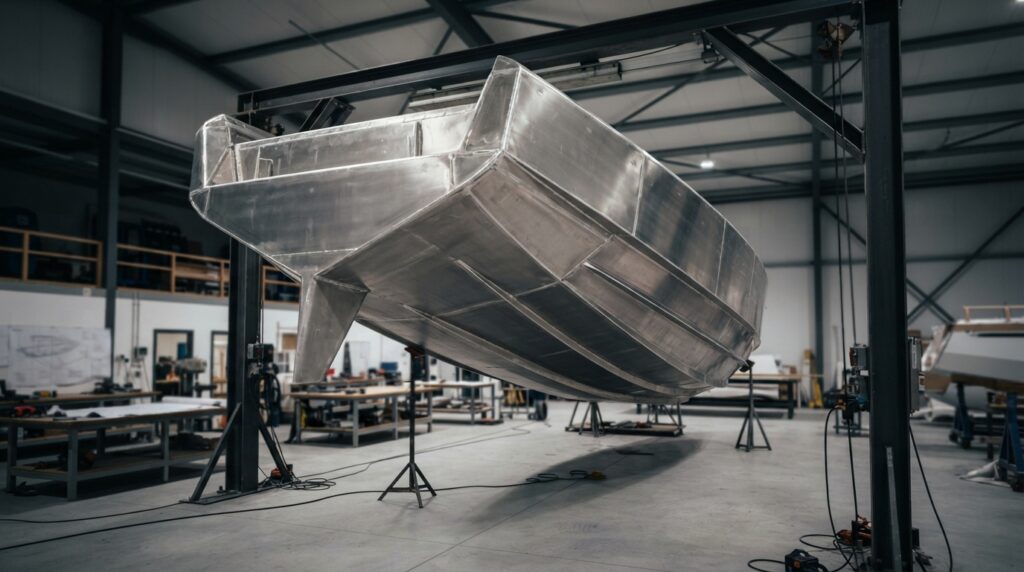
The hull is not a passive platform. It is the primary engineering element that determines how a boat behaves on the water. It governs stability, efficiency, handling, load capacity, and safety. The propulsion system must be selected to suit the hull—not the other way around.
This article examines why hull design must always come before motor selection in mini jet boats, and why reversing this order introduces significant performance and safety risks.
The Hull as the Core Engineering System
More Than Shape—A Functional Design
A mini jet boat hull is engineered to perform a series of critical functions:
- Displace and support weight
- Generate lift at speed
- Maintain directional stability
- Absorb impact forces
- Distribute structural loads
Every curve, angle, and structural reinforcement is designed with these functions in mind.
Importantly, the hull is designed based on assumptions about:
- Total system weight
- Power input levels
- Intended operating conditions
If these assumptions are not respected, the hull cannot perform as intended.
Hydrodynamics Define Behaviour
The way a hull interacts with water—its hydrodynamics—determines how the boat accelerates, turns, and maintains stability.
Key hydrodynamic factors include:
- Planing surface area
- Deadrise angle
- Chine design
- Water flow patterns beneath the hull
These characteristics are matched to a specific performance profile. Changing the propulsion system without regard to these factors disrupts this balance.
Why Starting with the Motor Creates Problems
The Temptation of Power-First Thinking
Buyers are often drawn to engines first because power is easy to quantify. It is a clear, measurable specification that appears to define performance.
This leads to decisions such as:
- Selecting the most powerful motor available
- Choosing based on advertised speed potential
- Prioritising acceleration over control
The Consequence: Forced Compatibility
Once a motor is selected, the builder attempts to “fit” it into a hull. This approach reverses the correct engineering process.
Instead of designing a system, it becomes an exercise in compromise:
- Adjusting mounting points
- Modifying weight distribution
- Attempting to correct handling issues after the fact
These adjustments rarely achieve optimal results and often introduce new problems.
Power-to-Hull Relationship
Matching Power to Hydrodynamic Capacity
Every hull has a limit to how much power it can effectively use. Beyond this limit:
- Additional power does not improve performance
- Stability decreases
- Efficiency drops
A properly designed mini jet boat ensures that:
- Power output aligns with hull capability
- Acceleration is controlled
- Top speed remains within safe handling limits
The Risk of Overpowering
When motor selection comes first, overpowering is common.
This leads to:
- Excessive speed relative to hull size
- Increased instability
- Structural stress
The hull is forced to operate outside its intended range, compromising safety.
Weight Distribution and Balance
The Impact of Motor and Battery Placement
In electric mini jet boats, the propulsion system includes both the motor and the battery pack. These components represent a significant portion of the vessel’s total weight.
If the hull is not designed to accommodate:
- The size and weight of the motor
- The placement of the battery system
the result is poor balance.
Consequences of Poor Balance
Incorrect weight distribution can cause:
- Bow rise or stern squat
- Reduced control at speed
- Increased likelihood of instability
A hull designed first allows for:
- Optimal placement of heavy components
- Proper centre of gravity
- Stable and predictable handling
Jet Propulsion Integration
Precision Is Essential
Mini jet boats rely on jet propulsion systems that must be precisely aligned with the hull.
Key considerations include:
- Intake positioning
- Water flow efficiency
- Alignment between motor and jet unit
Why Hull Design Leads
The hull dictates:
- Where the intake can be positioned
- How water flows into the system
- The angle at which thrust is delivered
Selecting a motor first does not address these factors. Only a hull-first approach ensures that propulsion is fully optimised.
Structural Integrity
Designing for Load and Stress
The hull must withstand forces generated by:
- Acceleration
- Turning
- Impact with water
These forces are directly influenced by the power of the motor.
The Risk of Retrofitting Power
When a motor is added to a hull not designed for it:
- Structural loads may exceed safe limits
- Reinforcements may be inadequate
- Long-term durability is compromised
A hull designed with the intended power in mind ensures that:
- Materials and construction methods are appropriate
- Stress is distributed safely
- The structure remains reliable over time
Handling and Control
Predictability Through Design
A well-designed mini jet boat provides predictable handling. This is achieved through:
- Balanced weight distribution
- Appropriate power levels
- Optimised hull geometry
The Effect of Mismatched Systems
When motor selection drives the design:
- Handling becomes inconsistent
- Steering response may be unpredictable
- Stability may be compromised
This reduces operator confidence and increases the risk of accidents.
Efficiency and Performance
The Role of Hydrodynamic Efficiency
Efficiency in a mini jet boat depends on how effectively the hull moves through water. This is influenced by:
- Hull shape
- Weight
- Power input
Why More Power Does Not Equal Better Efficiency
If the hull is not designed for a particular power level:
- Energy is wasted
- Drag increases
- Performance gains are limited
A balanced system delivers better real-world performance with less power.
The Importance of Testing
Validation of the Complete System
When the hull is designed first and the motor selected accordingly, the entire system can be tested as a unit.
This allows manufacturers to:
- Confirm performance characteristics
- Identify potential issues
- Ensure safety under various conditions
The Absence of Testing in Reverse Builds
In motor-first builds:
- Testing is often limited or absent
- Performance is uncertain
- Safety margins are unknown
This introduces unnecessary risk for the operator.
Practical Implications for Buyers
Evaluating a Mini Jet Boat
Buyers should prioritise:
- Hull design and construction quality
- Evidence of engineering and testing
- Integration of propulsion systems
Rather than focusing solely on:
- Power specifications
- Advertised speed
The Value of Integrated Systems
Fully engineered mini jet boats offer:
- Balanced performance
- Predictable handling
- Proven safety
These advantages are the result of starting with the hull and designing the system around it.
Australian Conditions: Why This Approach Matters
Australia’s waterways require versatility and reliability. Conditions can vary from:
- Shallow rivers
- Coastal environments
- Inland lakes
A hull-first design approach ensures that the boat is suited to these conditions, providing:
- Stability across environments
- Reliable performance
- Greater safety margins
Long-Term Ownership Benefits
Durability and Maintenance
A properly matched system experiences:
- Less structural stress
- Reduced wear on components
- Lower maintenance requirements
Resale Value
Buyers recognise the value of:
- Professionally engineered systems
- Proven performance
- Reliable construction
This supports stronger resale value compared to improvised builds.
Conclusion: Design Must Lead, Not Follow
In mini jet boats, the hull is the foundation upon which everything else is built. It defines the limits, capabilities, and behaviour of the vessel.
Selecting a motor before understanding the hull reverses the engineering process and introduces unnecessary risk.
A hull-first approach ensures that:
- Power is appropriate and controlled
- Weight is balanced
- Performance is predictable
- Safety is prioritised
For buyers and builders alike, the message is clear:
the hull is not just part of the boat—it is the boat. Everything else must follow.
See More at www.vectorwatercraft.com.au