
Introduction: The Thin Layer That Changes Everything
When people think about watercraft performance, they usually focus on visible features—hull shape, propulsion type, power output, or overall size. Yet one of the most influential factors in how a craft moves through water is almost invisible: the boundary layer.
The boundary layer is the thin region of water that clings to a hull’s surface as the craft moves forward. Within this layer, water velocity transitions from zero (right at the hull surface) to the free-stream flow of surrounding water. How this layer behaves determines drag, efficiency, stability, and ultimately how controllable and economical a watercraft can be.
For decades, boundary-layer behaviour was something designers worked around rather than actively controlled. Today, experimental watercraft are changing that. Advances in materials, electric propulsion, precise manufacturing, and fluid-dynamics modelling are allowing designers to deliberately manage the boundary layer rather than simply accept it.
This article explains what boundary-layer control actually is, why it matters, how experimental watercraft are using it, and where its real limits lie.
What the Boundary Layer Is and Why It Exists
The boundary layer forms because water, like all fluids, resists slipping freely over a solid surface. Molecules of water in direct contact with a hull adhere to it due to viscosity. As distance from the hull increases, water velocity gradually increases until it matches the surrounding flow.
This thin zone—often only millimetres thick—creates a disproportionate amount of resistance. In many small watercraft, a large percentage of total drag originates within this boundary layer rather than from wave generation or form drag.
Understanding this reality is the first step toward appreciating why boundary-layer control matters so much, particularly for electric and experimental craft where efficiency is critical.
Laminar vs Turbulent Flow: The Core Distinction
Boundary layers behave in two primary ways: laminar or turbulent.
- Laminar flow is smooth and orderly, with water moving in parallel layers
- Turbulent flow is chaotic, with swirling motion and energy loss
Laminar flow produces significantly less drag than turbulent flow. However, it is also fragile. Small imperfections, surface roughness, or changes in pressure can cause laminar flow to break down into turbulence.
Traditional watercraft rarely maintain laminar flow for long. Hull imperfections, fouling, and operating conditions usually force turbulence early along the hull surface.
Experimental watercraft aim not necessarily to eliminate turbulence, but to control where and how it occurs.
Why Boundary-Layer Control Matters More for Electric Craft
Boundary-layer control has always mattered, but it matters far more in electric watercraft.
Electric systems carry finite energy onboard. Unlike petrol craft, there is no easy refuelling mid-session. Every percentage point of drag reduction translates directly into longer runtime, greater range, or higher usable performance.
In experimental craft—often smaller, lighter, and operating at moderate speeds—boundary-layer drag can dominate total resistance. This makes boundary-layer management one of the highest-leverage design strategies available.
Reducing drag by even small amounts can deliver disproportionate real-world benefits.
Traditional Hull Design and Passive Boundary-Layer Management
Historically, boundary-layer behaviour was managed passively through hull shaping.
Smooth hull surfaces, gradual curvature, and careful transitions were used to delay turbulence and reduce separation. While effective to a point, this approach has limits. Once flow becomes turbulent, passive shaping alone cannot restore laminar behaviour.
In addition, real-world conditions—surface wear, minor damage, marine growth—quickly degrade theoretical performance.
This is why experimental watercraft increasingly explore active or semi-active boundary-layer strategies.
Surface Texturing: Learning from Nature
One of the most explored boundary-layer strategies involves surface texturing.
Nature provides well-studied examples. Shark skin, for instance, features microscopic riblets that reduce drag by organising turbulent vortices rather than eliminating them. These riblets reduce energy loss within the turbulent boundary layer.
Experimental watercraft are beginning to adopt similar concepts through:
- Micro-ribbed surface films
- Directional surface textures
- Engineered roughness patterns
The goal is not perfectly smooth surfaces, but controlled roughness that produces predictable flow behaviour.
These approaches are particularly attractive because they require no power and minimal mechanical complexity.
Boundary-Layer Tripping: Controlled Turbulence
Counterintuitively, some experimental designs deliberately trigger turbulence early in the boundary layer.
This technique, known as boundary-layer tripping, prevents unpredictable flow separation further downstream. While laminar flow is ideal, unstable laminar flow can collapse suddenly, causing sharp increases in drag and loss of control.
By forcing an early, controlled transition to turbulence, designers achieve more stable handling and predictable performance across a wider range of conditions.
This approach is common in aerospace and is now being adapted to watercraft operating in variable environments.
Air and Water Injection Concepts
More experimental approaches involve injecting air or water into the boundary layer.
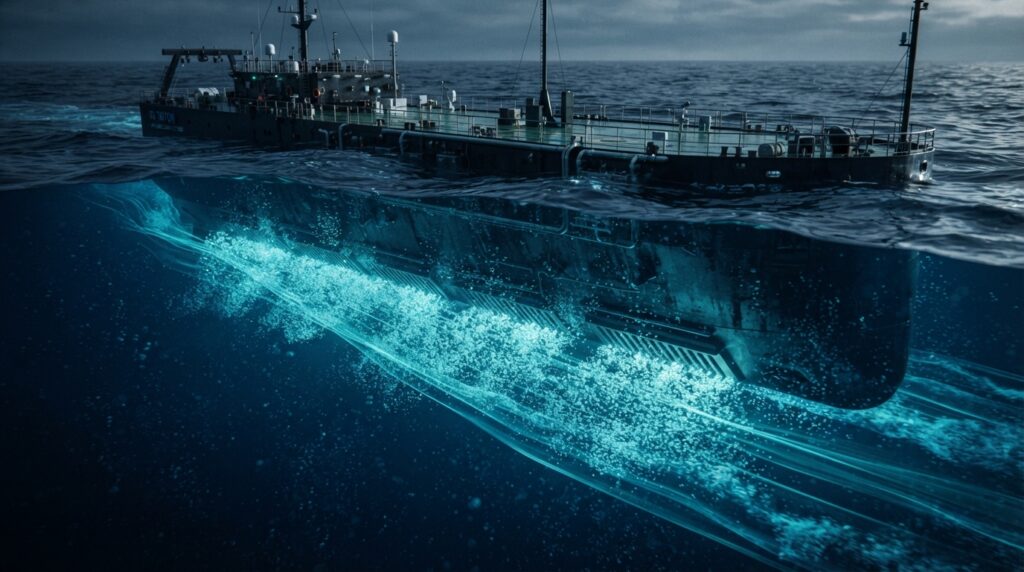
Air lubrication systems, for example, introduce a thin layer of air bubbles along the hull surface, reducing skin friction. While effective on large commercial vessels, these systems are complex and energy-intensive.
Experimental small craft explore scaled-down concepts, such as:
- Localised air injection near high-drag zones
- Water-jet boundary energisation
- Controlled micro-bubble generation
At present, these systems remain largely experimental due to complexity, reliability concerns, and energy trade-offs.
Hull Steps, Channels, and Flow Separation Control
Hull steps and channels represent another form of boundary-layer management.
By intentionally separating flow at specific points, stepped hulls reduce wetted surface area and reset the boundary layer. This can reduce drag at speed but introduces handling trade-offs.
Experimental watercraft refine these ideas by using shallow steps, micro-channels, and transitional surfaces rather than aggressive planing steps.
The goal is to manage boundary-layer thickness without destabilising the craft.
Manufacturing Precision and Boundary-Layer Reality
Boundary-layer control is extremely sensitive to manufacturing quality.
Small imperfections—waviness, misalignment, inconsistent surface finish—can negate theoretical gains. This is why many boundary-layer concepts remain confined to experimental or premium craft.
Advances in CNC machining, composite moulding, and surface finishing now allow tolerances tight enough to make boundary-layer control viable beyond laboratory conditions.
However, maintenance becomes critical. Damage or fouling can undo carefully engineered flow behaviour.
Boundary-Layer Control and Stability
Boundary-layer behaviour influences not only efficiency but also stability.
Flow separation along one side of a hull can create asymmetric drag, leading to yaw instability. Controlled boundary layers reduce this risk, producing more consistent handling across speed ranges.
For experimental craft—often ridden or operated close to the water surface—this stability improvement is as important as efficiency gains.
Why Boundary-Layer Control Has Limits
Despite its promise, boundary-layer control is not a magic solution.
Its effectiveness diminishes in:
- Very rough water
- Heavily fouled hulls
- Highly variable loading conditions
- Low-precision manufacturing environments
In addition, complexity introduces failure risk. Active systems must justify their weight, power consumption, and maintenance demands.
As a result, the most successful approaches tend to be simple, passive, and robust.
Boundary-Layer Control in the Context of Experimental Craft
Experimental watercraft are ideal platforms for boundary-layer exploration because they are not constrained by legacy design expectations.
Designers can test unconventional textures, hull features, and flow-management concepts without needing immediate mass-market acceptance. Successful ideas can then migrate into mainstream designs over time.
This is how many now-standard marine technologies began.
What Boundary-Layer Control Will Influence First
In the near term, boundary-layer control will most strongly influence:
- Runtime and range of electric craft
- Low-to-moderate speed efficiency
- Handling predictability
- Noise and vibration levels
Rather than delivering dramatic top-speed increases, it will quietly improve usability and confidence.
The Next Decade of Boundary-Layer Innovation
Over the next decade, expect gradual integration rather than sudden breakthroughs.
Surface coatings, refined hull transitions, and passive texturing will become more common. Fully active systems will remain rare outside specialist applications.
As electric watercraft adoption grows, efficiency gains that once seemed marginal will become economically and practically significant.
Conclusion: Small Layers, Large Impact
Boundary-layer control operates at the smallest scale of watercraft design, yet its influence is immense.
By managing how water behaves at the hull surface, experimental watercraft unlock gains in efficiency, stability, and predictability that cannot be achieved through power alone.
The future of watercraft performance will not be defined solely by bigger motors or larger batteries. It will be shaped by how intelligently designers manage the thin layer of water that touches the hull.
In experimental watercraft, boundary-layer control is not a curiosity. It is one of the clearest examples of how subtle engineering delivers real-world advantage.
See More at www.vectorwatercraft.com.au.