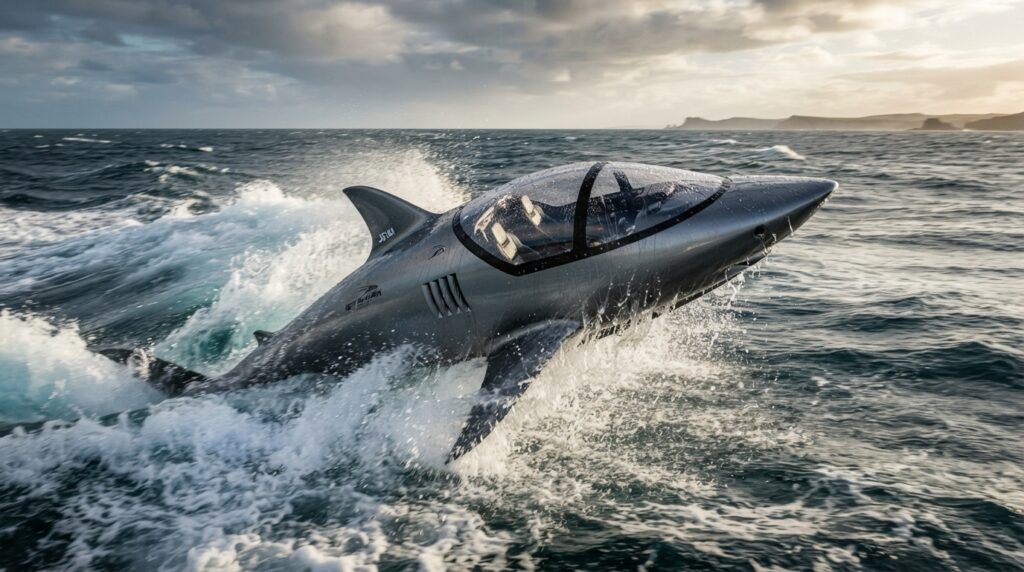
A high-impact action image of the Jet Shark on open water, clearly showing the shark-like body profile, dorsal fin styling, aggressive stance, and rider seated low within the hull.
Introduction: when imagination becomes hydrodynamics
Among experimental watercraft, Jet Shark occupies a very unusual space. It is not merely a fast craft, nor simply a novelty. Jet Shark is a deliberate attempt to merge biomimicry, personal watercraft engineering, and visual theatre into a single machine that challenges how people emotionally and physically engage with speed on water.
Where many experimental vessels pursue efficiency, sustainability, or outright performance, Jet Shark pursues something older and more primal: the sensation of being part of the water itself, shaped like one of the ocean’s most recognisable predators. This alone places it firmly within the “Emerging Watercraft and Experimental Concepts” category, because it redefines the relationship between rider, machine, and environment.
Jet Shark is not about practicality in the conventional sense. It is about experience design, and that makes it just as important to study as foil-borne craft or record-breaking speed machines.
The concept: riding inside a creature, not on a machine
Most personal watercraft place the rider on top of the vehicle. Jet Shark reverses that idea. The rider is positioned within the body of the craft, low to the waterline, almost cocooned. This fundamentally alters:
- Perceived speed
- Sensory immersion
- Rider confidence and fear response
By enclosing the rider and lowering their centre of gravity, Jet Shark produces a feeling closer to piloting a small submersible than riding a jet ski. The shark-inspired outer shell is not merely aesthetic; it frames the psychological experience.
This is a classic example of experimental watercraft design where emotion is engineered just as deliberately as propulsion.
Biomimicry as design language
Sharks represent one of nature’s most refined hydrodynamic forms. While Jet Shark is not a true biological replica, its designers clearly drew inspiration from:
- Tapered nose geometry
- Smooth, uninterrupted surface flow
- Broad mid-section narrowing to a stabilising tail
- Visual cues that suggest speed even when stationary
Biomimicry in marine design is not new, but it is rarely pushed this far into the realm of personal craft identity. Jet Shark doesn’t simply borrow shapes—it borrows narrative. The craft tells a story before it moves.
In experimental design, narrative matters because it influences how users accept unconventional machines.
Hull form and water interaction
From a hydrodynamic perspective, Jet Shark sits somewhere between:
- A personal watercraft (PWC)
- A small semi-submersible planing hull
- A novelty craft with serious engineering underneath
The hull is designed to ride low, increasing water contact compared to high-riding jet skis. This increases drag, but also:
- Improves directional stability
- Enhances rider immersion
- Creates smoother transitions through chop
Rather than skipping across the surface, Jet Shark cuts and flows, reinforcing the biological illusion.
Propulsion: jet-driven simplicity
Jet Shark uses jet propulsion, aligning it with modern PWCs rather than prop-driven novelty craft. This choice brings several advantages:
- No exposed propeller (critical for safety)
- Shallow water operation
- Rapid throttle response
- Compatibility with existing PWC propulsion technology
Importantly, jet propulsion also fits the shark metaphor. The thrust feels continuous and fluid rather than mechanical, reinforcing the sensation of swimming rather than driving.
Speed: deliberately secondary
Unlike Sailrocket or extreme PWCs, Jet Shark is not designed to chase outright speed records. That restraint is intentional.
Excessive speed would undermine:
- Rider comfort inside the shell
- Visual realism
- Control in confined waterways
Jet Shark instead prioritises controlled performance—fast enough to feel thrilling, slow enough to remain manageable and theatrical.
This highlights an important experimental lesson: innovation does not always mean faster. Sometimes it means different.
Control and ergonomics
Control systems in Jet Shark are designed to be intuitive, even for inexperienced riders. Key characteristics include:
- Low seating position
- Forward-focused visibility
- Hand controls that minimise abrupt inputs
- Predictable turning radius
Because the rider sits inside the body rather than balancing on top, fatigue is reduced and confidence increases. This makes Jet Shark surprisingly accessible, despite its radical appearance.
From a design standpoint, this addresses a long-standing challenge in personal watercraft: how to make high-engagement experiences less physically demanding.
Materials and construction
Jet Shark shells are typically constructed using advanced composites, chosen for:
- Smooth surface finish
- Structural rigidity
- Corrosion resistance
- Ability to form complex curves
This is where experimental watercraft often diverge from mass production. The tooling and labour required to create such sculpted forms would be impractical for mainstream PWCs, but acceptable for niche, high-impact concepts.
The internal structure must balance strength with weight, ensuring the craft remains responsive without becoming unwieldy.
Safety considerations
Despite its dramatic styling, Jet Shark integrates several safety advantages:
- Jet propulsion eliminates propeller risk
- Enclosed rider position reduces fall-off incidents
- Low centre of gravity improves stability
- Predictable handling reduces panic responses
However, the enclosed nature also requires careful ventilation, visibility management, and emergency egress design—areas where experimental craft must be engineered meticulously to avoid novelty becoming liability.
Jet Shark as experiential design
Jet Shark is best understood not as a boat, but as an experience platform. Its strongest applications are not necessarily personal ownership, but:
- Resorts and high-end tourist destinations
- Theme parks and controlled marine environments
- Promotional events and brand activations
- Film and media production
In these contexts, Jet Shark excels. It delivers spectacle without requiring extreme piloting skill, making it ideal for curated experiences.
Cultural impact: why people remember it
Most watercraft blur together in memory. Jet Shark does not. Its form taps into something deeply familiar and deeply emotional. People don’t just ride Jet Shark—they talk about it.
In experimental watercraft, memorability is a form of success. It keeps ideas alive long after the ride ends.
Relevance to the future of watercraft
Jet Shark hints at several future directions:
- Greater emphasis on experience-first design
- More immersive, enclosed personal craft
- Biomimicry influencing not just performance, but storytelling
- Hybridisation between entertainment and transportation
As electric propulsion and quieter motors become mainstream, concepts like Jet Shark become even more viable, particularly in sensitive or regulated waterways.
Australian context
Australia’s strong marine leisure culture makes it fertile ground for experiential watercraft concepts. However, Jet Shark would need to navigate:
- State-based marine compliance
- Registration classification (PWC vs vessel)
- Environmental and noise regulations
- Commercial operation licensing
That said, Australia’s resort destinations, coastal tourism hubs, and appetite for novelty make it a natural fit in controlled settings.
Lessons for designers and innovators
Jet Shark teaches several enduring lessons:
- Emotional engagement can be engineered
- Visual identity can be as powerful as raw performance
- Rider psychology matters as much as hydrodynamics
- Experimental craft don’t need mass appeal to be influential
In a field often obsessed with numbers, Jet Shark reminds us that feeling matters.
Conclusion: a predator of imagination
Jet Shark may never redefine mainstream boating—but that was never its purpose. Its role is to stretch the boundaries of what personal watercraft can be, emotionally and experientially.
As part of the Emerging Watercraft and Experimental Concepts category, Jet Shark stands as a bold reminder that innovation is not always linear. Sometimes it swims sideways, leaving a wake not of speed records, but of unforgettable impressions.
See more at www.vectorwatercraft.com.au