
Introduction: A Different Definition of Power at Sea
For most of modern maritime history, progress at sea has been measured in horsepower, fuel capacity, and range under internal combustion. The Silent 120 Explorer represents a decisive break from that legacy. Rather than asking how much fuel a vessel can carry or how fast it can burn it, Silent Yachts asks a far more contemporary question:
What if a large yacht could generate most of its own energy, operate almost silently, and dramatically reduce dependence on fossil fuels—without sacrificing luxury or capability?
The Silent 120 Explorer is not a concept sketch or speculative rendering. It is a real, ocean-capable vessel that belongs squarely in the category of emerging watercraft, because it challenges one of the most entrenched assumptions in marine design: that serious yachts must be noisy, fuel-hungry machines.
Origins of Silent Yachts and the Solar-Electric Vision
Silent Yachts originated from a simple but ambitious premise: the sun delivers more energy to a yacht’s deck each day than most owners realise. Rather than treating solar panels as auxiliary gimmicks, Silent Yachts integrates them as primary energy contributors.
Early Silent models focused on smaller catamarans, proving that solar-electric propulsion could be viable beyond short harbour cruises. With each successive generation, the company increased scale, battery capacity, and ambition—culminating in the Silent 120 Explorer, a vessel designed for serious passagemaking.
The Explorer variant in particular signals a shift from “eco-luxury novelty” to legitimate expedition-capable yacht.
Catamaran Architecture as an Enabler
The Silent 120 Explorer is built on a large catamaran platform, and this choice is foundational to its performance.
Catamarans offer several advantages critical to solar-electric vessels:
- Vast deck and roof area for solar panels
- Exceptional transverse stability
- Reduced hydrodynamic drag at displacement speeds
- Large internal volume without excessive draft
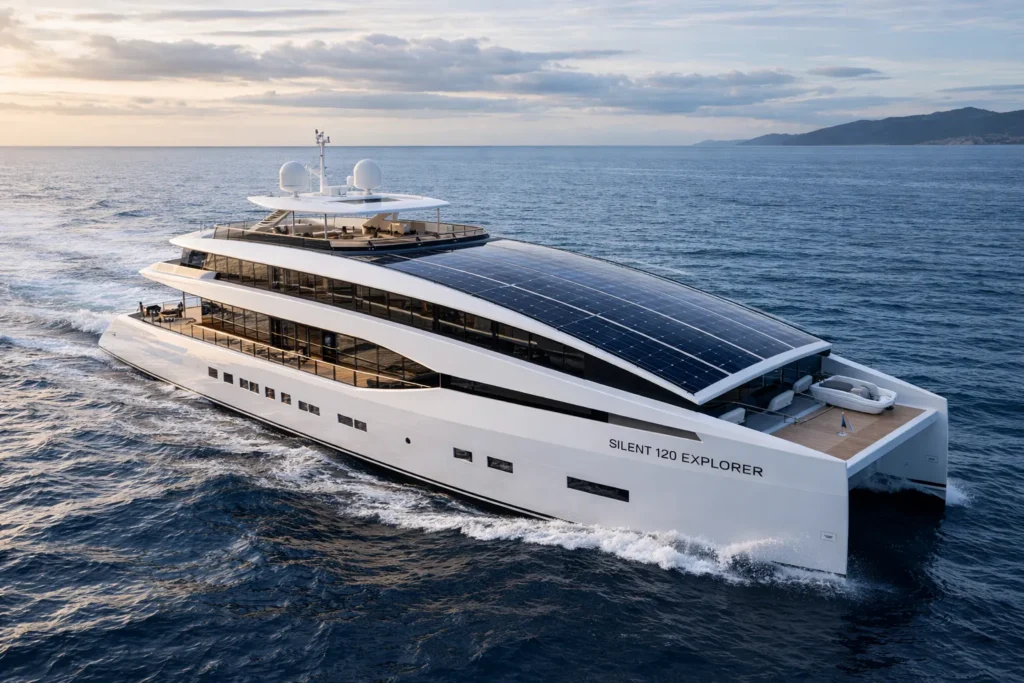
The twin-hull configuration allows Silent Yachts to integrate thousands of square metres of high-efficiency solar panels without compromising aesthetics or functionality.
Solar Generation: Treating the Yacht as a Power Plant
One of the defining features of the Silent 120 Explorer is its full-coverage solar array, seamlessly integrated across the superstructure and deck surfaces.
Unlike conventional yachts where solar is supplemental, here it is central. The panels are engineered to:
- Generate continuous power during daylight hours
- Feed directly into large onboard battery banks
- Reduce or eliminate generator runtime in favourable conditions
In practical terms, this means that during slow cruising, anchoring, or hotel-load operation, the yacht can function for extended periods without burning fuel at all.
Battery Storage and Energy Management
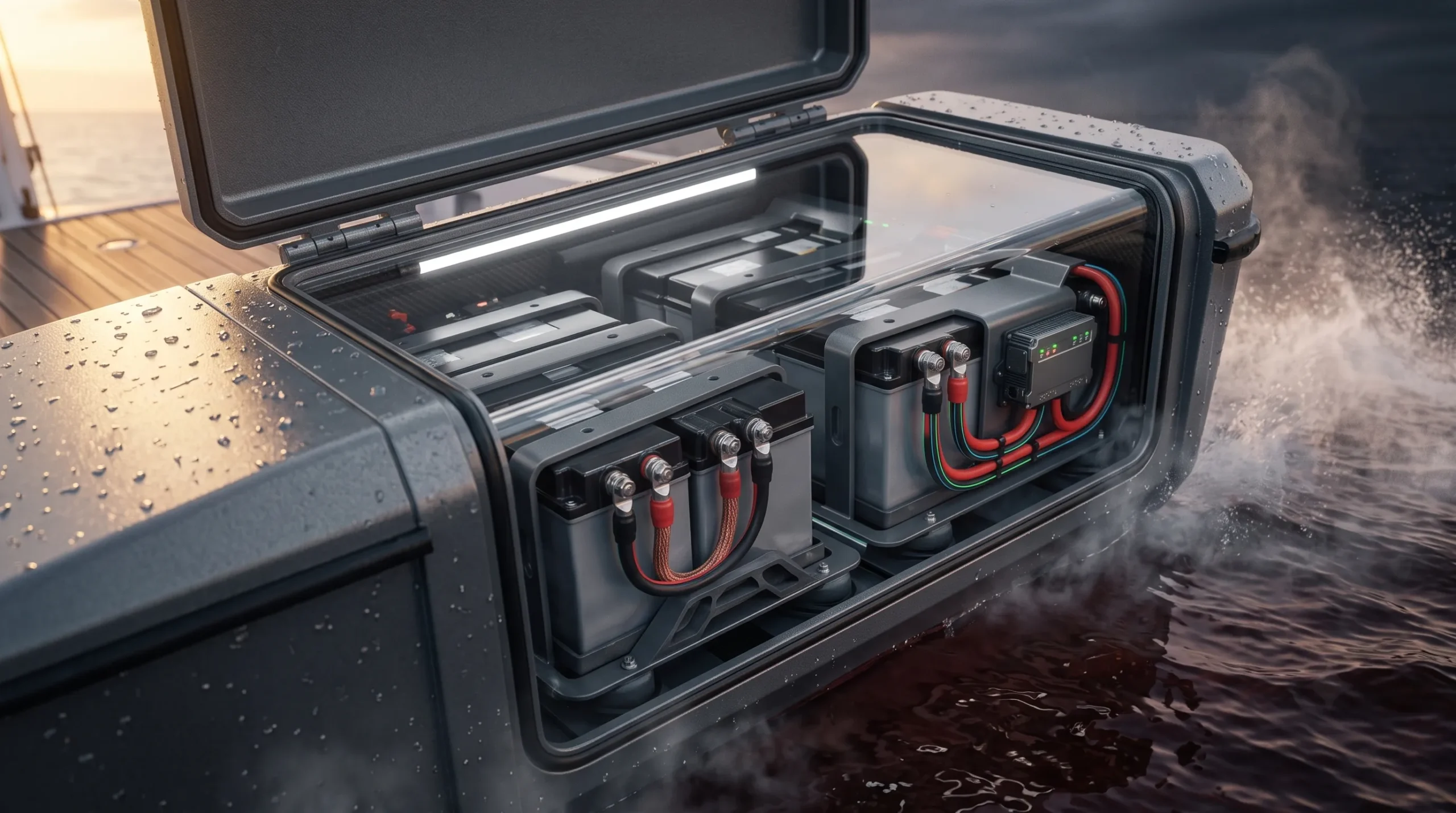
Solar generation alone is meaningless without robust storage. The Silent 120 Explorer incorporates large-scale lithium battery systems, comparable in concept (though far larger) to those used in grid-scale energy storage.
These batteries:
- Store excess solar energy for night operation
- Power propulsion motors at low to moderate speeds
- Supply hotel loads including air conditioning, lighting, and electronics
Advanced energy management software constantly balances solar input, battery charge, propulsion demand, and auxiliary systems to maximise efficiency and longevity.
Propulsion: Electric First, Diesel as Backup
The Silent 120 Explorer employs a hybrid propulsion philosophy.
Primary propulsion at low to moderate speeds is fully electric, delivering:
- Near-silent operation
- Instant torque
- Minimal vibration
For higher speeds, adverse conditions, or extended passages, the yacht is equipped with diesel generators that can recharge batteries or supply propulsion power indirectly.
Crucially, the generators are used strategically, not continuously, resulting in:
- Lower overall fuel consumption
- Reduced engine hours
- Less noise and emissions
This hybrid approach positions the Silent 120 Explorer as a transitional vessel between today’s diesel fleets and a future of fully electric ocean yachts.
Range and Real-World Capability
One of the most common criticisms of electric or hybrid yachts is limited range. The Silent 120 Explorer directly addresses this concern.
At displacement speeds, particularly in sunny conditions, the vessel can:
- Cruise for extended periods with minimal generator use
- Remain at anchor indefinitely under favourable solar conditions
- Undertake serious coastal and island-hopping voyages
While it is not designed for high-speed transoceanic sprinting, it excels in realistic cruising scenarios, where comfort, endurance, and efficiency matter more than top speed.
Interior Design and Liveability
Inside, the Silent 120 Explorer is every bit a luxury yacht—without the sensory overload of engines running constantly in the background.
Key interior characteristics include:
- Vast panoramic glazing enabled by catamaran beam
- Flexible layouts with owner’s suites, guest cabins, and crew areas
- Reduced noise and vibration, enhancing comfort
- Modern, understated luxury rather than ostentation
The absence of continuous engine noise fundamentally changes the onboard experience. Conversations are easier. Sleep quality improves. The yacht feels more like a floating residence than a machine.
Stability, Comfort, and Seakeeping
The catamaran platform delivers exceptional stability both underway and at anchor. Combined with reduced engine vibration, this results in:
- Less fatigue on long passages
- Improved comfort in moderate seas
- Safer movement onboard
For an explorer-style yacht, this stability is not a luxury—it is a safety and usability advantage.
Environmental Impact and Responsible Yachting
While luxury yachts will always have an environmental footprint, the Silent 120 Explorer represents a meaningful reduction compared to conventional vessels of similar size.
Benefits include:
- Dramatically reduced fuel consumption
- Lower emissions during normal operation
- Reduced noise pollution in sensitive marine environments
For owners increasingly conscious of sustainability—not just as a marketing term but as a practical reality—the Silent 120 Explorer offers a credible alternative.
Market Position and Owner Profile
The Silent 120 Explorer is not aimed at buyers seeking speed, spectacle, or status signalling through excess.
Instead, it appeals to:
- Experienced yacht owners
- Long-range cruisers
- Environmentally conscious explorers
- Owners prioritising comfort, autonomy, and quiet operation
It is a yacht for people who intend to use their vessel extensively, not simply display it.
Why the Silent 120 Explorer Is an Emerging Watercraft
The Silent 120 Explorer qualifies as an emerging watercraft because it represents a system-level innovation, not a single feature upgrade.
It rethinks:
- How energy is generated at sea
- How propulsion is prioritised
- How comfort is delivered
- How yachts interact with the environment
Rather than asking how to make diesel yachts cleaner, Silent Yachts asks how to design yachts that fundamentally rely less on diesel in the first place.
Broader Influence on Marine Design
As battery technology improves and solar efficiency increases, the design principles embodied by the Silent 120 Explorer are likely to influence:
- Future expedition yachts
- Long-range cruising catamarans
- Hybrid commercial vessels
- Electric-first marine architectures
What is experimental today may become expected tomorrow.
Conclusion
The Silent 120 Explorer is not a compromise yacht. It is not slower, lesser, or diluted. It is a vessel optimised for a different set of priorities—quiet, autonomy, efficiency, and sustainability.
In doing so, it stands as one of the most credible examples of emerging watercraft currently afloat. It does not shout about the future; it simply operates within it.