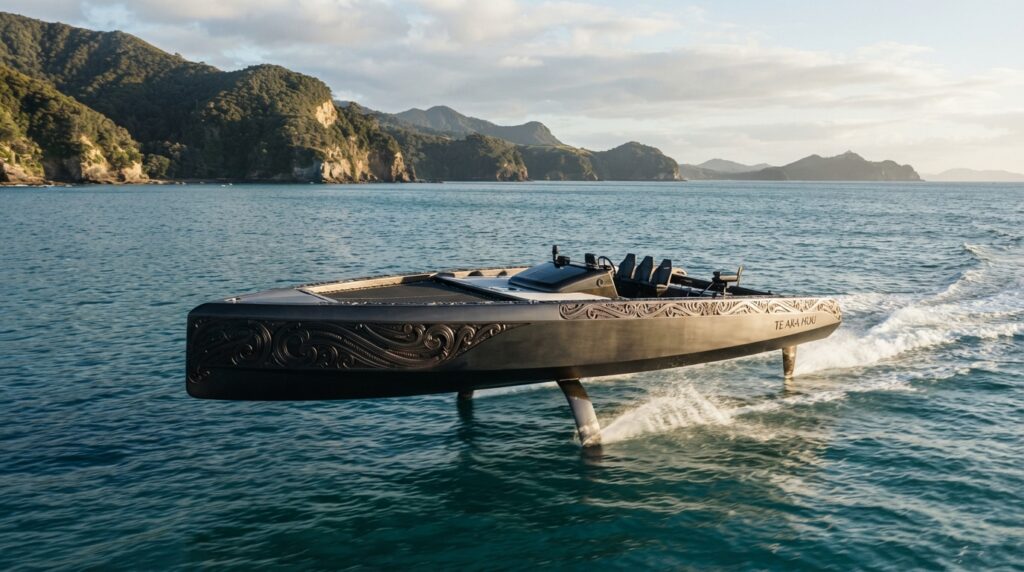
A clear image of the Wai Ika in use on open water, showing the rider prone or kneeling, using the unique hand-powered drive system beneath the hull, with the sleek board-like craft skimming quietly across the surface.
Introduction: When Tradition Inspires Technological Reinvention
Across the history of watercraft, some of the most important innovations have not come from engines or exotic materials, but from re-thinking how the human body interacts with water. The Wai Ika, developed in New Zealand, is a striking example of this philosophy.
Neither a surfboard, kayak, nor conventional paddle craft, Wai Ika represents a new class of human-powered watercraft, blending indigenous Māori inspiration with modern engineering. It is quiet, efficient, environmentally neutral, and deeply connected to place and culture.
Within Emerging Watercraft And Experimental Concepts, Wai Ika stands apart—not because it chases speed records or extreme performance, but because it proposes a fundamentally different relationship between people, water, and propulsion.
Meaning and Cultural Origins
The name Wai Ika comes from Te Reo Māori, translating roughly to “fish water” or “moving through water like a fish.” This is not branding poetry—it describes the design intent with precision.
The concept draws inspiration from:
- Traditional Māori interaction with waterways
- The efficiency of aquatic animals
- Indigenous respect for rivers, lakes, and coastal environments
Rather than imposing force on the water, Wai Ika seeks to move with it, mimicking natural motion patterns refined over millions of years.
This cultural grounding gives the craft a depth that many experimental designs lack.
What Is the Wai Ika?
At first glance, Wai Ika resembles a long, narrow board—somewhere between a surfboard and a rescue sled. But beneath this simple silhouette lies a unique propulsion system.
Core characteristics include:
- A prone or kneeling riding position
- A hand-powered underwater drive mechanism
- A streamlined hull optimised for low drag
- No paddle, sail, or motor
The rider propels the craft using a rhythmic arm motion that drives a submerged mechanism, translating human energy into smooth forward motion.
Rethinking Human-Powered Propulsion
Most human-powered boats fall into predictable categories:
- Kayaks and canoes (paddles)
- Rowboats (oars)
- Pedal craft (bicycles on water)
Wai Ika rejects all three.
Instead, it uses a direct, body-driven propulsion system that allows the rider to remain low and streamlined, minimising wind resistance and wave interaction.
This approach offers several advantages:
- Reduced fatigue over distance
- Improved efficiency compared to paddling
- Greater stability in choppy water
- Natural engagement of core and upper body
In essence, it allows a human to move across water more like a marine animal than a land mammal.
Hull Design and Hydrodynamics
The hull of the Wai Ika is long, narrow, and subtly contoured. It is not designed to plane aggressively, nor to displace large volumes of water.
Key hydrodynamic features include:
- Fine entry to reduce bow wave
- Minimal wetted surface
- Neutral trim across varying speeds
- Stability derived from length rather than width
This design allows the craft to maintain momentum efficiently, particularly at low to moderate speeds where most human-powered craft struggle.
The Underwater Drive System
The most innovative element of Wai Ika is its submerged propulsion mechanism.
Rather than churning water like a paddle, the system:
- Operates beneath the surface, away from wave interference
- Produces continuous thrust rather than intermittent bursts
- Converts smooth arm motion into forward drive
This reduces energy loss and creates a quiet, fluid movement that feels intuitive to the rider.
Observers often describe Wai Ika in motion as gliding rather than paddling.
Materials and Construction
Wai Ika prototypes and production units are typically constructed using:
- Lightweight composite materials
- Marine-grade foams and laminates
- Corrosion-resistant mechanical components
Durability is a key design requirement, as the craft is intended for:
- Coastal use
- Rivers and estuaries
- Lakes and harbours
The materials balance light weight with robustness, ensuring the craft can be carried, launched, and recovered by a single person.
Environmental Impact: Near Zero by Design
One of Wai Ika’s most compelling attributes is its environmental neutrality.
Because it uses:
- No fuel
- No batteries
- No lubricants
- No emissions
…it can operate in sensitive environments where motorised craft are restricted or prohibited.
This makes it particularly relevant in New Zealand, where environmental stewardship and waterway protection are cultural and legal priorities.
Use Cases and Applications
Although experimental in origin, Wai Ika has practical applications across several domains:
Recreation and Fitness
The rhythmic, low-impact motion provides a full-body workout without joint strain.
Eco-TourismSilent operation allows wildlife observation without disturbance.
Coastal Patrol and ObservationLow profile and quiet movement suit monitoring roles.
Cultural and Educational Programmes
Demonstrates indigenous-inspired innovation and sustainable design.
Unlike many experimental craft, Wai Ika is not limited to spectacle—it has real-world utility.
Comparison With Paddleboards and Kayaks
Stand-up paddleboards and kayaks dominate the human-powered watercraft market. Wai Ika challenges both.
Compared to paddleboards:
- Lower centre of gravity
- Less wind resistance
- More efficient propulsion
Compared to kayaks:
- Greater visibility and situational awareness
- Easier entry and exit
- More intuitive body engagement
It occupies a unique middle ground that did not previously exist.
Stability and Safety
Despite its narrow profile, Wai Ika is surprisingly stable.
Stability is achieved through:
- Hull length
- Rider position close to the water
- Even weight distribution
In the event of a capsize, recovery is straightforward, and the craft does not trap the rider.
This makes it accessible to a wide range of users, from experienced watermen to first-time riders.
Why Wai Ika Is an Experimental Watercraft
Wai Ika belongs in Emerging Watercraft And Experimental Concepts because it introduces a new propulsion paradigm rather than refining an existing one.
It challenges assumptions that:
- Paddles are the most efficient human interface
- Standing is optimal for balance
- Speed must come from power rather than efficiency
By revisiting first principles—how humans move, how water flows—it creates a new category altogether.
Broader Significance in Marine Design
Wai Ika reflects a growing shift in innovation:
- From fossil-fuel dependence to human-scale mobility
- From dominance over nature to coexistence with it
- From spectacle to sustainability
It demonstrates that experimentation does not always require extreme speed or advanced electronics—sometimes it requires listening to tradition and biology.
Limitations and Constraints
Like all experimental craft, Wai Ika has limitations:
- Speed ceiling limited by human power
- Not suited to heavy surf or offshore conditions
- Requires learning a new movement pattern
These are not flaws, but design trade-offs aligned with its purpose.
The New Zealand Context
New Zealand has a long history of water innovation, from ocean-racing yachts to surf lifesaving equipment. Wai Ika fits naturally into this lineage—practical, respectful of nature, and quietly innovative.
It reflects a national mindset that values function, simplicity, and environmental harmony.
Conclusion: Innovation Rooted in Respect
Wai Ika does not shout its achievements. It glides, silently and efficiently, across water—an embodiment of thoughtful design rather than technological excess.
As the marine world grapples with sustainability, access, and environmental impact, Wai Ika offers an alternative vision: one where progress is measured not in knots or horsepower, but in harmony between human, craft, and water.
That alone secures its place among the most meaningful emerging watercraft concepts of our time.
See more at www.vectorwatercraft.com.au