
Introduction: When Watercraft Stop Behaving Like Boats
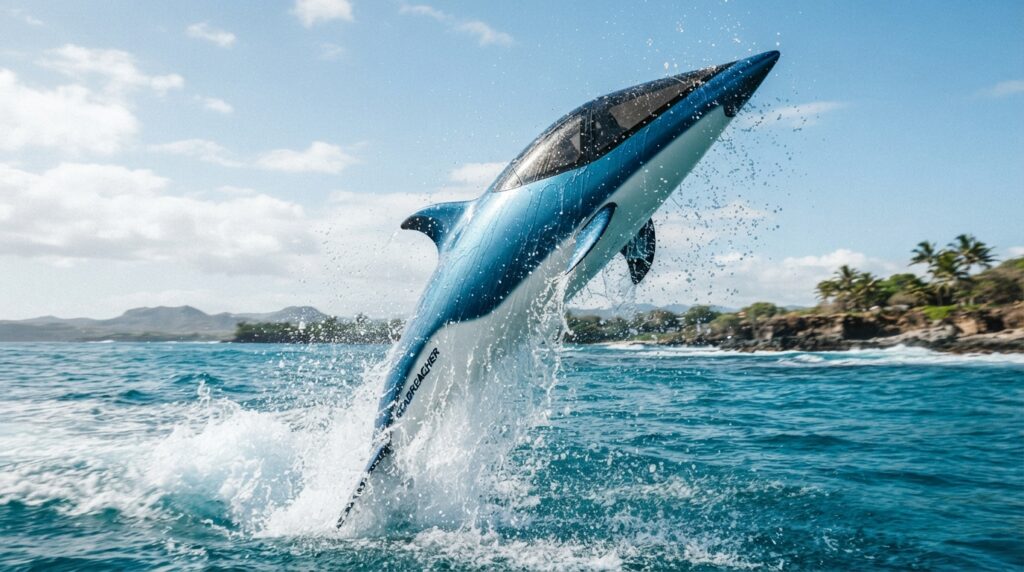
Among the many experimental and unconventional watercraft to emerge over the past two decades, few have captured public imagination quite like the Seabreacher. Neither a conventional boat nor a true submarine, the Seabreacher occupies a rare and fascinating middle ground: a high-performance semi-submersible personal watercraft designed to leap, dive, roll, and slice through the water with an almost animalistic presence.
Developed and refined in New Zealand, a country with a long tradition of marine innovation and adventurous boating culture, the Seabreacher challenges deeply entrenched assumptions about what recreational watercraft are meant to do. Rather than focusing on transport efficiency, passenger capacity, or comfort, the Seabreacher is engineered around movement in three dimensions, visceral sensation, and spectacle.
This article examines the Seabreacher in depth—its origins, engineering philosophy, performance characteristics, safety approach, market role, and its broader relevance to the future of experimental water sports technology.
Origins and Conceptual Development
The Seabreacher was born from a deceptively simple idea:
why should recreational watercraft be restricted to the surface of the water?
New Zealand’s maritime culture, shaped by deep coastal waters, strong engineering talent, and a history of custom boatbuilding, provided fertile ground for such thinking. Early designers drew inspiration from multiple disciplines, including:
- Small submersible craft
- Aeronautical control systems
- Jet-powered personal watercraft
- Marine composites used in offshore racing
Rather than pursuing military or scientific applications, the Seabreacher was intentionally positioned as a recreational and experiential craft, aimed at thrill-seekers, demonstration operators, and buyers seeking something entirely outside the norm.
Prototype development focused on proving three critical ideas:
- A compact craft could safely dive below the surface
- It could re-emerge repeatedly without structural fatigue
- All of this could be achieved using conventional petrol propulsion
The success of these early experiments laid the groundwork for the distinctive production craft that would later gain international attention.
Design Philosophy: A Three-Dimensional Watercraft
What fundamentally separates the Seabreacher from all conventional personal watercraft is its design intent.
Most recreational boats and PWCs are designed for stability and efficiency on the surface. The Seabreacher, by contrast, is engineered to transition seamlessly between surface and subsurface operation, and to treat the waterline not as a boundary, but as a fluid zone to be crossed repeatedly.
Key design principles include:
- A narrow, hydrodynamic hull optimised for penetration rather than flotation
- A reinforced internal structure capable of absorbing vertical impact loads
- Control surfaces that allow pitch and directional control underwater
- A sealed cockpit canopy that protects the operator during splashdown and dives
The resulting craft behaves less like a boat and more like a marine analogue of an aerobatic aircraft.
Hull Construction and Structural Engineering
The Seabreacher hull is typically constructed using advanced composite materials, chosen for their high strength-to-weight ratio and resilience under dynamic loading.
Unlike conventional fibreglass runabouts, which are designed primarily for steady planing loads, the Seabreacher must withstand:
- Repeated high-energy surface re-entries
- Torsional loads during aggressive manoeuvres
- Localised pressure loads during shallow dives
Internally, the hull incorporates reinforced bulkheads and mounting points for the engine and jet drive, ensuring alignment and reliability even under repeated stress cycles.
The exterior form—often styled to resemble sharks, dolphins, or other marine predators—is not merely cosmetic. The tapered nose, dorsal fin, and body contours contribute to stability and directional control during both surface and subsurface operation.
Propulsion System and Power Delivery
Despite its unconventional behaviour, the Seabreacher relies on a petrol internal combustion engine coupled to a jet propulsion system.
Jet propulsion is critical to the craft’s function, offering several advantages:
- No exposed propeller, improving safety during jumps and dives
- High thrust at low speeds for controlled ascent and descent
- Compact installation within the narrow hull envelope
The propulsion system is tuned not for maximum top speed alone, but for instant throttle response, allowing the operator to precisely control dive angles, surfacing speed, and jump dynamics.
Cockpit Design and Operator Experience
The Seabreacher cockpit places the operator deep within the hull, reinforcing the sensation of piloting rather than riding.
Key features include:
- A clear, reinforced canopy for visibility and splash protection
- Secure harnessing to manage vertical loads during jumps
- Intuitive control layout integrating steering, throttle, and dive control
- Adequate ventilation for comfort during surface operation
While submersion is brief and shallow, the experience of diving—even momentarily—creates a powerful psychological distinction from any conventional watercraft.
Performance Characteristics
The Seabreacher’s performance is best described qualitatively rather than purely numerically.
Its defining capabilities include:
- Rapid surface acceleration
- Controlled shallow dives below the surface
- Dramatic breaching manoeuvres that lift the hull clear of the water
- Tight turning response during planing
These characteristics are not accidental by-products of speed; they are designed-in behaviours, repeatable within a defined operating envelope.
Safety Philosophy and Operational Limits
Despite its theatrical appearance, the Seabreacher is designed with conservative safety margins.
Key safety considerations include:
- Limited dive depth to avoid pressure risks
- Jet propulsion eliminating propeller hazards
- Reinforced structure to manage impact loads
- Clear guidance on suitable operating environments
The craft is intended for open water use by trained operators, not crowded waterways or confined marinas.
Market Position and Ownership Profile
The Seabreacher occupies a niche category entirely its own.
It is not designed to replace:
- Jet skis
- Rigid inflatable boats
- Small runabouts
Instead, it appeals to:
- High-net-worth private owners
- Experience and adventure operators
- Marine exhibition and demonstration organisations
- Buyers seeking exclusivity and spectacle
Its value proposition lies in experience, uniqueness, and emotional impact, not practicality.
Cultural Impact and Public Visibility
Few recreational watercraft have achieved the visual and cultural recognition of the Seabreacher. Its dramatic form and behaviour have made it a favourite in:
- Viral online videos
- Marine exhibitions and boat shows
- Film and television appearances
- Promotional and experiential events
This visibility reinforces its status as a symbol of what becomes possible when marine design breaks from convention.
Significance for the Future of Water Sports Technology
While the Seabreacher itself is unlikely to become mainstream, its influence is significant.
It demonstrates that:
- Recreational watercraft can operate vertically, not just horizontally
- Hybrid concepts between boats and submersibles are viable
- Emotional engagement can be a legitimate design goal
- Safety and radical design are not mutually exclusive
As propulsion systems evolve—particularly electric and hybrid technologies—the design principles pioneered by the Seabreacher may well inform future experimental craft.
Conclusion
The Seabreacher is not simply an unusual boat; it is a statement of intent.
Emerging from New Zealand’s culture of maritime experimentation, it challenges the assumption that recreational watercraft must remain bound to the surface. By embracing three-dimensional movement, dramatic form, and experiential design, the Seabreacher expands our understanding of what water sports technology can be.